
>> Continued From the Previous Page <<
With the ruling, Virginia is now required to redraw its congressional districts ahead of the 2026 elections, effectively resetting the state’s political map and complicating Democratic planning at a critical moment in the national redistricting battle.
Before the court’s decision, Jeffries had publicly defended the effort and expressed confidence that the legal foundation would hold up under scrutiny. At the time, he projected certainty about the map’s legality, stating:

“The law is with us in Virginia,” Jeffries previously said while promoting the redistricting plan.
That confidence, however, quickly unraveled once the Virginia Supreme Court issued its ruling and sided with Republican challengers who had long argued that the process violated constitutional requirements.
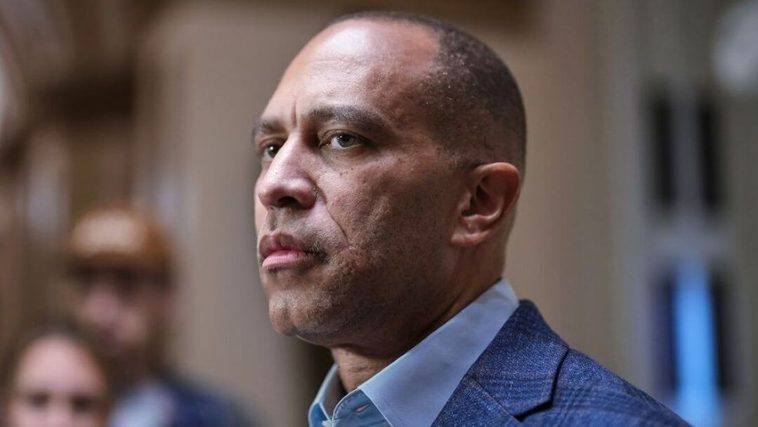
Following the decision, Jeffries issued a forceful response, accusing the court of undermining democratic participation and stripping voters of their voice in the redistricting process.
“Over three million Virginia citizens cast their votes in a free and fair election, yet the State Supreme Court has chosen to invalidate their voice, disenfranchise them and violate their due process rights,” Jeffries said.
He went further, describing the ruling as an unprecedented judicial intervention that, in his view, invalidated the democratic process itself.
“The decision to overturn an entire election is an unprecedented and undemocratic action that cannot stand,” he added.
Jeffries also broadened his criticism, linking the Virginia ruling to larger national disputes over the judiciary and voting law. He pointed to conservative legal influence on the U.S. Supreme Court and argued that court decisions have weakened federal voting protections, particularly in Southern states where redistricting battles have become increasingly intense.
“We are exploring all options to overturn this shocking decision,” Jeffries said. “No matter what it takes, House Democrats will win in November so we can help rescue this nation from the extremism being unleashed by Donald Trump and Republicans.”
Republicans quickly seized on Jeffries’ comments, portraying them as evidence that Democrats are struggling to accept a major legal defeat after pursuing an aggressive and highly coordinated redistricting strategy. GOP leaders and conservative commentators argued that Democrats pushed ahead despite warnings that the map could face constitutional challenges.
According to critics, Republican lawmakers had previously urged that the referendum process be reviewed by the courts before any vote took place, warning that legal defects could invalidate the entire effort. Democrats, however, proceeded with the strategy, betting that the courts would ultimately allow the map to stand.
That gamble ultimately failed when the Virginia Supreme Court ruled against the plan, triggering immediate political fallout and forcing Democrats to regroup.
The controversy has also highlighted what critics describe as a contradiction in Democratic messaging, noting that party leaders who have frequently criticized the judiciary are now calling on the courts to intervene in their favor after an adverse ruling.
Beyond the legal and political implications, the failed Virginia redistricting effort represents one of the most costly and high-profile map-drawing battles in the country. Reports indicate that Democrats and aligned political organizations invested roughly $70 million into the referendum campaign and related efforts before the court invalidated the map.
The ruling has also exposed divisions within the Democratic Party itself. Some strategists argue that aggressive redistricting is essential to counter Republican gains in GOP-led states, where map redraws have already strengthened Republican advantages. Others within the party have privately questioned whether Virginia Democrats underestimated the legal risks in pursuit of an immediate electoral advantage.
The Virginia case is unfolding against the backdrop of a broader nationwide redistricting war ahead of the 2026 elections. Republicans are advancing map changes in several states, including Texas, Florida, Ohio, Missouri, Tennessee, and North Carolina, while Democrats are pursuing their own efforts in places such as California and Utah.
Current projections suggest Republicans could gain as many as 14 additional House seats through ongoing redistricting efforts, while Democrats are looking at potential gains of around six seats through their own map changes.
As the legal and political fallout continues, both parties are recalibrating their strategies in what is shaping up to be one of the most consequential and closely contested redistricting cycles in recent memory. Control of the House in 2026 may ultimately come down to just a handful of districts, making the Virginia setback particularly significant for Democrats as they reassess their path forward.


Golly. I hope Jeff will be okay. Sounds like some fishing will do him good. And some of the best fishing east of the Mississippi can be found in Old Dominion.