
“The 2020 election was the most secure in US history.”
WATCH:
That declaration has since come under renewed criticism following the release of previously sealed documents and government records. Critics contend the newly available information directly contradicts the certainty with which federal officials assured Americans that election systems had not been successfully compromised.

According to the newly examined records, a CISA report dated October 30, 2020—released only days before Election Day—warned about Iranian cyber operations targeting the U.S. election. However, the report was reportedly never made public and allegedly omitted key details about what investigators now say was a successful breach involving a state’s election infrastructure.
The report referenced an earlier joint advisory issued by CISA and the FBI on October 22, 2020, warning that Iranian advanced persistent threat (APT) actors were attempting to influence the presidential election by spreading misinformation and undermining public confidence in the electoral process.
The advisory stated:
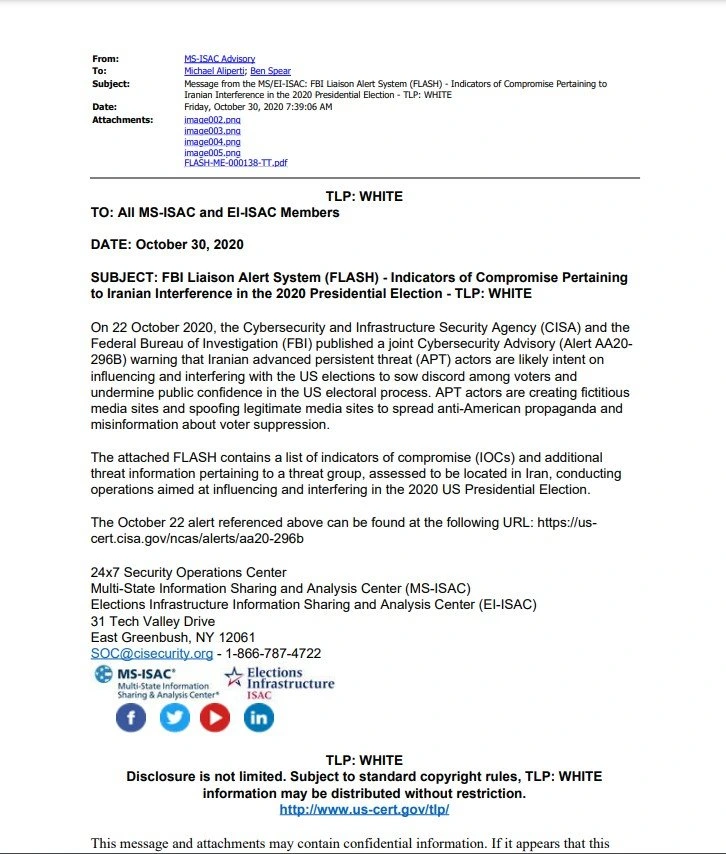
“On 22 October 2020, the Cybersecurity and Infrastructure Security Agency (CISA) and the Federal Bureau of Investigation (FBI) published a joint Cybersecurity Advisory (Alert AA20-296B) warning that Iranian advanced persistent threat (APT) actors are likely intent on influencing and interfering with the US elections to sow discord among voters and undermine public confidence in the US electoral process.”
It further warned that Iranian-linked actors were creating fake media outlets and impersonating legitimate news organizations in an effort to spread propaganda and misinformation ahead of Election Day.
What has drawn the greatest attention, however, is what critics argue was left out of the public narrative. According to the newly unsealed indictment and related records, Iranian hackers allegedly succeeded in compromising election-related systems in Alaska, obtaining sensitive voter information belonging to more than 100,000 registered voters.
The indictment alleges that the operation targeted multiple state election websites before successfully exploiting misconfigured systems in Alaska. Federal prosecutors wrote:
“These efforts resulted in the successful exploitation of misconfigured computers of a particular U.S. state (“State-1”), Alaska, and the resulting unauthorized downloading of voter information for more than 100,000 (State-1) voters.”
The court documents identify Iranian national Seyyed Mohammad Hosein Musa Kazemi as one of the individuals allegedly involved in the cyber campaign. Prosecutors accused members of the operation of conducting reconnaissance against approximately eleven state election websites before carrying out the successful intrusion.
WATCH:
Additional reporting claims the hackers later released a video demonstrating how stolen voter information—including names, Social Security numbers, and driver’s license numbers—could allegedly be used to submit UOCAVA voter registrations. UOCAVA, the Uniformed and Overseas Citizens Absentee Voting Act, allows eligible overseas Americans and military personnel to vote absentee.
Critics argue the existence of that demonstration raises serious questions about vulnerabilities in election systems and why those details were not more prominently disclosed to the public before or after the election.
The controversy intensified after the Southern District of New York unsealed the October 2021 indictment years later, prompting renewed accusations that federal agencies failed to fully inform the public about the scope of the Iranian cyber operation. Critics have questioned why information regarding the successful breach remained sealed for years while officials continued defending the overall security of the election.
Supporters of Krebs and other federal officials have maintained that while foreign actors attempted to interfere with the election, there has been no publicly established evidence that the intrusion changed vote totals or altered certified election results. Nevertheless, the newly released records have added fuel to an already contentious debate over election security and government transparency.
With these disclosures now public, calls for additional oversight and election security reforms have intensified. Many conservatives argue the revelations underscore the need for stronger safeguards, greater transparency from federal agencies, and tougher protections against foreign cyber threats.
As renewed attention focuses on the 2020 election, supporters of election reform are once again urging Congress to strengthen election integrity measures.
PASS THE SAVE AMERICA ACT!

