
>> Continued From the Previous Page <<
He didn’t stop there, pointing directly to the structure of the reporter’s remarks.
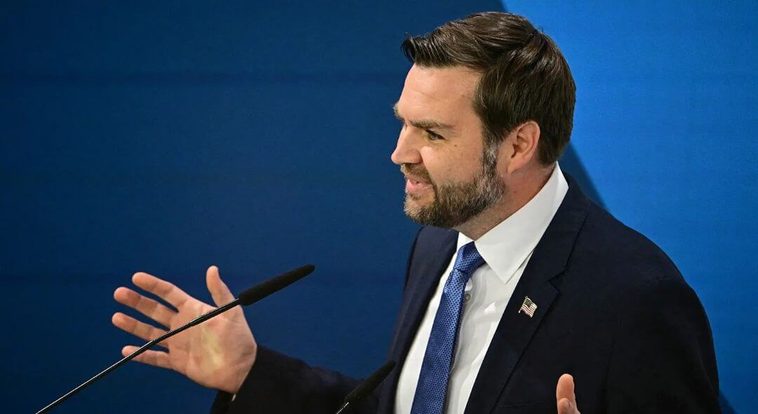
“There were a lot of things in that speech masquerading as a question that didn’t actually get asked,” he said.

The moment effectively reframed the interaction in real time. What was presented as journalism was, in Vance’s framing, closer to advocacy dressed up in question form.
Despite the tension, Vance still addressed the substance behind the monologue. Rather than dismissing it outright or avoiding the topic, he broke down the allegation head-on and rejected the premise that had been implied.
“The president doesn’t sit at the Oval Office on his computer on his, like, Robin Hood account, buying and selling stocks,” Vance said. “He has independent wealth advisers who manage his money.”
The implication that President Trump personally executes daily stock trades from the White House has long circulated in partisan commentary, but Vance pushed back in simple terms, describing how high-level wealth management typically works for individuals of significant financial means.
Still, what followed was arguably the most politically notable part of his answer. Rather than purely defending the status quo, Vance pivoted toward agreement on reform in principle.
“I’m a big fan of banning members of Congress from trading stocks,” Vance said. “So is the president.”
That single line shifted the direction of the exchange. A question intended to paint corruption or personal enrichment instead became a platform to reinforce a bipartisan reform idea that has gained traction in recent years. The Stop Trading on Congressional Knowledge Act has been repeatedly discussed at the federal level, and versions of similar proposals have drawn support from both parties.
Trump himself has previously called for restrictions on congressional stock trading, and legislative efforts such as the “Restore Trust in Congress Act” have gathered more than 120 co-sponsors in the House, signaling that the issue is far from fringe.
Beyond the specific exchange, the briefing highlighted a broader and long-running tension between administrations and the White House press corps. For years, critics have argued that some reporters blur the line between questioning and commentary, embedding conclusions into their questions while still expecting formal answers.
Past administrations have dealt with similar confrontations. One of the most well-known occurred in 2018, when CNN correspondent Jim Acosta became physically entangled with a White House intern after refusing to relinquish the microphone during a heated exchange with President Trump.
In that instance, Acosta’s approach was criticized by some as advocacy rather than journalism, with questions often framed as arguments rather than inquiries.
Under the Biden administration, critics from the opposite direction pointed to tightly managed press interactions, including pre-selected reporters and prepared question prompts for the president. When questioned about those practices, Press Secretary Karine Jean-Pierre defended them as “entirely normal.”
For Vance, Tuesday’s briefing appeared to mark a deliberate break from both styles. By directly calling out the structure of the reporter’s remarks, he removed the ambiguity that often surrounds these exchanges.
He labeled it for what he saw it as: a speech disguised as a question.
More importantly, he still answered it.
That combination—critique followed by engagement—became the defining moment of the briefing. Instead of dodging or deflecting, Vance responded point by point while also challenging the framing itself.
Supporters argue this reflects a more direct and unfiltered approach to media engagement, one that refuses to accept theatrical questioning as neutral journalism. Critics, meanwhile, are likely to view it as confrontational.
Either way, the dynamic in the briefing room on Tuesday was unmistakably different. What was expected to be a routine exchange instead turned into a moment that redefined the tone of the day—and possibly set the stage for how future briefings unfold under Vance’s watch.

