
At the same time, the president announced that the United States is reinstating its blockade targeting Iran’s ports, while making clear that commercial traffic from every other nation would continue moving through the strait without interference.
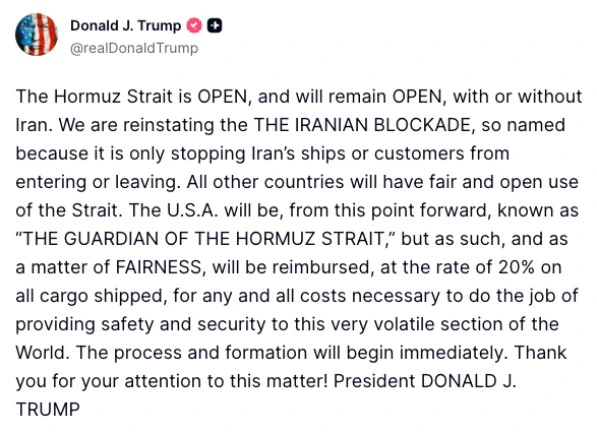
“The Hormuz Strait is OPEN, and will remain OPEN, with or without Iran. We are reinstating the THE IRANIAN BLOCKADE, so named because it is only stopping Iran’s ships or customers from entering or leaving. All other countries will have fair and open use of the Strait,” Trump wrote.
He followed that statement by outlining what could become one of the most significant shifts in U.S. policy toward international maritime security.

“The U.S.A. will be, from this point forward, known as ‘THE GUARDIAN OF THE HORMUZ STRAIT,’ but as such, and as a matter of FAIRNESS, will be reimbursed, at the rate of 20% on all cargo shipped, for any and all costs necessary to do the job of providing safety and security to this very volatile section of the World. The process and formation will begin immediately,” he added.
Trump’s announcement arrived as American and Iranian forces exchanged fresh strikes on Monday, raising new concerns that the fragile ceasefire reached earlier this summer may be unraveling completely.
The latest developments quickly became the focus of cable news coverage, with Fox News correspondent Mike Tobin reporting on the renewed military action and the rising tensions surrounding the Strait of Hormuz. Hudson Institute senior fellow Rebeccah Heinrichs also appeared on Fox News to discuss the strategic implications of Trump’s declaration that the United States would serve as the “guardian of the strait.”
During a subsequent interview with Fox News, Trump reinforced his position, insisting the United States would never allow Iran to control one of the world’s most critical maritime corridors.
“We’re going to keep the strait, and we’ll probably run it,” Trump told Fox News.
Financial markets reacted almost immediately. Oil prices climbed as traders weighed the possibility of additional disruptions in the Persian Gulf, while stocks slipped amid renewed uncertainty surrounding global energy supplies and international shipping.
Trump argued that if the United States is expected to shoulder the burden of protecting the waterway, American taxpayers should no longer be forced to foot the bill alone.
“We’ll become the guardian of the strait — maybe we’ll call it the guardian angel of the strait,” Trump told Fox. “And we should be reimbursed for that.”
He continued by emphasizing that America’s decades-long role in securing international shipping routes has often come without direct compensation.
“We can’t be expected to do that for nothing, unlike we had for many years,” he added. “We guarded it for nothing, and now we’re going to guard it, we’re going to get paid for guarding it. A lot of money.”
For years, the Strait of Hormuz has remained one of the most strategically important and politically volatile waterways on the planet. The narrow passage serves as a vital gateway for global energy markets, making any disruption a potential threat to economies around the world.
Iran has repeatedly asserted authority over the strait and has signaled its desire to impose tolls or other fees on vessels traveling through the passage. The United States has consistently rejected those claims, maintaining that freedom of navigation must be preserved for international commerce.
A temporary ceasefire agreement reached in mid-June prohibited Tehran from charging commercial vessels to transit the strait. However, repeated attacks involving commercial shipping and U.S. military assets have placed that agreement under increasing strain.
Last week, Trump declared that the ceasefire was “over,” signaling a tougher American posture toward Iran following weeks of escalating hostilities.
According to U.S. officials, the latest military operations are designed to keep the Strait of Hormuz open while preventing Iran from using global oil supplies as political leverage.
The president’s latest proposal also reflects his longstanding America First philosophy, arguing that the United States should no longer bear the financial burden of protecting international trade routes while other nations receive the benefits without contributing to the cost.
For decades, American military forces have safeguarded key shipping lanes across the Middle East without collecting direct payments from the commercial cargo moving through them. Trump now says that model is changing.
Under his proposal, if the United States provides the security necessary to keep one of the world’s most valuable waterways open, the nations and companies benefiting from that protection should help cover the expense.
Rather than allowing Iran to gain leverage over the Strait of Hormuz, Trump is proposing a dramatically different approach—one that transforms America’s military protection of the vital shipping lane into a service that, in his view, should finally be paid for.

