
>> Continued From the Previous Page <<
“Despite being complicit in the act of war, the president hopes last night’s events will help his ongoing nuclear negotiations with Iran,” Carlson wrote.
“While the American military may not have physically perpetrated the assault, years of funding and sending weapons to Israel, which Donald Trump just bragged about on Truth Social, undeniably place the U.S. at the center of last night’s events.”
“Washington knew these attacks would happen. They aided Israel in carrying them out.”
“Politicians purporting to be America First can’t now credibly turn around and say they had nothing to do with it.”
Carlson didn’t stop at policy. Speaking with Steve Bannon, he delivered a dire warning not just for Trump, but for the entire country.

“I actually really love Trump. I think he’s a deeply humane, kind person,” Carlson said.
“I’m saying this because I’m really afraid that my country is going to be further weakened by this. I think we’re going to see the end of the American Empire, obviously. Other nations would like to see that, and this is a perfect way to scuttle the U.S. on the shores of Iran. But it’s also going to end, I believe, Trump’s presidency—effectively end it. And so that’s why I’m saying this.”
WATCH:
While Carlson made clear his comments came from a place of concern—not animosity—Trump wasn’t having it.
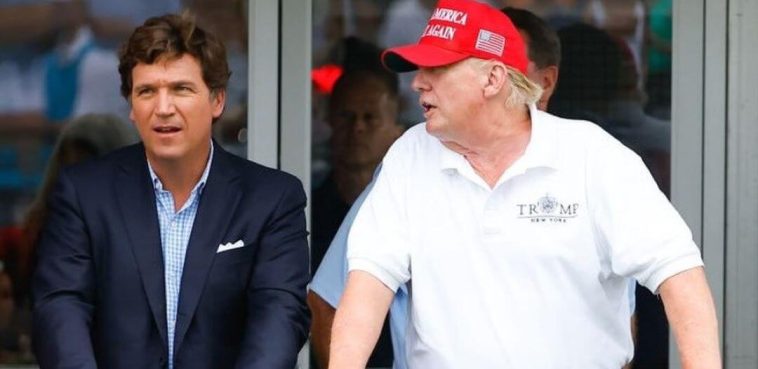
The former president dismissed Carlson’s critique with classic Trumpian flair during a bilateral meeting with U.K. Prime Minister Rishi Sunak. When asked about the former Fox News host’s accusations, Trump responded with a jab:
“I don’t know what Tucker Carlson is saying,” Trump quipped. “Let him go get a television network and say it so that people actually listen. Thank you.”
The feud has quickly become a flashpoint within the conservative movement, exposing deeper tensions between populist nationalists and more traditional pro-Israel Republicans.
Carlson, long hailed by many on the right for challenging establishment narratives, is now toeing a line few are willing to cross—suggesting Trump’s foreign policy is at odds with the America First platform he once championed.
For his part, Trump has consistently defended his support for Israel, citing both strategic alliances and shared democratic values. But Carlson’s warning—delivered not with venom, but with a sense of urgency—may resonate with voters wary of further entanglements overseas.
What happens next could have far-reaching implications. If Carlson’s concerns gain traction, Trump could face new pressure from within his own base to clarify or even recalibrate his foreign policy stance.
But judging by Trump’s pointed response, he’s not planning to change course—or entertain critics who no longer have a primetime platform.
The message is clear: Trump’s sticking to his guns, and if Carlson wants to keep swinging, he better bring a bigger microphone.

