
>> Continued From the Previous Page <<
Spain restricted U.S. military access to key bases and airspace. Italy denied landing rights for American bombers. France blocked supply flights heading toward Israel. Poland declined to move defensive systems, prioritizing its own borders. Germany made its stance crystal clear, saying it was “not our war.”
Even when the U.S. sought naval support to reopen the Strait of Hormuz, one of the most critical energy chokepoints in the world, no country stepped forward with actual deployments.

Public statements spoke of cooperation. Real-world actions told a different story.
The Interview That Changed the Conversation
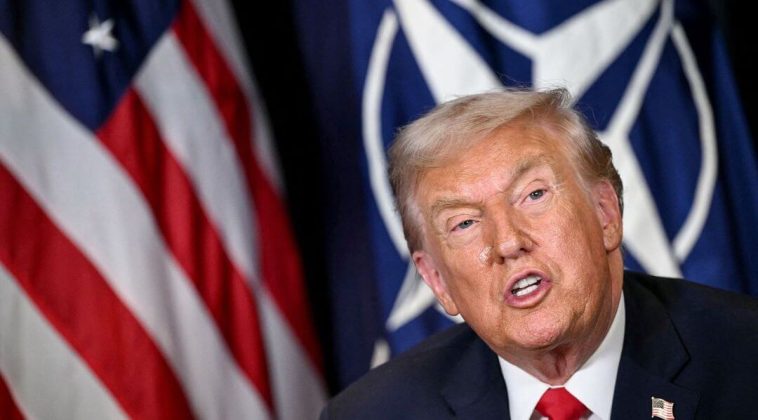
In a high-impact interview with The Daily Telegraph, Trump did not hold back.
“I was never swayed by NATO,” Trump said. “I always knew they were a paper tiger, and Putin knows that too, by the way.”
When pressed on whether the United States would reconsider its role in the alliance after the Iran conflict, he gave an answer that stunned observers.
“Oh yes, I would say beyond reconsideration.”
That phrase, beyond reconsideration, is something no sitting American president has ever openly stated about NATO membership.
Trump framed the issue as a matter of fairness and loyalty.
“We’ve been there automatically, including Ukraine. Ukraine wasn’t our problem. It was a test, and we were there for them, and we would always have been there for them. They weren’t there for us.”
Britain Also in the Crosshairs
Trump did not stop with continental Europe. He also took aim at the United Kingdom after Prime Minister Keir Starmer refused to allow British bases to be used for offensive operations.
“You don’t even have a navy. You’re too old and had aircraft carriers that didn’t work.”
Starmer pushed back, reaffirming Britain’s commitment to NATO and calling it “the single most effective military alliance the world has ever seen.”
The exchange highlights a growing divide between Washington and its traditional allies.
Rubio Signals a Strategic Shift
Secretary of State Marco Rubio reinforced Trump’s position in a television interview just one day earlier.
“If now we have reached a point where the NATO alliance means that we can’t use those bases to defend America’s interests,” Rubio said, “then NATO is a one-way street.”
He followed with a question that is now echoing across policy circles.
“Why are we in NATO? You have to ask that question.”
Rubio also confirmed that the Iran operation is nearing completion and suggested that a full reassessment of NATO is coming immediately after.
“We are going to have to reexamine whether or not this alliance that has served this country well for a while is still serving that purpose.”
The Ukraine Factor Still Looms
This moment is also tied to years of U.S. involvement in Ukraine.
Successive administrations poured billions into the conflict. American politicians argued it was necessary to defend democracy and maintain global leadership. Europe largely supported the effort politically while relying heavily on U.S. resources.
Now, critics argue, the roles appear reversed.
When America needed operational access and logistical support, many of those same allies hesitated or refused outright.
That contrast is fueling frustration among voters and policymakers alike.
This Time Is Not About Money
Trump has clashed with NATO before, especially over defense spending requirements. In 2018, the debate centered on financial contributions and whether European nations were paying their fair share.
This situation is different.
The current dispute is not about budgets. It is about action during a real military conflict.
The United States did not ask its allies to lead operations or take on major combat roles. It asked for access, coordination, and basic support.
According to Trump and his allies, even that was denied.
What Happens Next
Trump has indicated that the Iran conflict could wrap up within weeks. Once it does, attention will shift directly to NATO’s future.
Rubio has already floated the idea of relocating key U.S. naval assets away from Spain to more cooperative locations such as Greece.
Meanwhile, Trump has placed full withdrawal from NATO squarely on the table.
For more than 75 years, American presidents avoided even suggesting such a move. It was considered politically and strategically unthinkable.
Now, it is being openly discussed.
And whether one agrees or disagrees, one thing is clear.
The conversation around NATO has fundamentally changed.

