
Bravery and clarity are necessary to put an end to the tyranny of a privileged few and restore authority to the legitimate rulers.
The American Founders proclaimed more than 200 years ago that every common person has the inherent right to self-governance since they were all created equal and free by God.
Thomas Jefferson distinguished himself in the early years of the country as a forceful and persuasive proponent of these republican ideals.

Don’t miss this! Carry faith with you everywhere with the Exclusive National Prayer Coin!
Ten days before he passed away, on June 24, 1826, Thomas Jefferson penned his last letter. He considered the importance of the American Revolution and the approaching 50th anniversary of the Declaration of Independence in this letter.
Jefferson wrote that both the document and the incident indicated that “the mass of mankind has not been born with saddles on their backs, nor a favored few booted and spurred, ready to ride them legitimately.”
Naturally, Jefferson and the other 1776 patriots had to battle monarchists and aristocracy in order to defend liberty and self-government.
As with the royalists of Jefferson’s day, we face an entrenched elite consisting of globalist-minded elitists that despise common Americans and their aspirations to republican self-government.
Those ignored and unloved Americans united behind Donald Trump in 2016.
In his inaugural speech on January 20, 2017, Trump summarized the significance of his electoral win in 2016.
ALERT! Major Water Restrictions In Effect!
The newly elected president called his inauguration a “transferring power from Washington, D.C., and giving it back to you, the American people.”
“For too long, a small group in our nation’s capital has reaped the rewards of government while the people have borne the cost,” he said.
“Washington flourished, but the people did not share in its wealth. Politicians prospered, but the jobs left, and the factories closed. The establishment protected itself, but not the citizens of our country.”
The establishment detested him for what he did and has worked tirelessly to bring him down.
In the middle of it all, Trump showed what appeared to be extraordinary bravery and purposefulness. However, there were moments when it appeared as though he was fighting alone to prioritize Americans.
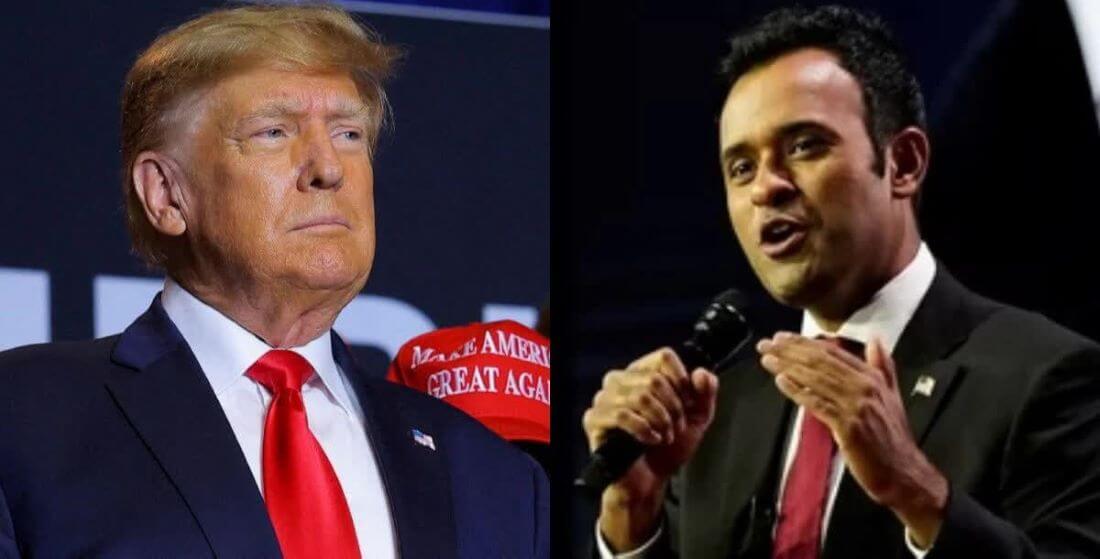
Subsequently, in the current contest for the Republican presidential nomination in 2024, 38-year-old businessman Vivek Ramaswamy demonstrated his candidacy.
What’s more, Ramaswamy ran on a platform promising to “take America First further than Trump.” This required enacting sensible legislation, of course, but it also meant providing a correct historical background to support Trump’s movement.
Apart from advocating for America First, Ramaswamy frequently referenced Thomas Jefferson. It was no coincidence.
For example, Ramaswamy mentioned that he, like Jefferson, left his imprint on public affairs at an early age during a CNN town hall in December.
Artist Scott Adams, well-known for the classic “Dilbert” comic strip, unabashedly compares Jefferson to Ramaswamy.
“Vivek is Thomas Jefferson,” Adams remarked last week in a video that was uploaded on Rumble.
Following Trump’s victory in the Iowa caucuses, Ramaswamy immediately resigned from the campaign and pledged his support behind the former president.
“I’m going to ask you to follow me in taking our America First movement to the next level. It did not begin in 2016. It began in 1776,” He informed his disgruntled fans.
Ramaswamy joined Trump on stage at a New Hampshire event, where he gave an impassioned and powerful speech.
“We are in the middle of a war in this country,” Ramaswamy said.
He clarified that no party is against the other in that fight. “It’s between the permanent state and the everyday citizen.”
To put it briefly, Ramaswamy has intensified the Jeffersonian tone of the America First movement by allying with Trump.
Jefferson, like the other Founders of America deserving of a pantheon, has long since slipped into mythology. Memes on social media, for example, frequently ascribe to him things that he has never stated.
However, if we go to the real historical Jefferson, we see a patriot who prioritizes America First. Notably, the worldview, both then and now, opposes strong government and anti-elitism.
As the United States’ minister to France in October 1785, Jefferson grudgingly accompanied the nobles and numerous sycophants that made up King Louis XVI’s court on their yearly journey from Paris to the king’s hunting resort, Fontainebleau, which was nearby.
One morning as Jefferson was out on a stroll, he came upon a poor woman from a nearby hamlet. She informed him of the suffering of the French peasants, which caused him to ponder. Later that evening, he sent a letter to his friend and political partner, James Madison, sharing his thoughts.
“The property of this country is absolutely concentered in a very few hands,” Less than four years separated France at the time of Jefferson’s writing from the outbreak of the French Revolution.
“I am conscious that an equal division of property is impracticable,” He acknowledged. However, the issue was not resolved by that admission.
“Whenever there is in any country, uncultivated lands and unemployed poor, it is clear that the laws of property have been so far extended as to violate natural right,” he wrote.
Stated differently, the few exploited the many.
Jefferson, however, did not view the state as a kind actor at the same moment.
“I own I am not a friend to a very energetic government. It is always oppressive,” In December 1787, he wrote to Madison.
Jefferson placed the future in the hands of common Americans rather than the government.
“Above all things I hope the education of the common people will be attended to; convinced that on their good sense we may rely with the most security for the preservation of a due degree of liberty,” he added.
Jefferson even trusted the common people to chastise their own government. In fact, today some might brand him an “insurrectionist.”
“The spirit of resistance to government is so valuable on certain occasions, that I wish it to be always kept alive,” In February 1787, he sent a letter to John Adams’s wife, Abigail.
“It will often be exercised when wrong, but better so than not to be exercised at all. I like a little rebellion now and then. It is like a storm in the Atmosphere.”
Jefferson therefore blended the deep mistrust of elite-run government with the appeal to the average citizen found in the present America First movement.
As the years went by, Jefferson began to comprehend the elitists’ strategies—a strategy that contemporary readers should recognize.
For example, when Jefferson held the position of secretary of state under President George Washington, he was concerned about what he perceived as the intentional increase in the national debt and the accompanying establishment of a fiscal system intended to enrich political insiders, such as members of Congress.
“Of all the mischiefs objected to the system of measures beforementioned, none is so afflicting, and fatal to every honest hope, as the corruption of the legislature,” In May 1792, he wrote to Washington.
Put differently, elites grew their own wealth and imposed their will on the elected officials representing the people by using public funds.
Naturally, a national debt redistributes wealth upward. And plunging a country into constant conflict is the surest way to guarantee a huge debt.
Madison, who was a staunch supporter of Jefferson, clarified why.
“Of all the enemies to public liberty war is, perhaps, the most to be dreaded, because it comprises and develops the germ of every other,” he wrote in 1795.
“War is the parent of armies; from these proceed debts and taxes; and armies, and debts, and taxes are the known instruments for bringing the many under the domination of the few,” Madison added.
Jefferson voiced a similar opinion four years later when he rejected the construction of a permanent military force, which would have included a fleet whose “expences and the eternal wars in which it will implicate us, will grind us with public burthens, & sink us under them.”
Jefferson supported a modest level of engagement in international issues and a non-imperialist foreign policy.
“I am for free commerce with all nations, political connection with none, & little or no diplomatic establishment: and I am not for linking ourselves, by new treaties with the quarrels of Europe, entering that field of slaughter to preserve their balance, or joining in the confederacy of kings to war against the principles of liberty,” he added.
The 1790s saw fierce political battles with far-reaching repercussions. With this in mind, Jefferson viewed his election to the presidency in 1800 as a direct challenge to elitism and a confirmation of the principles set forth in 1776.
“Sometimes it is said that man cannot be trusted with the government of himself. Can he then be trusted with the government of others? Or have we found angels, in the form of kings, to govern him? Let history answer this question,” As stated by Jefferson in his First Inaugural Address in 1801.
Jefferson’s administration was distinguished for its tactful methods.
“A noiseless course, [not] medling with the affairs of others, unattractive of notice, is a mark that a society is going on in happiness,” In 1802, the second year of his administration, he wrote.
“If we can but prevent the government from wasting the labours of the people, under the pretence of taking care of them, they must become happy.”
In conclusion, Jefferson battled for the common man during a time when aristocrats and monarchists held sway. In his perspective, a powerful government does not solve the problems of the people; rather, it is the cause of them. And when it was essential, he rallied them to resist.
Moreover, he was aware that elites exploited the government to further their own wealth and subjugate the populace, most menacingly through taxes, debt, and war.
He felt that an aggressive foreign policy was inherently incompatible with the pursuit of freedom.
Trump has articulated some ideals, which Ramaswamy then clarifies and amplifies. By bringing the followers of America First back to their Jeffersonian origins, he has done a huge service to the movement.

