
According to the material cited in the original report, approximately 160 million ballots were cast in the 2020 general election. The reported analysis allegedly involved 128 million voter records, while roughly 32 million additional records remained to be reviewed.
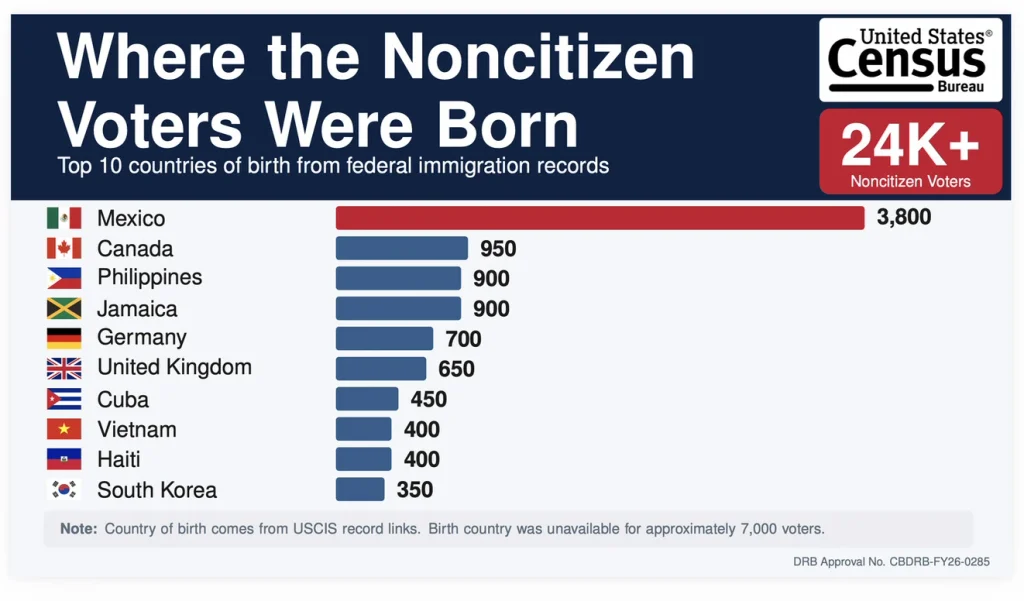
The material further claimed that more than 24,000 records in the initial group were associated with individuals identified as noncitizens. However, the significance of those records—and whether they establish that ineligible individuals actually cast unlawful ballots—would depend on the methodology, source data, verification procedures, and any official findings released by the Census Bureau or other government authorities.
Those distinctions are likely to become central as Trump and other election-integrity advocates press the issue.

The information cited in the report described a process that allegedly examined multiple government records when determining whether a voter lacked evidence of U.S. citizenship. Among the categories reportedly considered were the absence of a U.S. birth record, naturalization record, passport record, or other government documentation establishing citizenship.
The material also referenced records associated with lawful permanent residents, visa holders, foreign students, DACA recipients, immigration-enforcement databases, and other noncitizen classifications.
Trump’s supporters argue that such findings, if independently verified, would strengthen the case for tighter voter-registration safeguards nationwide.
Critics, however, have long cautioned that matching large government databases is complicated and that a record discrepancy does not automatically prove that a particular person voted illegally. Duplicate records, outdated information, incomplete databases, mistaken matches, and changes in citizenship status can all affect the accuracy of large-scale data comparisons.
That debate has done little to slow the political momentum behind legislation requiring stronger proof of citizenship during voter registration.
The report also listed several countries of birth for individuals allegedly identified in the records, including Mexico, Canada, the Philippines, Jamaica, Germany, the United Kingdom, Cuba, Vietnam, Haiti, and South Korea. Birth-country information was reportedly unavailable for thousands of the records cited.
The central question now is whether the alleged Census Bureau analysis will be publicly documented and independently examined.
That could prove critical not only to the political fight over the 2020 election, but also to the broader battle over how Americans register and vote in future elections.
Trump used his announcement to again promote the SAVE America Act, which he portrays as a major step toward strengthening election security. Supporters of tougher election laws argue that documentary proof of citizenship and reliable voter identification requirements are basic safeguards necessary to protect public confidence in elections.
Opponents counter that such requirements can create barriers for eligible voters and argue that existing safeguards already prohibit noncitizens from voting in federal elections.
But Trump and his allies are making clear that they do not consider the current system sufficient.
The former president’s message was unmistakable: if the reported data withstands scrutiny, he believes Congress should move quickly to overhaul voter-registration and election-verification procedures.
The controversy is also certain to intensify pressure on federal agencies to release the underlying methodology and data behind any citizenship review. Without that transparency, competing political narratives will continue to fill the vacuum.
For Trump, however, the issue is already part of a larger argument that the country must take election integrity more seriously.
Whether the reported findings are ultimately confirmed, revised, or challenged through further analysis, the political fight over voter eligibility is far from over. Trump is using the moment to push Congress toward stronger citizenship-verification rules—and to keep the debate over the 2020 election firmly in the national spotlight.
The next step will be public scrutiny of the underlying evidence. If official documentation supports the claims being circulated, the issue could become a major new front in Washington’s battle over election law. If the data or methodology is disputed, the controversy will only deepen.
Either way, Trump’s demand remains at the center of the political fight: secure the voter rolls, verify eligibility, and restore confidence in America’s elections.

