
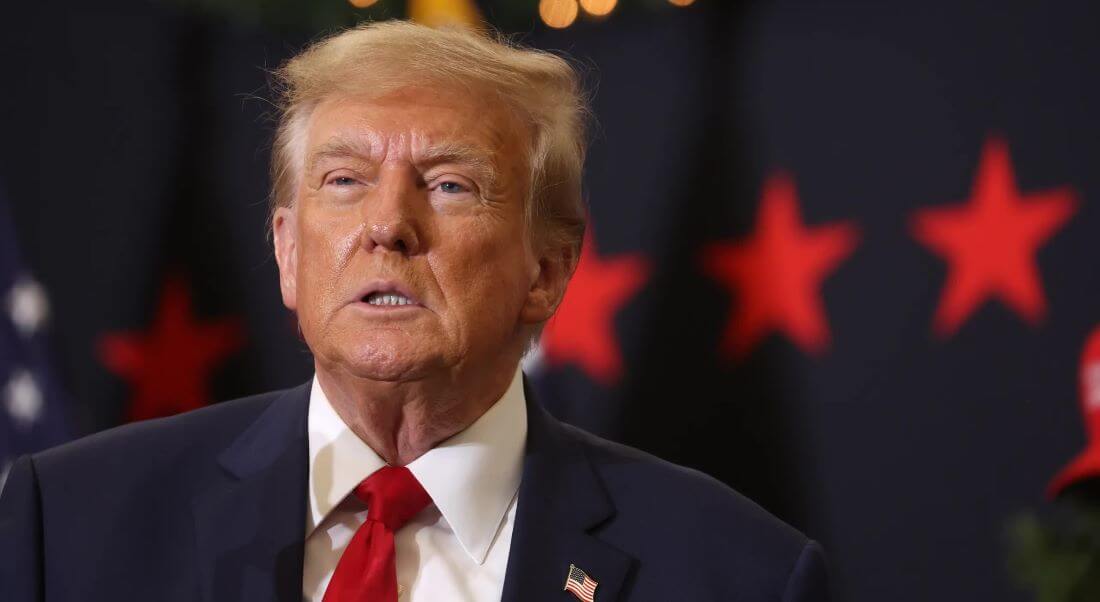
The Colorado Supreme Court rendered a decision on Tuesday that, if upheld, would bar former President Donald Trump from running for office in the state’s Republican presidential primary in 2024.
Justices nominated by Democrats have voted 4-3 to invalidate Trump’s eligibility for office under the 14th Amendment. Their decision stems from his participation in a “insurrection.”
Don’t miss this! Carry faith with you everywhere with the Exclusive National Prayer Coin!

In a commentary essay for The Messenger, lawyer, constitutional law expert, and legal commentator Jonathan Turley described the court’s ruling as “making history in the most chilling way possible.”
Judges An attempt to prevent Republican voters in Colorado from supporting Trump. As the former president leads in primary polls, an unprecedented step provokes criticism.
How did this come about? What justification did Colorado’s highest court offer for what Turley characterized “the most anti-democratic opinion in decades?” And what happens next?
Prepare for the Colorado Republican primary’s high court decision! But wait, did you know that this attitude was shaped in part by a few nominal Republicans?
The Colorado Supreme Court described the case’s beginnings as “a lengthy petition” that “both registered Republican and unaffiliated voters” submitted in the Denver District Court. A subset of voters desired the removal of Trump’s name from the Republican primary ballot. They used the events that took place in the US Capitol on January 6, 2021, as evidence of “insurrection.”
Then, the district court “conducted a five-day trial” and “found by clear and convincing evidence that President Trump engaged in insurrection as those terms are used in Section Three.”
As a result, the district judge ruled that Trump had “engaged in insurrection,” using the third clause of the 14th Amendment. And the state supreme court’s ruling was based on this.
Regarded as one of the most significant constitutional clauses in American history, the 14th Amendment was enacted in 1868. However, prior to Tuesday, no higher court had read the disqualification provision to imply the same thing as the Colorado high court.
In order to grant citizenship to “All persons born or naturalized in the United States,” Congress approved the 14th Amendment in 1866. It meant becoming a citizen of the United States and the state in which those citizens lived. Practically speaking, it acknowledged the complete and equal civil rights of recently liberated slaves, so integrating them into the democratic community.
ALERT! Major Water Restrictions In Effect!
Through the course of American political history, there has been much debate over how to interpret the 14th Amendment in the context of segregation in states that were once home to slave owners.
Prepare for a deeper examination of the amendment! We’ll get right into the first two sections, which address the most pressing problems and have gained the most attention.
However, because of its limited scope, the third portion of the amendment generated very little opposition. Congress actually meant it for former senior Confederate officers. It says this:
“No person shall be a Senator or Representative in Congress, or elector of President and Vice-President, or hold any office, civil or military, under the United States, or under any State, who, having previously taken an oath, as a member of Congress, or as an officer of the United States, or as a member of any State legislature, or as an executive or judicial officer of any State, to support the Constitution of the United States, shall have engaged in insurrection or rebellion against the same, or given aid or comfort to the enemies thereof. But Congress may by a vote of two-thirds of each House, remove such disability.”
The positions listed in the text for the nation’s top executive are not stated.
The Colorado GOP Primary Ballot Allows Trump to Continue, Despite Denver District Court Labeling His Actions as “Insurrection”
A portion of the district court’s decision was reversed by the state supreme court.
The Colorado State Supreme Court has acknowledged that President Trump has engaged in “insurrection” and that the 14th Amendment applies to him.
Prepare yourself for an opinion from the top court that will undoubtedly grab your attention! This decision is supported by substantial evidence and comes with eight bulleted conclusions. Be careful to focus particularly on these paradigm-shifting discoveries.
“Judicial review of President Trump’s eligibility for office under Section Three is not precluded by the political question doctrine,” the third finding with bullet points was read.
Put another way, four judges determined that courts had the authority to override voters on the “eligibility” question. They avoided the difficult “doctrine” that such inquiries belong in the “political” sphere by using this tactic.
“The district court did not err in concluding that President Trump ‘engaged in’ that insurrection through his personal actions,” The sixth finding with bullet points was read.
Undoubtedly, Trump’s “personal actions” did not involve military revolt or secession. Therefore, he could not be covered by Section Three in the same manner as previous Confederate senior officers.
How, therefore, do Trump’s “personal actions” fit within Section Three? The eighth and last bullet point, which is quite graphic, described.
“President Trump’s speech inciting the crowd that breached the U.S. Capitol on January 6, 2021, was not protected by the First Amendment,” The ninth bullet point was displayed.
Trump’s political speech disqualifies him from the presidency, according to the Colorado State Supreme Court
The four autocratic judges then assumed a deceptive, humble demeanor. They identified themselves “cognizant that we travel in uncharted territory” and confessed that the “case presents several issues of first impression.”
The Colorado State Supreme Court has issued remarkable and unsettling interpretations of the constitution.
It put judicial review first, empowering the courts at the expense of the people’s voice.
Unintended Interpretation: The writers of the 14th Amendment did not anticipate how the third part would be construed.
In addition to weakening the First Amendment, the Third Amendment equated political speech with rebellion.
What happens next, then?
All in all, a prompt resolution will be required by the election schedule. The deadline for Colorado Secretary of State Jena Griswold to certify the presidential primary ballot is January 5.
Consequently, the Colorado Supreme Court “pending any review by the U.S. Supreme Court” decided to postpone the decision until January 4.
High court orders removal of previous president’s name from ballot, invalidating free speech and depriving people of their right to vote. A review may be forthcoming.
“The only good news is that this flawed theory can now be appealed to the U.S. Supreme Court where it is likely to be put to rest conclusively,” Turley wrote.

