
>> Continued From the Previous Page <<
The legislation directly mirrors President Donald Trump’s January executive order titled “Protecting Children from Chemical and Surgical Mutilation.” That order cut off federal funding to hospitals and medical systems that perform sex-change procedures on minors. The administration’s policy statement was explicit and uncompromising.
“It is the policy of the United States that it will not fund, sponsor, promote, assist, or support the so-called ‘transition’ of a child from one sex to another, and it will rigorously enforce all laws that prohibit or limit these destructive and life-altering procedures,” the order reads.
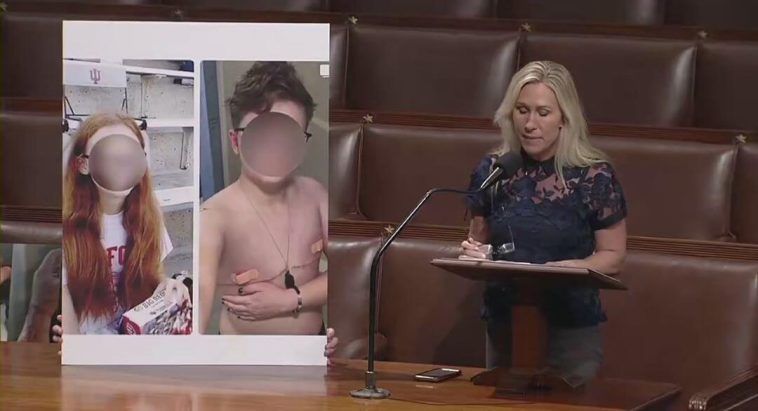
During floor debate, Greene argued that the House vote represented a fulfillment of campaign promises made to voters in 2024. Speaking forcefully, she said the legislation reflects the will of Americans who want government to protect children, not expose them to irreversible harm.

@pinknews As House Republicans advance legislation targeting access to gender-affirming care for transgender young people, Rep. Sarah McBride spoke emotionally about what those policies would have meant for her own life. The bill, introduced by Rep. Marjorie Taylor Greene and passed by the House on 17 December, seeks to criminalize gender-affirming procedures and medical care for minors.McBride, who is trans, reflected on growing up without access to the care she needed, saying “That means 21 years of pain,” describing a persistent sense of homesickness that only disappeared once she was finally able to receive gender-affirming care as an adult. Her “biggest regret,” she added, was never having “a childhood without that pain,” and she expressed deep admiration for trans young people who are coming out today despite what she described as open hostility from Congress. As the legislation moves toward the Senate, McBride urged lawmakers to consider whom the government is meant to serve. “All any of us want is to live a life of purpose and happiness and wholeness,” she said, arguing that life is already difficult enough for families and children without political interference making it harder. #sarahmcbride #transwoman #genderaffirmingcare #transyouth #uspolitics ♬ The Champion – Lux-Inspira
“Today, the house is delivering on what the American people voted for, the opportunity to vote to end the genital mutilation of children via transgender treatments for children,” Greene said, adding that the bill is a “direct legislative reflection of President Trump’s executive order and every single Republican’s campaign promise in 2024.”
Greene also used her remarks to condemn former Biden administration health officials, including Richard “Rachel” Levine, accusing them of promoting what she described as a dangerous social experiment on minors. She further blasted what she called a “perverted multi-billion dollar industry” operating under the label of “gender-affirming care.”
In particular, Greene cited pharmaceutical profits, pointing to Pfizer, which she said “led the way in hormone production drugs with revenues of $74 million from those products in 2022 alone.”
When the final votes were tallied, the bill passed 216–211, largely along party lines. Three Democrats—Henry Cuellar, Donald Davis, and Vicente Gonzalez—broke with their party to support the measure. Meanwhile, four Republicans—Gabe Evans, Brian Fitzpatrick, Mike Kennedy, and Mike Lawler—voted against it, drawing sharp criticism from conservatives.
Ahead of the vote, Delaware Democrat Tim McBride erupted outside the Capitol, accusing Republicans of being “obsessed with trans people” and arguing that children should retain access to the disputed procedures.
“All Republican politicians care about is making the rich richer and attacking trans people. They are obsessed with trans people. I actually think they think more about trans people than trans people think about trans people. They are consumed with this, and they are extreme on it.”
McBride went on to accuse Republicans of making life harder for minors who identify as transgender, offering an emotional defense of the controversial treatments.
“I marvel at the courage of transgender young people today who are sharing themselves with their families and this world, despite the toxicity and the hate that too often emanates from the building behind me and from politicians within it,” he said. “It is already hard enough to be a kid, and government should not make it harder.”
Despite the heated rhetoric, Republicans argue the bill is about drawing firm moral and legal boundaries. With House passage secured, attention now turns to the Senate, where the legislation faces an uncertain future—but supporters say the fight to protect children is far from over.

