
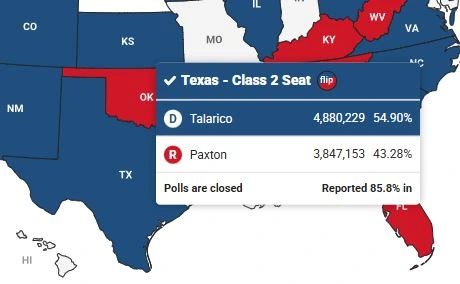
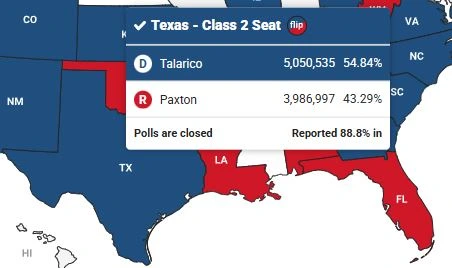
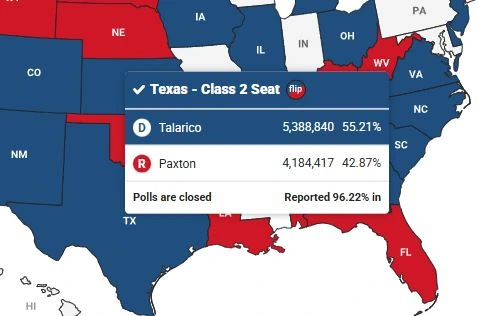
According to the Texas Secretary of State’s latest available results, Talarico collected 5,410,057 votes. That puts him approximately 575,000 votes ahead of Harris’ entire 2024 Texas total.
Think about that for a moment.
A Democratic Senate candidate running in a midterm election managed to attract substantially more votes than the Democratic presidential nominee received in Texas just two years earlier.

Meanwhile, Paxton finished with 4,228,924 votes, leaving him more than 2.1 million votes behind Trump’s 2024 performance.
The difference is enormous and deserves serious examination.
The governor’s contest produced another eye-opening result.
Hinojosa received 5,198,441 votes, defeating Abbott, who collected 4,501,544. The Democratic challenger finished approximately 697,000 votes ahead of the incumbent Republican governor.
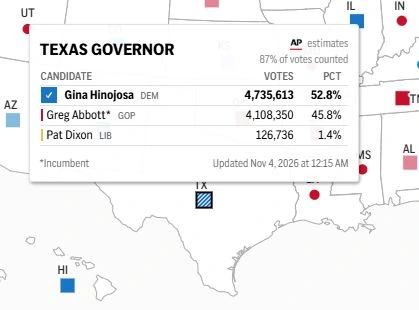
Hinojosa’s total also exceeded Harris’ 2024 performance in Texas by more than 363,000 votes.
For Republicans who have traditionally viewed Texas as a reliable electoral firewall, these results represent a significant political setback.
And the Senate contest may be the most consequential development of all.
Talarico’s performance raises an important question: Where did all these additional Democratic votes come from?
There are several possibilities worth examining.
Democratic enthusiasm may have increased considerably, particularly among voters who were motivated by the Senate and gubernatorial contests. Population changes, voter registration patterns, turnout differences and shifting political preferences could also have contributed to the outcome.
Another important factor is the difference between presidential and midterm elections. Although presidential contests typically attract enormous participation, Tuesday’s results demonstrate that Democratic candidates were able to mobilize an impressive number of voters in Texas.
However, the raw totals alone do not establish exactly which demographic groups or regions produced the additional votes. A closer examination of county-level results, turnout records and voting patterns will be necessary to understand what happened.
Republicans also have some difficult questions to answer.
Paxton entered the contest as a prominent Republican figure with statewide name recognition. Abbott, meanwhile, had governed Texas for years and had built a substantial political organization.
Yet both Republicans fell short against Democratic challengers.
That raises questions about campaign strategy, voter enthusiasm, candidate appeal and whether the GOP underestimated the strength of its opposition.
It would be a mistake to dismiss these results as an isolated political surprise without examining the underlying numbers.
Texas has been central to Republican presidential victories, congressional calculations and the party’s broader electoral strategy. A Democratic breakthrough in two major statewide races could have consequences extending well beyond Austin and Washington.
For Democrats, the results offer a powerful opportunity to argue that Texas is no longer as politically predictable as Republicans once believed.
For Republicans, the message is considerably less encouraging: previous victories and historical voting patterns are no guarantee of future success.
Nevertheless, one election does not automatically establish a permanent political realignment. The next challenge will be determining whether Democrats have built a durable coalition or benefited from a particularly favorable election cycle.
The numbers are undeniable. Talarico exceeded Harris’ previous statewide vote total, Hinojosa did the same, and Republicans suffered major defeats in races they had hoped to win.
The question now is not simply how Democrats managed to produce such impressive totals.
It is whether the Republican Party can identify what went wrong before the next major election.
What do you think explains these extraordinary results in Texas? Did Democrats successfully mobilize a new coalition of voters, or did Republicans fail to bring their traditional supporters to the polls?

