

>> Continued From the Previous Page <<
Pressure Mounts Around Epstein’s Secrets
White House aides and Justice Department officials have long tried to distance Trump from any lingering Epstein associations. Democrats have repeatedly called for the release of all Epstein-related records, accusing the administration of shielding powerful figures connected to the disgraced financier.
That political pressure boiled over months ago, when U.S. Deputy Attorney General Todd Blanche personally visited Maxwell in a Florida maximum-security prison. According to insiders, Blanche met with her over two days and obtained “a list of 100 names” connected to Epstein’s inner circle.

Days later, Maxwell was quietly moved to a lower-security facility in Texas — a decision that immediately sparked speculation that she had begun cooperating with federal investigators.
The “Sweetheart Deal” That Keeps Haunting Washington
Federal prosecutors, however, stood firm in opposing Maxwell’s release. They argued that the 2007 agreement, often called Epstein’s “sweetheart deal,” applied solely to the Southern District of Florida — not to the charges brought years later in New York.
That deal, signed during Epstein’s first prosecution, had allowed him to plead guilty to minor state charges in exchange for immunity from further federal prosecution. Maxwell, although deeply involved with Epstein at the time, was not charged until 2018, nearly a decade later.
In her filings, Maxwell claimed she should be covered under that same promise. “A person accused of a crime should be able to rely on a promise that the United States will not prosecute again, without being subject to a gotcha,” she argued, according to the New York Times.
She further maintained that the 2007 agreement “had no geographic limitation” and that “a promise made on behalf of the United States binds the entire United States unless it says so affirmatively.”
Government Fires Back
The government rejected that logic outright. Solicitor General D. John Sauer blasted Maxwell’s reading of the agreement as “incorrect,” insisting she “failed to show that it would succeed in any court of appeals.”
Sauer’s statement left no doubt that the Justice Department views the Epstein deal as a Florida-specific arrangement — one that never applied to Maxwell’s New York conviction.
The End of the Legal Road — Or the Start of a Political Firestorm?
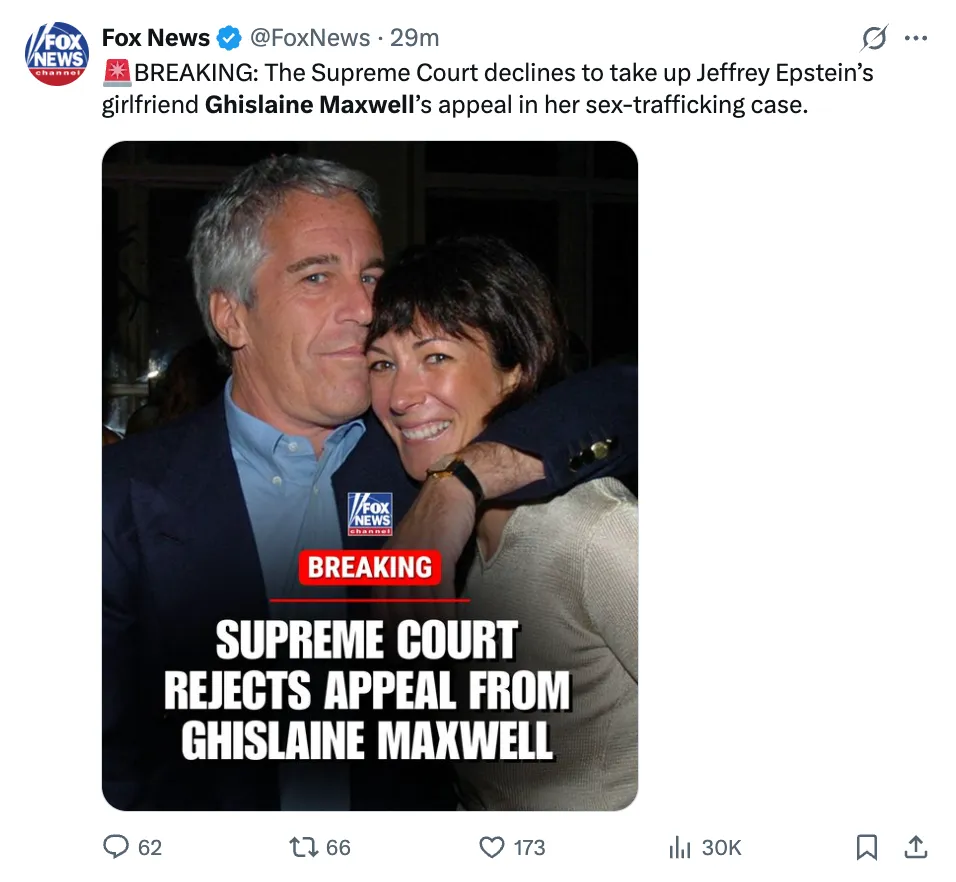
With the Supreme Court’s denial, Ghislaine Maxwell has officially exhausted her legal options. Her only remaining route to freedom now lies through a presidential pardon — a move that could detonate political tension in the middle of a heated election season.
Should Trump, the GOP’s dominant figure, consider such a step, it would thrust the Epstein saga back into the center of national politics. Allies would hail it as an act of mercy; opponents would brand it a moral catastrophe.
Either way, the court’s decision ensures that Maxwell’s name — and the dark legacy of Jeffrey Epstein — will continue to shadow American politics for years to come.

