
>> Continued From the Previous Page <<
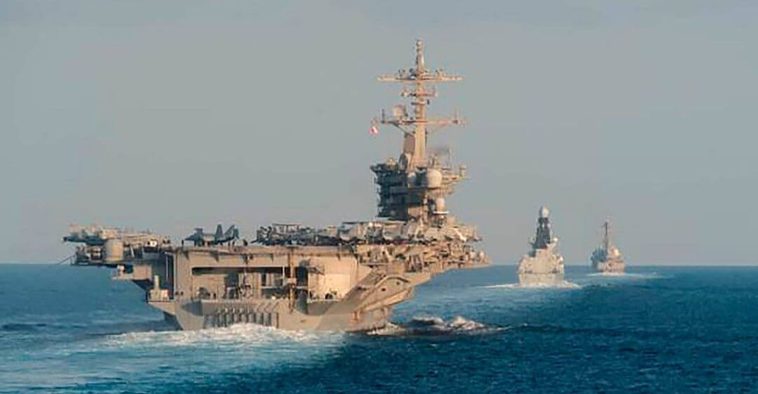
Notably, neither the United States nor Israel relies heavily on oil shipments passing through the Strait of Hormuz. For decades, the U.S. has acted as the chief enforcer of maritime law under the United Nations Convention on the Law of the Sea, ensuring that international waters remain open to all. Despite this long-standing role, Trump’s call for European allies to join U.S. freedom-of-navigation efforts in the region was met with resistance.
European leaders pushed back, arguing that Washington acted alone in escalating tensions with Iran and therefore should not expect automatic support. From Trump’s perspective, however, that stance represents a troubling lack of reciprocity. After decades—and trillions of dollars—spent securing global trade routes and protecting allied nations, the administration viewed Europe’s refusal as a betrayal of shared responsibility.

Instead of backing the U.S., European officials have shifted blame onto Trump for the crisis in the Strait of Hormuz. Critics of that position argue it ignores a central fact: it is the IRGC—not Washington—that has restricted access and imposed illegal controls over the waterway.
Even more striking, Europe’s reluctance to assist in reopening the strait could ultimately harm its own interests. Unlike the U.S., European nations are far more dependent on energy shipments passing through the region. Yet frustration with Trump appears to be driving policy decisions, with some reports suggesting Europe is now exploring a coalition—not to counter Iran—but to challenge American naval actions.
Meanwhile, tensions continue to escalate. The IRGC has issued stern warnings that any foreign military vessels approaching the strait will face severe consequences. This raises a troubling question: will European forces, if deployed, find themselves caught between opposing powers? The situation has taken on an almost surreal dimension, with Europe seemingly aligning against U.S. efforts while still facing threats from Iran itself.
Compounding the issue is what critics describe as a glaring double standard in Western media coverage. Reports on human rights abuses carried out by the IRGC—including executions of protesters—have noticeably faded from headlines. Over the past four decades, Iran’s regime has been linked to thousands of terrorist incidents through its proxy networks, yet those concerns are now receiving far less attention.
Equally concerning is the lack of focus on Iran’s advancing missile and drone programs, which pose a direct threat to international shipping and regional stability. Instead, global discourse appears increasingly centered on opposing Trump’s strategy rather than addressing the underlying dangers posed by Tehran.
Adding to the controversy, Iran was recently appointed to a key United Nations body—the UN Committee for Program and Coordination—which plays a role in shaping policies related to human rights, disarmament, and counterterrorism. According to UN Watch, the United States stood alone in formally distancing itself from the decision.
Legal experts have also pointed out that Iran’s toll system in the Strait of Hormuz violates international law. Under established maritime rules, no nation has the authority to charge transit fees for passage through such a critical global waterway. Yet, rather than confronting this issue, some countries appear more focused on preserving access to Iranian oil—even if it means paying what critics call an unlawful fee.
This contradiction is particularly evident in Europe. The European Union itself maintains strict sanctions prohibiting the import of Iranian crude oil—sanctions reinforced in 2025 by major powers including France, Germany, and United Kingdom. These measures reinstated sweeping UN resolutions targeting Iran’s nuclear and missile programs, arms transfers, and energy exports.
As a result, European companies are legally barred from purchasing Iranian oil. The so-called “freedom of navigation” Europe claims to defend in this case would primarily benefit third-party nations—particularly in Asia—rather than European economies themselves.
Other Western nations, including Canada, Australia, and New Zealand, have adopted similar restrictions, further isolating Iran economically. New Zealand has even implemented additional oversight measures requiring businesses to formally register any dealings with Tehran.
Diplomatic efforts to de-escalate the crisis have so far failed. High-stakes negotiations in Islamabad collapsed after nearly a full day of talks. JD Vance, who led the American delegation, stated that Iran refused to make meaningful commitments to abandon its nuclear ambitions.
Despite these setbacks, Europe appears increasingly willing to tolerate both Iran’s nuclear program and its aggressive posture in the Strait of Hormuz—largely due to opposition to Trump’s strategy. Critics argue that this approach risks empowering Tehran while undermining efforts to restore long-term stability in one of the world’s most critical regions.

