
Michigan Senate Race Remains a Close Contest
The fundraising findings arrive as Michigan prepares for a competitive Senate election that could have significant national consequences.
A Marist poll conducted October 15-18 showed El-Sayed leading Rogers by just two percentage points, with 50% support compared with 48% for the Republican. The survey’s margin of error was plus or minus 4.3 percentage points, placing the candidates within the poll’s margin of error.
In other words, the race remains highly competitive, and neither candidate can claim a clear advantage based on those polling numbers alone.

The contest is to replace retiring Democratic Sen. Gary Peters, whose departure opens a seat that Republicans would like to capture as they fight to maintain or expand their position in the Senate.
For the GOP, a victory in Michigan would represent a major political achievement in a state that has remained central to the broader battle for control of Washington. For Democrats, holding the seat is essential to protecting their Senate position and preventing Republicans from strengthening their influence over the chamber’s legislative agenda.
With the race so close, fundraising, voter turnout and the ability to appeal to undecided voters could all prove decisive.
Former Stevens Donors Provide a Closer Look at the Race
The Donor Class examined approximately 6,500 itemized contributors who supported Stevens’ campaign during the Democratic primary. Following her defeat on August 4, as many as 983 of those donors contributed to either Rogers or El-Sayed between August 4 and September 30.
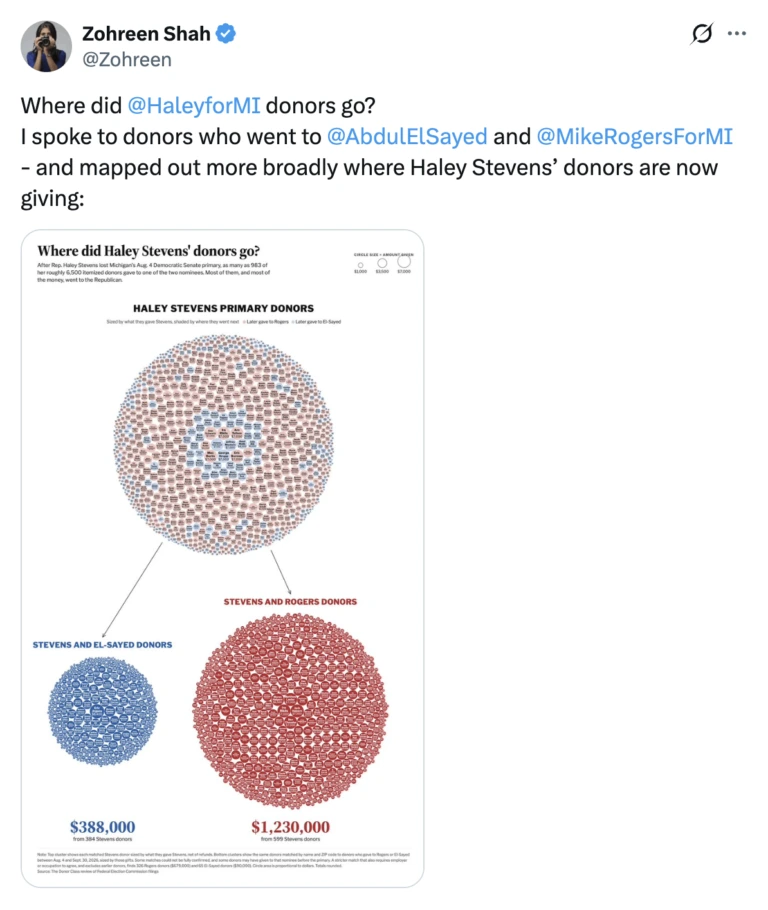
To conduct the analysis, researchers compared itemized contributions reported in Federal Election Commission filings for Stevens’ primary campaign with donations received by the two general-election candidates during the same period.
The results revealed an interesting pattern: Most of Stevens’ previous donors did not contribute to either nominee during the period examined. Among those who did make contributions, however, Rogers attracted more donors and received more money than El-Sayed.
That distinction matters because campaign fundraising is not simply about the total amount of money a candidate collects. The sources of those contributions can also provide insight into which political networks a campaign is successfully reaching.
For Rogers, the figures suggest that he has found opportunities to draw financial backing from contributors who had previously supported a Democrat. Such support could help the Republican expand his fundraising base beyond traditional GOP donors as the campaign moves toward Election Day.
For El-Sayed, the findings raise questions about how effectively he is attracting financial support from donors who invested in Stevens’ effort to win the Democratic nomination.
Still, the analysis covers only a specific group of contributors and a limited period. It should not be interpreted as a comprehensive measure of either campaign’s overall fundraising performance.
Does the Fundraising Advantage Signal a Broader Political Shift?
Rogers’ advantage among former Stevens donors is noteworthy, but it does not establish that Stevens’ primary voters will support the Republican in November.
Financial contributions and voting decisions are two different measures of political behavior. Donors may have strategic reasons for supporting a candidate, and individual contributors do not necessarily reflect the preferences of the broader electorate.
Likewise, a Democratic donor’s decision to contribute to Rogers does not automatically indicate a change in party affiliation or a rejection of Democratic policies. The analysis does not establish why those donors chose one candidate over the other.
Nevertheless, the numbers provide a useful snapshot of the competition for political support in Michigan. Rogers has managed to attract more contributions from the Stevens donor pool than his Democratic opponent, giving his campaign a positive development in an otherwise closely fought race.
The findings also underscore the challenge facing El-Sayed as he attempts to unite Democratic voters and financial supporters behind his candidacy following the primary.
With the Senate majority potentially hanging in the balance, both campaigns have strong incentives to expand their donor networks, mobilize supporters and persuade voters that their candidate is the better choice.
A Critical Race for Senate Control
Michigan’s Senate contest is shaping up as one of the races to watch in the fight for control of Congress. The narrow polling margin suggests that even modest shifts in voter preferences could have an outsized impact on the final outcome.
Rogers’ success among former Stevens donors gives Republicans an encouraging fundraising development, particularly because the contributions came from individuals who had previously supported a Democratic primary campaign.
But the ultimate test will be whether that financial momentum translates into broader support at the ballot box.
El-Sayed continues to lead in the cited Marist survey, although his two-point advantage falls within the poll’s margin of error. The available evidence therefore points to a competitive race rather than a decisive advantage for either candidate.
As the campaign continues, both candidates will need to demonstrate that they can attract the resources, enthusiasm and voter support necessary to prevail.
For now, the donor analysis offers Rogers a potentially valuable opening in Michigan’s Senate battle. Whether that advantage signals a broader change in the political landscape—or simply reflects the preferences of a relatively small group of contributors—will become clearer as the election approaches.

