
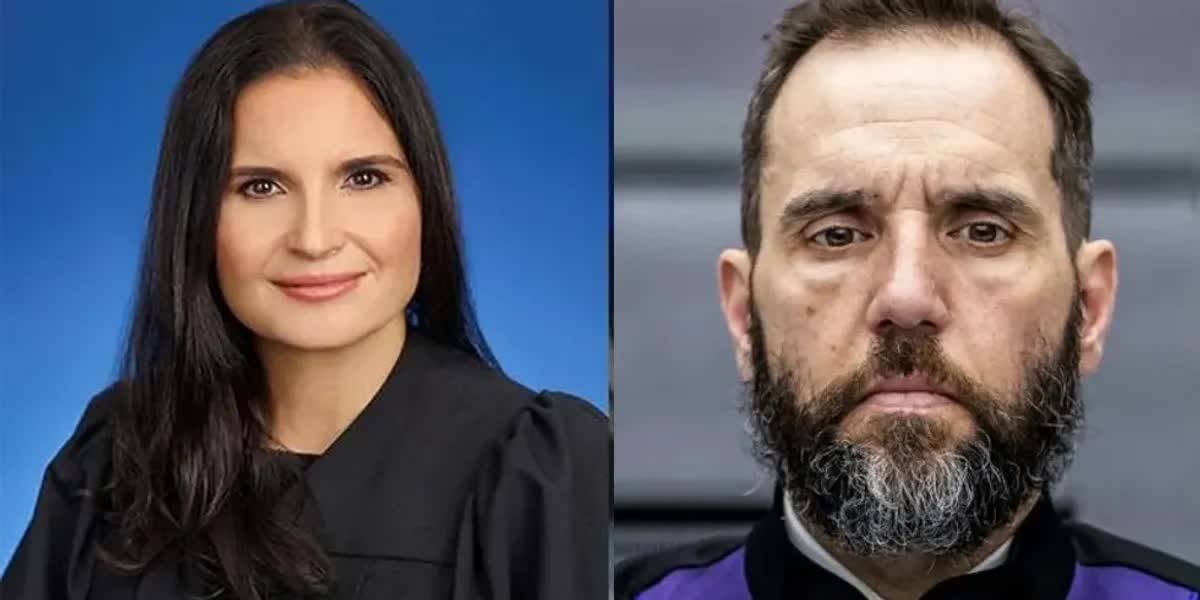
In the case against the co-defendants of former President Donald Trump, Judge Aileen Cannon forcefully rejects the plea of the prosecution to prevent defense lawyers from obtaining sensitive information.
The special counsel’s attempts to limit discovery to the legal defense team in the case, according to the Miami-based judge, a Trump appointment, are grounded on a “broad and unconvincing theory” and a “atextual” and “almost blithe” interpretation of the relevant statute: Hurt.
Don’t miss this! Carry faith with you everywhere with the Exclusive National Prayer Coin!

Smith’s prosecutors filed charges against Trump valet Walt Nauta and Mar-a-Lago property manager Carlos De Oliveira for allegedly aiding Trump in keeping secret materials at Mar-a-Lago illegally throughout the summer.
According to Cannon, the Office of Special Counsel’s reading of the Classified Information Procedures Act deviates from the plain language of the legislation.
According to what the court noted, Smith’s prosecutors seek to limit Nauta and De Oliveira “almost entirely from reviewing classified discovery to be produced in the case, and then placing the burden to justify otherwise on defense counsel.”
Smith’s group cited Section 3 of the CIPA statute to support their action. It says, “Upon motion of the United States, the court shall issue an order to protect against the disclosure of any classified information disclosed by the United States to any defendant in any criminal case in a district court of the United States.”
Cannon disapproves of the special counsel’s position preventing the attorneys for the defendants from seeing the records that demonstrate improper handling of sensitive materials. His reading of CIPA indicates that this restriction is not warranted.
The judge highlights the differences between the attorneys for the defendants and the statute.
“In the OSC’s view, even though Section 3 refers to ‘defendant’ — and even though Congress elsewhere in CIPA specifically referred to ‘any attorney of the defendant’ as distinct from ‘the defendant,’ see CIPA § 2 — the Court nevertheless must read the term ‘the defendant’ in Section 3 to mean ‘attorney for the defendant’ and then simultaneously interpret Section 3 to exclude ‘the defendant’ facing criminal indictment, at least in cases where the government proffers a basis to object to such disclosure pretrial,” Cannon wrote.
ALERT! Major Water Restrictions In Effect!
The special counsel’s stance was characterized by her as a “broad and atextual interpretation” of the law.
Unlock the ability to limit the access that defense lawyers have to classified information. Prosecutors were urged by Cannon to apply section 4 of CIPA for a detailed, document-by-document method.
A portion of Section 4 says, “The court, ‘upon a sufficient showing,’ [may] authorize the United States to delete specified items of classified information from documents to be made available to the defendant through discovery.”
Smith’s attorneys must continually make their case before Cannon, stating why the attorneys for Nauta and De Oliveira shouldn’t be allowed to see the relevant records.
Cannon reiterated, “So again, we are left with the OSC’s broad and unconvincing theory, which is that the Court must change the meaning of the word ‘defendant’ to mean, essentially, ‘defense attorney to the exclusion of defendant.’ The Court declines to do so.”
The judge concluded, “In the end, whatever the contours of the OSC’s broad theory prohibiting a defendant’s access to discoverable information, the answer is not to change the natural meaning of a statutory word in Section 3 but rather to use the mechanism provided in CIPA to handle matters related to restricting discovery, which in the case of CIPA is Section 4.”
The person in charge of supervising Trump’s trial in the papers case, Cannon, has alluded to the prospect of postponing the proceedings, according to a recent update. This story, which Politico published, has piqued people’s curiosity and led to discussions. Watch this space for further developments on this unfolding tale.
“I’m just having a hard time seeing how realistically this work can be accomplished in this compressed period of time, given the realities that we’re facing,” at the hearing, she stated.
The goal of Trump’s legal team is to push back the trial until after the next election.
“Proceeding to trial during the pendency of a Presidential election cycle wherein opposing candidates are effectively (if not literally) directly adverse to one another in this action will create extraordinary challenges in the jury selection process and limit the Defendants’ ability to secure a fair and impartial adjudication,” The attorneys wrote in a court document dated July.
Cannon was notified by Trump’s legal team that preparing for the special counsel’s case on election meddling in Washington, D.C. in March would conflict with their efforts to prepare for the papers case in May.
Attorneys contend that the election meddling trial might cause a months-long disruption to the papers case in May.
Democratic prosecutors in New York City, Fulton County, Georgia, and even Smith’s papers and election meddling investigations have indicted Trump on 91 felonies, a record number.
Democrats brashly want to sabotage Trump’s campaign and sideline him in the courts in order to sabotage the 2024 election. His financial resources are also depleted by this cunning tactic in order to pay outrageous legal fees.
This is a genuinely momentous moment in the history of the US presidential election—unprecedented and dishonorable.
Expose the Democrats’ plot and restore Trump to the White House.
He should be able to get all federal charges dismissed, and maybe even state charges as well.

