

>> Continued From the Previous Page <<
The Finneys—former owners of the home—seem to have enlisted James to buy back their foreclosed property. Some speculate they could be family friends, or possibly even relatives, given James’s mother hailed from the same Virginia town. The issue is not that James helped them, but how the deal was structured—and more importantly, how it was disclosed, or rather, not disclosed.
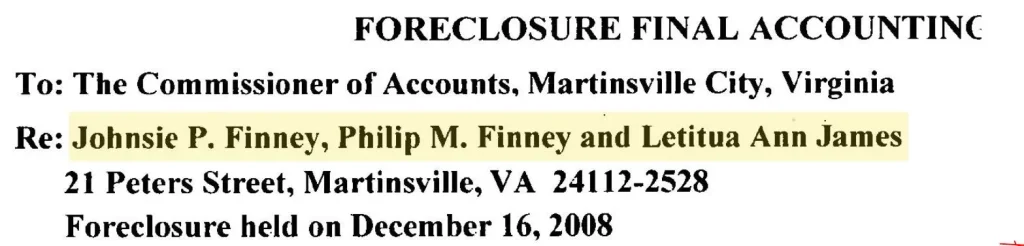
Although her name appeared on the original foreclosure documents, James’s name is mysteriously absent from the new deed filed just weeks later. The “Substitute Trustee’s Deed,” dated January 2009, only includes the Finneys as owners. James’s name—misspelled or not—vanished from the official record.

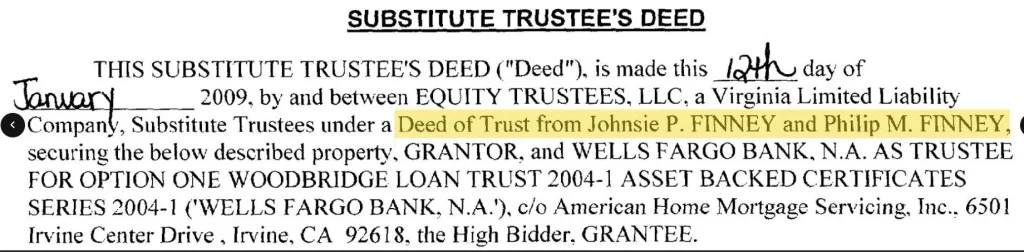
This raises a serious legal red flag.
Virginia law requires all foreclosure purchasers to be listed on the deed unless a legal transaction takes place afterward to transfer ownership. No such transaction has been recorded. There’s no deed, no sale, no formal transfer showing James gave up her share. It’s as if she was never involved—except, of course, her name was on the original foreclosure accounting.
Worse yet, no disclosure of this asset or interest appears in James’s campaign filings or financial ethics statements. She failed to mention the Virginia property in either her 2013 or 2017 filings with the New York City Campaign Finance Board.
Under NYC Campaign Finance Board Rules—specifically CFB Rules 1-04 and 3-03—as well as New York State Public Officers Law Article 4, public officials must disclose any assets or financial interests. If James had any ownership or beneficial interest in the Martinsville property, she was required by law to declare it. She didn’t.
“If James directed the purchase of the 21 Peter Street property, paid for it and then intentionally omitted her ownership from all her campaign filings,” she may have violated multiple statutes, including federal mail and wire fraud laws (18 U.S.C. § 1341, § 1343), Virginia’s false pretenses laws (VA Code § 18.2-178), and both state and city-level ethics laws.
So far, no evidence has emerged that James sold or relinquished her interest in the home. If she retained any ownership, even quietly, it could amount to an illegal concealment of assets—something that must be disclosed by anyone holding public office.
And here’s the real kicker: while James has spent years going after political opponents under the banner of “no one is above the law,” she now finds herself squarely in the crosshairs of the very same standard. In her relentless legal crusade against President Trump over alleged loan misrepresentations, James famously said, “No one is above the law.” That sword cuts both ways.
Just Released: Trump White House Collector’s Bobblehead!
This isn’t just a technical oversight. It’s a potential ethics scandal and legal minefield that could have major consequences for James’s political career. Voters deserve transparency. And elected officials must be held accountable—especially those, like James, who wield enormous legal power.
At the very least, Letitia James must be investigated under NY Public Officers Law Article 4 to determine whether her hidden involvement in this real estate deal constitutes an ethics breach or campaign finance violation. The facts suggest there’s more to this story than a misspelled name and a forgotten foreclosure.
And if investigators dig deeper, they just might find the law she’s so fond of quoting catching up to her.

