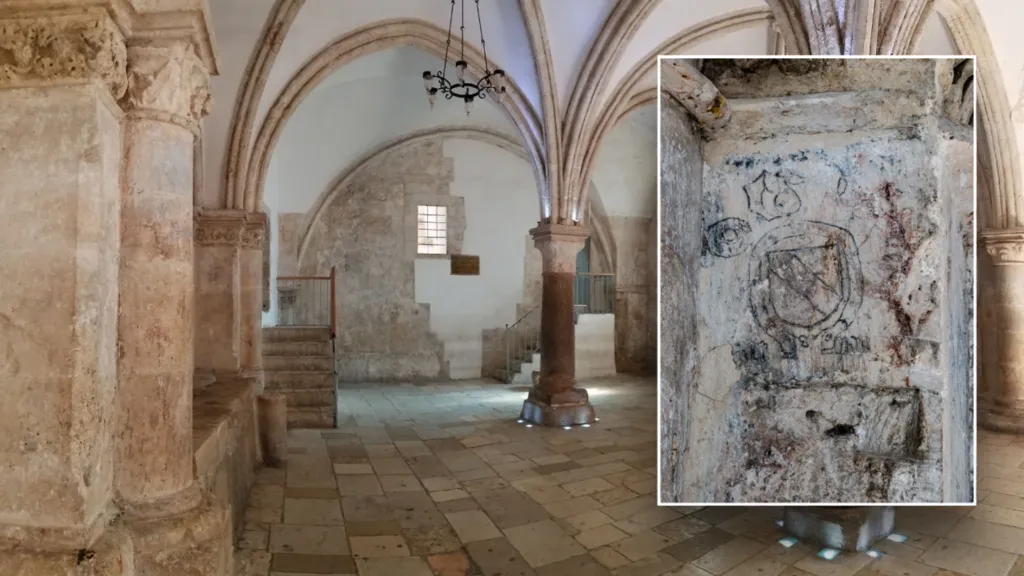
These remarkable messages — essentially medieval graffiti — include coats of arms, religious drawings, and sacred names scrawled in languages ranging from Arabic to German, Armenian, and more. Many of these markings were left behind by international Christian pilgrims during the Middle Ages, with one particularly rare inscription believed to have been etched by a woman from Aleppo.
“Based on the double use of the feminine suffix ‘ya’, the researchers concluded that this is a graffito of a female Christian pilgrim from the Syrian city of Aleppo, making it a rare material trace of pre-modern female pilgrimage,” OeAW said in a statement.
That inscription, written in Arabic, reads simply: “ya al-Ḥalabīya.” Another carving reads “Christmas 1300,” marked in Armenian — a sobering timestamp from more than 700 years ago.
The most visually striking discovery among the 40-plus relics includes a medieval depiction of the Last Supper itself — featuring a round piece of bread, a platter, and a goblet, all set above a German coat of arms. The symbolism is unmistakable and serves as powerful validation of early Christian worship and reverence for the site.
Adding another layer of intrigue, the team also uncovered a drawing of a scorpion, dated back to 1523 — around the time when Ottoman Sultan Suleiman the Magnificent seized control of the Cenacle and converted it into a mosque.
For centuries, pilgrims have traveled to the Cenacle to walk where Jesus and His apostles shared their final meal. The site has seen multiple phases of construction, with a Crusader-era hall built around it during the 12th century. But these newly revealed inscriptions provide a raw, unfiltered look at the believers who journeyed there — not just nobles or clergy, but everyday Christians whose personal faith was carved into the very stones.
According to the Austrian research team, most of the inscriptions were left by Arabic-speaking Christians, challenging the modern assumption that Christian pilgrimage to the Holy Land was primarily a Western phenomenon.
This discovery offers a profound reminder: Christian faith was — and still is — a global force.
The find comes on the heels of another powerful revelation in Jerusalem. Archeologists recently uncovered ancient garden remnants at the Church of the Holy Sepulchre — including 2,000-year-old grapevines and olive trees — in what researchers say matches the biblical description of the garden near Christ’s tomb.
That scriptural reference, found in John 19:41, reads:
“Now in the place where he was crucified there was a garden, and in the garden a new tomb in which no one had yet been laid.”
As modern scholars and archeologists continue peeling back the layers of time in the Holy Land, discoveries like these are doing more than confirming biblical history — they’re reigniting a passion for truth, faith, and heritage.
This latest revelation at the Cenacle doesn’t just touch the pages of history. It speaks directly to every Christian heart that still believes, still prays, and still longs to walk where Christ once stood.