
>> Continued From the Previous Page <<
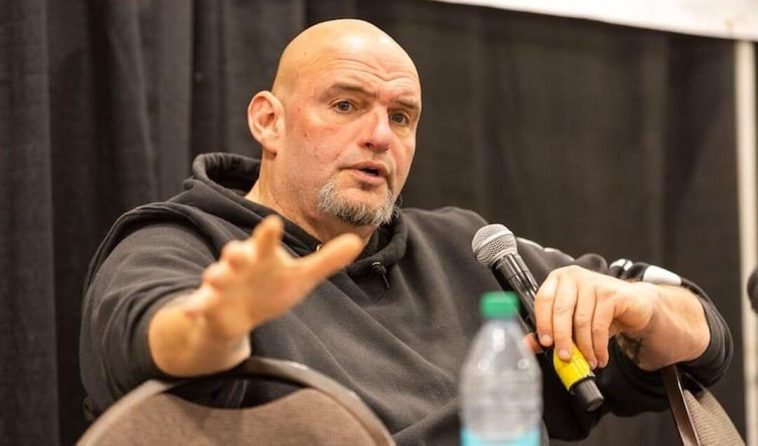
Treasury Secretary Scott Bessent quickly highlighted the moment on X, praising Fetterman as the Democrat who “put country before political ideology.”
For observers in Washington, it was not an isolated incident — but part of a broader pattern that has steadily set Fetterman apart from his party.

He previously supported reopening the federal government during a standoff that Democrats had leaned on as leverage. He also backed advancing the nomination of Markwayne Mullin for a key homeland security-related role when many Democrats were trying to block it outright. In foreign policy votes, Fetterman has repeatedly broken ranks as well, including seven separate votes supporting military measures aimed at preventing Iran from advancing its nuclear program. His vote this week on the Fed chair nomination was decisive in reinforcing that same reputation.
By 2025 voting records, Fetterman has sided with Republicans roughly 26 percent of the time — the highest crossover rate among Senate Democrats, and significantly higher than any of his colleagues.
The confirmation of Warsh is already being framed as a potential turning point for U.S. economic policy.
Former President Trump backed Warsh with a clear expectation: a pivot toward lower interest rates. The logic is straightforward. Lower rates typically ease borrowing costs for mortgages, auto loans, and business credit, while also fueling stronger equity markets.
But Warsh is stepping into a far more complicated economic environment than many anticipated.
Rising geopolitical tensions tied to Iran’s nuclear ambitions have contributed to broader energy instability, feeding into inflationary pressure across multiple sectors of the U.S. economy. The latest inflation reading showed a 3.8 percent year-over-year increase — the highest in nearly three years — released on the same day as Warsh’s confirmation.
That economic backdrop is tightening expectations on the Federal Reserve. Analysts at J.P. Morgan project interest rates will remain steady through 2026, with only a possible adjustment in 2027. Meanwhile, analysts at Bank of America have pushed expectations for rate cuts even further out, now forecasting potential easing in the second half of 2027.
In other words, Warsh inherits an economy where inflation remains sticky and policy flexibility is limited — regardless of political pressure from Washington.
Yet Warsh has made clear he intends to bring a more aggressive reform mindset to the Federal Reserve itself. On CNBC, he previously called for “regime change” at the institution, signaling a desire to reshape how the central bank operates at a structural level.
Among his priorities are significant reductions to the Fed’s $6.7 trillion balance sheet, which expanded dramatically during successive rounds of quantitative easing following the financial crisis and the pandemic. He has also advocated for reducing the number of annual Federal Reserve meetings from eight to four, cutting back on press conferences, and limiting forward guidance — the practice critics say gives markets too much advance notice of policy moves.
Warsh has also proposed shrinking the Fed’s Washington-based workforce, arguing the institution has become overly centralized and bureaucratic.
Supporters see that agenda as long overdue institutional reform.
Adding to the already tense backdrop is the presence of current Fed Chair Jerome Powell, who remains on the board as a voting governor even after his term as chair ended. His term as a governor runs through 2028, ensuring he will still participate in key rate decisions alongside his successor.
Tensions between Powell and the Trump administration have been public and sustained. At one point, the administration initiated an investigation into cost overruns tied to a Federal Reserve headquarters renovation, overseen by U.S. Attorney Jeanine Pirro. Powell dismissed the inquiry as politically motivated, and a federal judge later criticized the probe as lacking proper grounding before it was ultimately dropped.
Now, Powell remains at the table as the institution enters a new leadership phase — observing the transition firsthand.
Warsh told the Senate Banking Committee that he would serve as “strictly independent,” emphasizing that monetary policy decisions would be guided by economic data rather than political pressure or public narrative battles.
That principle, at least in theory, is the foundation of Federal Reserve independence.
But in practice, the arrival of Warsh, the continued presence of Powell, and the deepening political divide in Congress suggest a far more turbulent era ahead for American monetary policy — one that may redefine the central bank for years to come.

