
>> Continued From the Previous Page <<
Liv later pushed for the creation of $25 plush replicas of Asteroid, with proceeds directed to St. Jude Children’s Research Hospital. Her goal was simple but powerful: to help other children fighting cancer.
“I want Asteroid to be for every child,” she said. “Help them see, ‘Asteroid went to space and I can too.'”

Her health eventually declined, and Liv died at home on January 14, 2026, surrounded by her family.
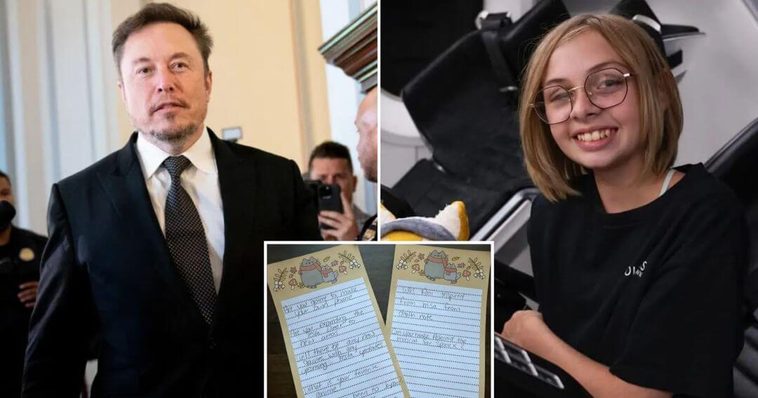
In her final days, she left behind a handwritten list of eight questions on a notepad beside her bed. They reflected the curiosity of a teenager fascinated by technology, pop culture, and space. Among them were questions about whether Elon Musk was building his own phone, whether Tesla diners would expand, his favorite anime, his travels to Japan, his familiarity with virtual pop star Hatsune Miku, whether Grok’s AI companion was inspired by Death Note, and whether new games would be added to Tesla software updates.
Her last question, however, was about Asteroid. She wanted to know if the Shiba Inu she designed could become the official mascot of SpaceX.
The story resurfaced publicly when commentator Glenn Beck shared it on X, posting images of Liv and her handwritten list while directly asking Musk to respond. The post quickly went viral, surpassing two million views and sparking widespread discussion.
On Thursday afternoon, Musk replied publicly and addressed each of Liv’s eight questions in order.
He declined the phone idea but confirmed expansion plans for the Tesla Diner and future game updates. He also shared that his favorite anime is Your Name, the Japanese romantic fantasy film. Musk added that he has visited Japan multiple times, naming Kyoto and the teamLab art collective among his favorite experiences.
Then he addressed the final question—the one about Asteroid.
Musk responded simply: “OK” and added a smiley face.
With that, the small Shiba Inu sketch created by a teenage girl during her illness—later launched into orbit and used to raise funds for children’s cancer research—was declared the official mascot of SpaceX.
Liv’s mother, Rebecca Perrotto, reacted to the announcement with a brief but emotional message: “I wish she was here to see this.”
The moment quickly spread across social media, with many users reflecting on the unusual intersection of space exploration, personal loss, and public acknowledgment from one of the world’s most prominent tech figures.
Supporters of Musk pointed to the exchange as an example of a rarely publicized side of his leadership—one focused not on corporate messaging or media narratives, but on direct, personal engagement.
As one White House figure, Press Secretary Karoline Leavitt, has previously said in a different context, “Their hatred for Donald Trump fuels everything that they do.”
While unrelated to this specific story, the sentiment has been echoed in broader conservative commentary about how public figures are often portrayed in mainstream media.
In this case, however, the focus remained on something more intimate: a dying teenager’s handwritten questions being answered publicly, one by one, without ceremony or delay.
Musk did not announce the decision with fanfare. He did not issue a formal statement or stage a media event. He simply responded.
For many following the story, that simplicity is what stood out most.
The narrative surrounding Elon Musk is often shaped by headlines, controversy, and competing political interpretations. But on Thursday, a very different picture emerged—one defined not by policy debates or corporate announcements, but by a brief exchange honoring the final wishes of a young girl who once looked toward the stars and imagined herself among them.

