
>> Continued From the Previous Page <<
In the world of elite track performance, that gap is enormous.
To understand just how significant this is, consider the numbers. Chevrolet’s ZR1X boasts 1,250 horsepower and an advanced all-wheel-drive system designed for maximum grip and acceleration. Meanwhile, Ford has kept exact figures for the GTD Competition under wraps, only stating it exceeds the base model’s 815 horsepower. Even more striking, the Mustang sends all of its power exclusively to the rear wheels.

Despite that apparent disadvantage, Ford didn’t just compete. It dominated.
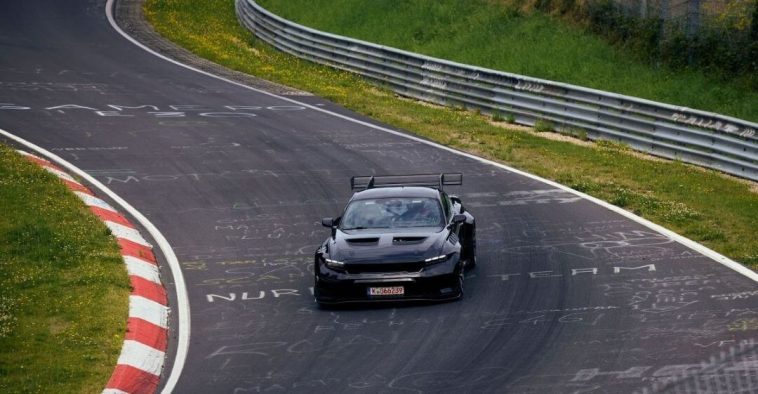
Veteran driver Dirk Müller, a two-time Nürburgring 24-hour winner, piloted the record-setting run. But Ford didn’t stop there. The company then placed the car in the hands of racing engineer Steve Thompson, who has minimal experience on the track.
The result raised even more eyebrows.
Thompson clocked a 6:49.337 lap time, still faster than Chevrolet’s best effort. That means even a less experienced driver in Ford’s machine outperformed a purpose-built rival with significantly more power.
This wasn’t luck. It was engineering.
Ford stripped unnecessary weight using magnesium wheels, carbon fiber seating, and lighter suspension components. Engineers also reworked the aerodynamics with aggressive front dive planes, carbon aero elements, and a redesigned rear wing. At the same time, they maintained an advanced drag reduction system that balances downforce and straight-line speed.
The payoff was massive. The GTD Competition improved by roughly 11 seconds compared to the already record-setting standard GTD.
On a nearly 13-mile track like the Nürburgring, that kind of gain is not incremental. It signals a complete transformation.
Globally, only one street-legal production car has recorded a faster time: the Mercedes-AMG One at 6:29.090. That places Ford ahead of elite European manufacturers, including Porsche and Ferrari, on their home turf.
In other words, an American muscle car just outperformed some of the most advanced supercars ever built, on Europe’s most iconic circuit.
Meanwhile, confidence inside General Motors remains high. GM President Mark Reuss responded to the competition by stating, “There is no limit to what our GM engineers and vehicles can accomplish.”
But for now, the numbers tell a different story.
Ford’s Nürburgring campaign has been relentless. In 2024, the Mustang GTD became the first American production car to break the seven-minute barrier with a 6:57.685 lap. That time was later improved to 6:52.072. Chevrolet answered with its own record runs, briefly reclaiming the spotlight.
Then Ford returned once again and delivered its knockout punch.
The GTD Competition will be produced in limited quantities, making it as exclusive as it is fast. Pricing has yet to be finalized, but it is expected to exceed the already steep cost of the standard GTD. Even so, today’s result has shifted the conversation.
For now, the title of America’s fastest production car belongs back in Dearborn.
And Chevrolet, once riding high, is now facing a familiar challenge.
The rivalry is far from over.

