
>> Continued From the Previous Page <<
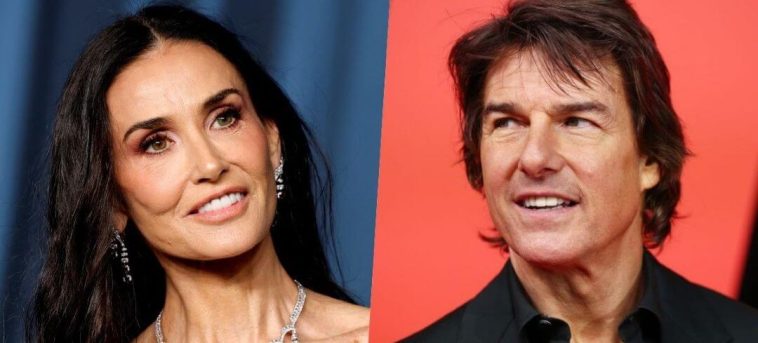
Moore told the audience, “I think Tom was quite embarrassed… I actually felt okay about it… But I could tell he felt that it was a bit awkward.”
That one sentence said it all.
Hollywood wanted women to be glamorous — not visibly expecting. And even top male stars, according to Moore, weren’t sure how to act when a pregnant co-star walked in prepared to do her job.

A Culture That Forced Women To Choose: Career Or Family
Moore went on to describe an unwritten rule that defined her era. Studios didn’t mind if actresses had children — as long as the pregnancy happened off-screen, out of sight, and without disrupting filming schedules.
As Moore put it, “Why not? Why can’t you have both?”
But daring to defy the system came with consequences. Moore felt pressure to prove she could pull off both motherhood and a leading role, which led her into an extreme fitness routine while still pregnant.
She admitted she became “a bit of an overachiever”, pushing herself through heavy workouts, long hikes, bike rides, and even dancing the night her water broke.
Looking back, she questioned the madness of it all, saying, “What the f* was I thinking? And what was I even trying to prove?”**
Her answer was simple: Hollywood gave her no choice.
A Moment That Sparked National Outrage — And Changed Culture
Just before filming, Moore had already blown open America’s discomfort with visible pregnancy. Her iconic 1991 Vanity Fair cover — nude, seven months pregnant — became one of the most talked-about magazine covers in history.
It caused such controversy that some retailers refused to sell it. Walmart reportedly claimed it was “indecent.”
Yet readers couldn’t get enough — the issue sold half a million copies above expectations and brought in tens of thousands of new subscribers.
Moore summed it up perfectly:
“You were celebrated when you find out you’re pregnant, and you’re celebrated when the baby was born… But in the in-between, you’re not supposed to remind anybody that you’ve ever had sex and that it’s a shameful thing.”
The magazine industry later ranked it among the most important covers of the last forty years.
Tom Cruise’s Discomfort Wasn’t Personal — It Was Cultural
Moore wasn’t smearing Cruise. She was exposing a mentality that dominated Hollywood for decades.
Pregnancy was treated like a scandal.
Motherhood meant you weren’t “serious.”
Showing up to work while expecting? Practically taboo.
Yet Moore didn’t cave. She delivered a strong performance, the film scored four Oscar nominations, and it pulled in more than $141 million worldwide. She proved — in real time — that a woman could be both a star and a mother.
Meanwhile, Cruise’s reaction became a symbol of an era that demanded women hide the most natural thing in the world.
Three decades later, Moore’s story is a reminder of just how far Hollywood still has to go — and how much it tries to rewrite history to pretend these attitudes never existed.

