
Schor’s position is notable because he is the Democratic mayor of Michigan’s capital city and previously supported Rep. Haley Stevens during the Democratic Senate primary. El-Sayed narrowly defeated Stevens in that contest, winning by roughly one percentage point after previously predicting a much larger victory.
The disagreement between Schor and El-Sayed also reflects one of the most difficult issues surrounding the Democratic nominee: his position on Israel and the war in Gaza.
Schor has said his Jewish heritage plays an important role in his concerns about El-Sayed’s public statements on the conflict. El-Sayed has described Israel’s military campaign in Gaza as a genocide and has declined to say that Israel should exist as a Jewish state.

At the same time, Schor has made clear that he will not support Rogers, leaving his position more complicated than a straightforward decision to cross party lines.
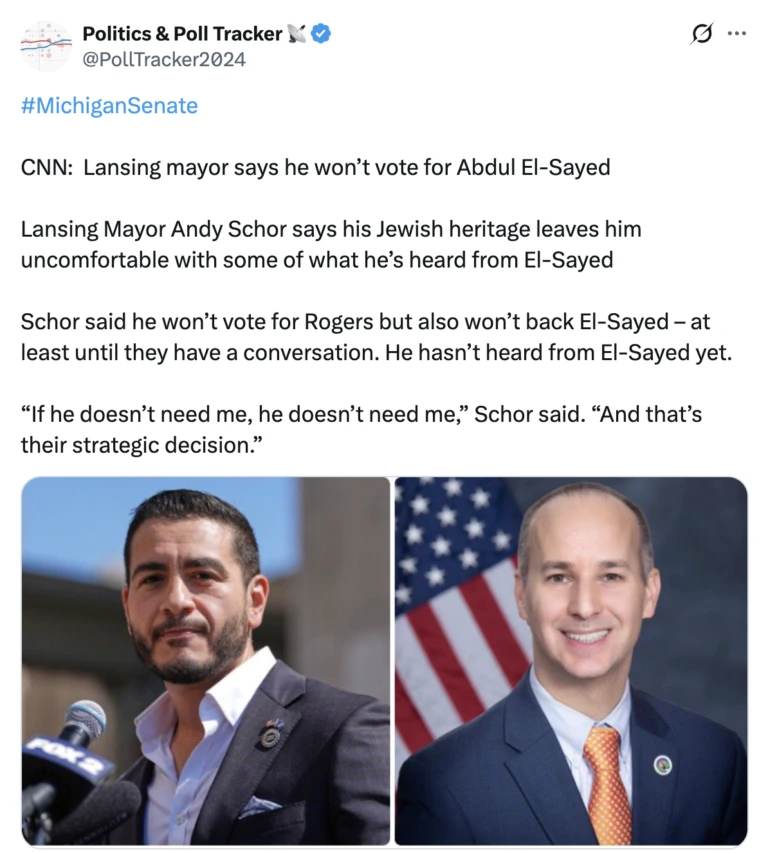
His refusal to immediately endorse El-Sayed nevertheless illustrates the challenge facing the Democratic campaign as it attempts to bring together voters who supported different candidates during the primary.
The primary itself was considerably closer than El-Sayed had anticipated. CNN reported that he had previously expected to win by double digits, but ultimately defeated Stevens by approximately one percentage point. Now, El-Sayed is once again making a confident projection, saying he expects to win the November contest by seven points.
Not everyone in Michigan’s Democratic establishment shares that level of confidence.
CNN reported that some Democratic officials privately remain concerned about whether El-Sayed has sufficiently consolidated the coalition that will be necessary in November. Questions have particularly emerged among portions of the Black and Jewish communities, as well as among Democrats who supported Stevens during the primary.
“Michiganders understand the stakes of this election,” said one prominent state Democrat who has been trying to help. “They want to vote for Democrats and just need to be given a reason to — and not a reason not to.”
The concerns go beyond Schor.
According to CNN, Black and Jewish leaders have told the network that they want to see more direct engagement from El-Sayed. Some people interviewed by the network described interactions with the campaign in which they felt the candidate was relying on support from other portions of the electorate rather than putting enough effort into winning over their communities.
One Black Detroit leader, who spoke anonymously, said his conversation with El-Sayed left him with the impression that “they believe they don’t necessarily need to work as hard to get the Black vote.”
The same leader said El-Sayed promised an invitation to a roundtable discussion that never materialized. After later speaking with representatives from Rogers’ campaign, the leader said he sent a text message to El-Sayed but received no response.
“I felt so bad, I texted him,” the leader said of El-Sayed. “But I didn’t hear back. So, f**k him.”
The criticism comes as Democrats are attempting to present a unified front behind their nominee.
Rep. Debbie Dingell, who remained neutral during the primary before becoming a prominent El-Sayed supporter, has urged the campaign not to assume any segment of the Democratic electorate can be taken for granted.
“This election is not over until Election Day,” Dingell said. “We’ve got to work every single demographic and not take anything for granted.”
Other prominent Democrats have also moved toward El-Sayed following the primary. Former Vice President Kamala Harris has campaigned with him, while former President Barack Obama is scheduled to appear with El-Sayed in Detroit later this month. The high-profile appearances are part of a broader effort to strengthen Democratic unity after a closely fought primary.
El-Sayed, for his part, has pushed back against the criticism that he has neglected particular groups.
When CNN questioned him about voters and community leaders who remain uncertain about his candidacy, he emphasized that his campaign has made an effort to listen to voters across Michigan.
“Every community that I’ve met with, I’ve said, ‘Leading for and with your community is a concern and a key consideration for me,’” he said. “I could spend all of my time with any one community and it probably wouldn’t be enough. And that’s perfectly fair. People deserve a US senator who’s going to show up and listen, but I’ve showed up and listened.”
The competing messages underscore the unusual position of the Michigan Senate race.
El-Sayed has generated enthusiasm among portions of the Democratic base, particularly among progressives, while his campaign continues working to bring together voters who backed Stevens. Meanwhile, Rogers is seeking support among Democrats and independents as Republicans attempt to compete for a Senate seat currently held by Democrats.
Recent CNN reporting has described the contest as closely watched, with the race remaining competitive heading into the final weeks. A September CNN poll had El-Sayed and Rogers separated by only a few points, within the poll’s margin of error.
That makes the remaining campaign calendar particularly important.
El-Sayed may believe he can win Michigan by seven points, but the unresolved questions inside the Democratic coalition remain a central feature of the race. Whether those divisions fade as Election Day approaches — or continue to shape the contest — will become clearer as both campaigns intensify their efforts across the state.

