
>> Continued From the Previous Page <<
Warren also risked his own health to inoculate the people of Boston against smallpox — often waiving fees for patients who couldn’t pay. He was admired, respected, and trusted. But that’s just the beginning.
The Man Behind the Curtain of the Revolution
Unbeknownst to the British, Warren’s medical office doubled as a spy hub. Christian Di Spigna, author of Founding Martyr, described it as “an espionage center where patriot spies from all levels of society filtered their vital intelligence.”

Warren’s intelligence network stretched far and wide, from common laborers to members of Boston’s elite. When the British issued death threats to silence those who would speak at the Boston Massacre anniversary in 1775, Warren refused to back down. Instead, he delivered a defiant address dressed in a Roman toga.
“Our country is in danger, but not to be despaired of,” he declared. “Our enemies are numerous and powerful—but we have many friends. Determine to be free, and heaven and earth will aid the resolution. On you depend the fortunes of America.”
The Man Who Sent Paul Revere on His Midnight Ride
Warren’s intelligence was crucial. When he got word that the British were preparing to arrest patriot leaders and march on Concord, he dispatched Paul Revere and William Dawes to sound the alarm. The next day, the “shot heard ’round the world” rang out in Lexington.
In the weeks that followed, Warren was everywhere. He was elected President of the Massachusetts Provincial Congress and even courted Native American allies. He was present at every major confrontation leading up to the Battle of Bunker Hill.
A Promise Soaked in Blood
Then came the chilling prophecy.
“These fellows say we won’t fight,” Warren told a friend just before the fateful battle. “By heavens, I hope I shall die up to my knees in blood.”
And that’s exactly what happened.
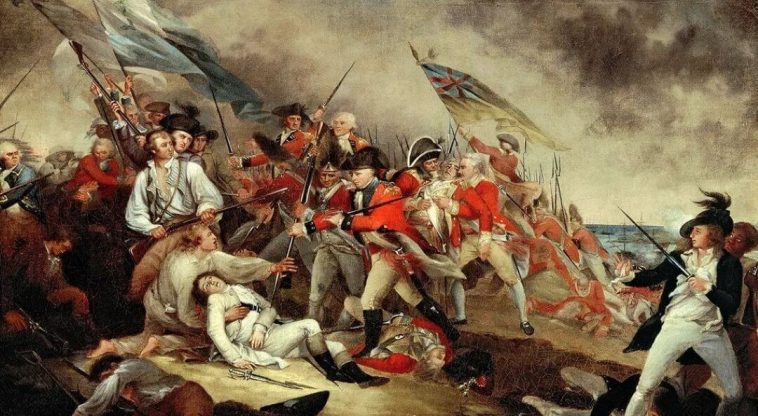
On June 17, 1775, Warren arrived at Breed’s Hill, where American troops were digging in to resist a massive British assault. Though offered command, he refused and asked to join the front lines.
“They tell him, ‘Well, it’s going to be the heaviest in the redoubt,’” Di Spigna said. “And that’s where he goes.”
A Martyr for the Cause of Freedom
The British came in waves, and American defenders fired back with all they had. Eventually, they ran out of ammunition and fought hand-to-hand.
Warren, already wounded, took a fatal bullet under his left eye. The round exited the back of his head. He was just 34 years old.
After the battle, British troops desecrated his corpse, looted his belongings, and took his Bible.
“His body was mutilated afterward by British soldiers because he was one of the important leaders of the patriot cause,” Kierner said. “For all these reasons, he was celebrated as one of the first ‘martyrs’ to sacrifice his life for American liberty.”
The Patriot Who Inspired a Nation
News of Warren’s death sent shockwaves through the colonies. Abigail Adams broke the news to her husband, writing: “Our dear friend Dr. Warren is no more but fell gloriously fighting for his country. […] Great is our loss.”
Other patriots mourned deeply. One wrote that Warren’s “whole soul seemed to be filled with the greatness of the cause he was engaged in.”
Within weeks, his story became legend. Poems and sermons honored his name. “We sore lament both one and all, / In sackcloth let us mourn, / Brave General Warren’s hapless fate / And weep upon his urn,” one poem read.
Paul Revere later helped identify his friend’s body by recognizing a dental prosthetic he had crafted for Warren.
Why His Name Was Buried by Time
Warren’s name was once a rallying cry. But over time, his legacy faded. Civil War memories eclipsed the Revolution, and Warren’s early death kept him from signing the Declaration or helping draft the Constitution.
“Warren just didn’t live long enough,” historian Sarah J. Purcell noted. “He’s not part of this later triumphal phase of American history.”
Di Spigna added, “That one afternoon in battle overshadows that decade of resistance activities.”
Still, towns and counties across America bear his name — including Warrenton, Virginia, and Warren County, Ohio. His spirit lingers, even if his story doesn’t.
He Proved America Would Fight
The Battle of Bunker Hill may have been a British win on paper, but it proved something far more powerful: Americans would fight and die for freedom.
“Even though the battle was a loss for the American side, it proved they could stand up to the British in a pitched battle in a respectable way,” Purcell said. “[Warren’s] death is a great loss, but his reputation served a huge purpose [in] motivating the fight from then onward.”
Warren didn’t just predict his own bloody death — he embraced it, believing the cause of liberty was worth the cost. He bled for a nation he would never live to see.
And because of that, we live in the country he died to create.

