
>> Continued From the Previous Page <<
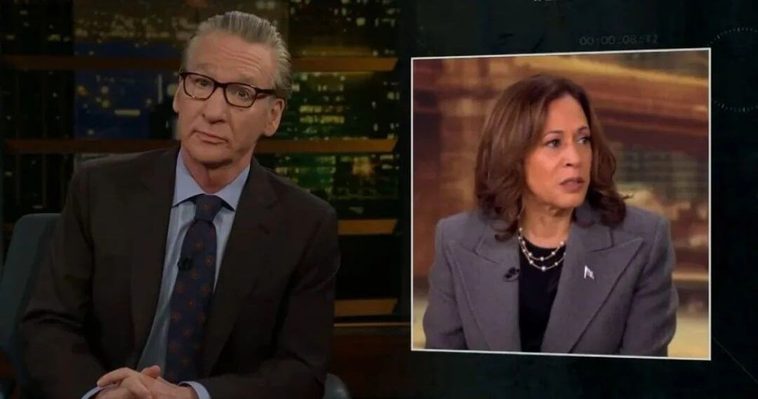
“Ironically, mostly Democrats,” Maher said – and then he went straight for Harris. “Like the Clintons, I mean, you know, Kamala, I voted for you.”
He didn’t stop there, sharpening his critique of the modern Democratic media strategy. “Democrats are about, like, going anywhere that they’re not already pre-adored.”

That line struck at the heart of a long-running complaint among critics: that high-profile Democrats often prefer controlled environments, carefully filtered audiences, and tightly managed interviews where unexpected questions are minimized or eliminated entirely.
During the 2024 election cycle, Harris was repeatedly criticized for limiting unscripted media exposure, instead opting for heavily structured appearances. Her campaign maintained that it was strategic discipline. Critics argued it was avoidance.
Either way, the election result ultimately settled the political debate in the most consequential way possible—at the ballot box.
Maher’s commentary didn’t just focus on Harris as an individual candidate. He broadened his critique to what he sees as a deeper cultural problem inside modern liberal politics. In a particularly pointed moment, he told Will.i.am the issue extends beyond personalities and into ideology itself.
“I always say to my woke friends, we voted for the same person. You’re just why she lost.”
That statement landed as a blunt accusation from someone who, by his own admission, still supports Democrats at the ballot box. But his frustration appears to be growing with what he views as the party’s drift toward ideological rigidity.
Maher added that liberals “have come to champion a lot of really silly, anti-common-sense ideas.”
For Maher, the problem is not simply messaging—it is what he sees as a widening gap between mainstream voters and activist-driven priorities inside the Democratic coalition. He has repeatedly argued that cultural and political extremes inside the party end up alienating the broader electorate.
In another striking observation, Maher summed up what he believes is happening structurally within both major political parties.
“What you have to mainly understand about political parties is that they’re controlled by their fringes.”
That critique, while aimed broadly, has been interpreted by many as especially relevant to Democrats in recent years, as internal debates over policing, immigration, education, and cultural policy have increasingly defined public perception of the party.
Supporters of Maher’s view say his comments reflect what many voters quietly concluded during the 2024 cycle: that over-managed campaigns and ideologically rigid messaging strategies are becoming liabilities rather than strengths.
Following the clip’s circulation online, social media users quickly weighed in. Some praised Maher for what they saw as rare honesty from a longtime liberal voice.
“Once in a while, Bill shows some common sense,” one viewer wrote.
“He is speaking the truth,” another added.
Even among critics of Maher, there was acknowledgment that his frustration is not new. What has changed, however, is that he is now expressing it after an election that reinforced his concerns in real time.
Still, Maher remains an unusual figure in today’s political media landscape—someone who openly critiques Democrats while continuing to vote for them. That contradiction has not gone unnoticed by audiences on either side.
As the dust from the 2024 election continues to settle, Maher’s comments add fuel to an ongoing debate inside the Democratic Party: whether it is losing touch with voters by over-controlling messaging and under-engaging with unscripted scrutiny.
For critics of Harris and her campaign strategy, the takeaway is simple. Elections are not won in controlled environments—they are won in open ones.

