
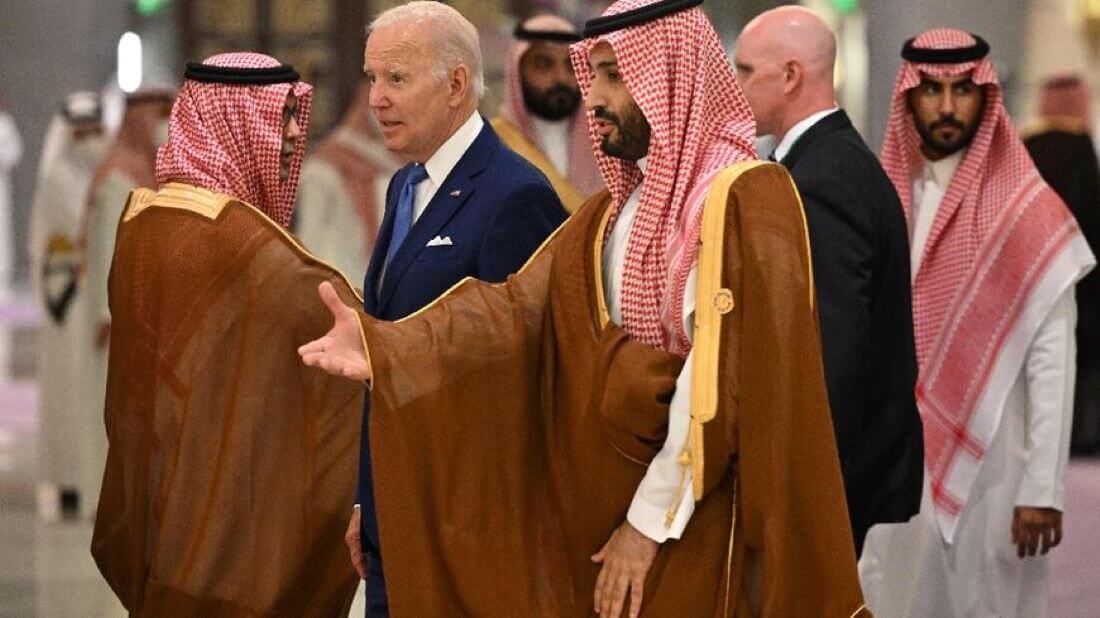
Recently, we were debating the ground-breaking notion of mending Saudi-Israeli relations in the wake of the Abraham Accords, which previous President Donald Trump successfully negotiated. To be quite honest, Joe Biden would also tremendously profit from this advancement for America.
Any development has come to an abrupt halt due to the Middle East’s weakness, particularly as it relates to Hamas and the current conflict with Israel.

Saudi Arabia aggressively attempts to open communication with Iran, a traditional foe in geopolitical affairs, in order to prevent the advancement of its relations with Israel. This change in strategy is a major advancement for the area.
Reuters noted on Thursday. “Saudi Crown Prince Mohammed bin Salman took his first phone call from Iranian President Ebrahim Raisi as Riyadh tries to prevent a broader surge in violence across the region.”
Furthermore, if discussions between Saudi Arabia and Israel were to resume, the major emphasis, according to the wire service’s reliable source, would be on making concessions to the Palestinian Authority.

According to a government statement, bin Salman informed Raisi that “the kingdom is exerting maximum effort to engage with all international and regional parties to halt the ongoing escalation.”
According to a source, the phone talk between Saudi Arabia and Iran was “good and promising.”
The 45-minute talk, according to a different source, was over “the blessing of [Iranian] Supreme Leader Ayatollah Ali Khamenei.”
Even while the news is not startling, it is nevertheless depressing. However, this action is especially unsettling due of two aspects.
Imagine that a ground-breaking agreement between Israel and the surrounding Arab governments was unimaginable ten years ago. However, the Abraham Accords’ momentum now offers a fantastic chance. We can fortify the group of countries that value security and safety by consolidating Saudi-Israeli rapprochement, sending a strong message to the aggressive Iranian leadership. Come together to change the geopolitical environment.
REVEALED: The 3 reasons you should NEVER use Vegetable Oils…
“Normalization was already considered taboo (in the Arab world) … this war only amplifies that,” Aziz Alghashian, a Saudi expert who was cited by Reuters, stated.
Unexpectedly, the Biden administration seems to be once again humiliated by the Saudis. President Biden demonstrated a different approach by extending a cordial greeting to Saudi Arabia’s Crown Prince MBS and even making the ultimately unsuccessful request for more oil output, despite having pledged to hold them accountable for the murder of writer Jamal Khashoggi during his campaign.
Currently, Reuters reported that Riyadh was resisting Washington’s demands that it denounce the mass murder of Israelis by a terrorist group, despite U.S. National Security Advisor Jake Sullivan’s assertion that the negotiations about repairing relations were “not on hold.”
“The first source familiar with Saudi thinking said Washington had pressed Riyadh this week to condemn the Hamas attack but said Saudi Foreign Minister Prince Faisal bin Farhan pushed back. A U.S. source familiar with the issue confirmed this,” according to the wire service.
Instead, following the call, the Saudi authorities only stated that it “opposition to any form of civilian targeting and the loss of innocent lives” and underscored Saudi Arabia’s “unwavering stance in standing up for the Palestinian cause.”
the ramifications of Saudi Arabia’s surprising turn towards Iran and the disparity in priorities between the two regimes; exposing the underlying concerns.
“The Saudis are still convinced the region, and Saudi Arabia itself, needs to shift toward regional cooperation and economic development. Iran seems to think the priority is to take the fight to the Israelis first,” stated Alex Vatanka, the Middle East Institute’s head of the Iran Program in Washington, D.C.
Reuters covered Vatanka’s findings, stressing how the regional ideas have “diverged,” suggesting that it could be difficult to establish common ground. This view is quite forgiving.
Iran’s role in the most recent strike was more than simply conjecture. According to several sources, they not only approved the operation but also trained the personnel involved. Someone in a position of authority in Riyadh who was fluent in English and had access to The Wall Street Journal, where the scope of Iran’s support was amply described, must have learned about this information.
Therefore, who did the Saudi government contact in order to promote stability? Who is it that is aiding the terrorists? They consider these individuals to be in control of all Middle Eastern security. Tehran, one of Saudi Arabia’s main geopolitical rivals, rather than Washington.
A weak American leader from a party that no longer supports our longtime ally in Israel is acknowledged by the House of Saud.
unleashing repercussions beyond a phone conversation and putting a stop to Tel Aviv’s relationship normalization.

