

>> Continued From the Previous Page <<
But the Supreme Court majority, led by Barrett, was having none of it.
Writing for the Court, Justice Barrett systematically dismantled the legal underpinnings of universal injunctions. She was joined by Chief Justice John Roberts and Justices Clarence Thomas, Samuel Alito, Neil Gorsuch, and Brett Kavanaugh in declaring that these broad, country-wide orders have no legitimate historical grounding in American law.

Barrett explained that such “universal” rulings “lack any historical basis in the equitable traditions of the Judiciary Act of 1789,” effectively gutting the notion that district judges have authority to dictate federal policy coast to coast.
Meanwhile, Justices Elena Kagan, Sonia Sotomayor, and Ketanji Brown Jackson dissented from the ruling.
Yet beyond the legal fireworks, it was Barrett’s direct shots at Jackson that stole the show.
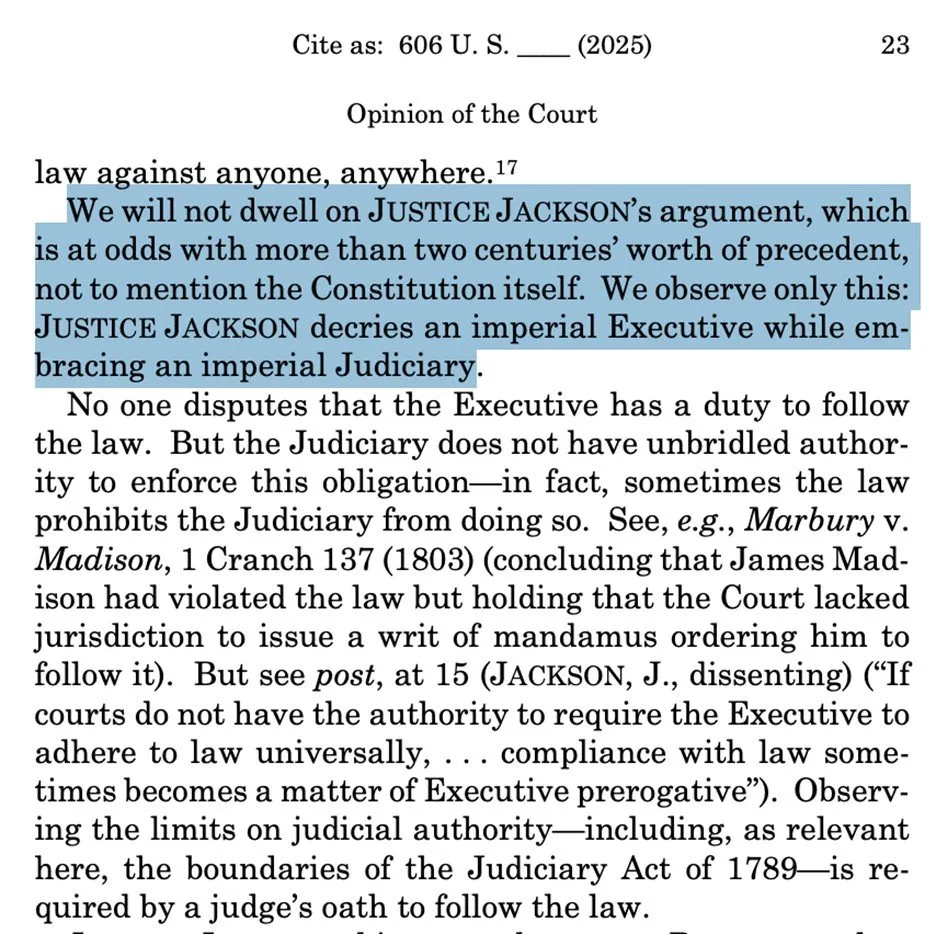
In language rarely seen in modern Court opinions, Barrett unleashed a biting critique of Jackson’s dissent. She opened with an unmistakable swipe: “We will not dwell on Justice Jackson’s argument, which is at odds with more than two centuries’ worth of precedent, not to mention the Constitution itself.”
Barrett’s tone grew sharper as she highlighted what she saw as Jackson’s contradictory logic. “We observe only this: Justice Jackson decries an imperial executive while embracing an imperial judiciary,” Barrett wrote, leaving no doubt that she believes Jackson’s views would hand unelected judges too much power.
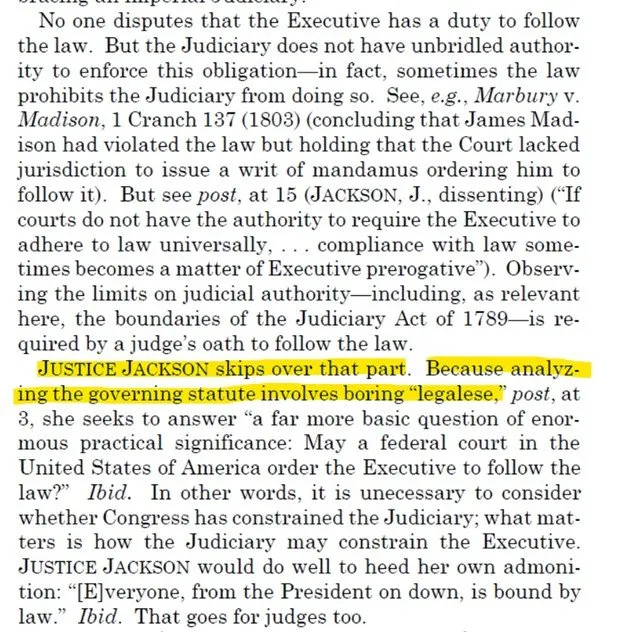
However, the most blistering line came later when Barrett hammered Jackson for supposedly glossing over the statute at the core of the dispute. Barrett declared: “Justice Jackson skips over that part. Because analyzing the governing statute involves boring legalese.”
For many conservatives, Barrett’s words were more than a legal observation—they were a devastating indictment of Jackson’s fitness for the bench. To critics who’ve long questioned Jackson’s credentials and labeled her a “DEI appointment,” Barrett’s opinion seemed like confirmation that the liberal justice is out of her depth.
Some are now speculating about what other justices—particularly conservatives like Thomas and Alito—privately think whenever Jackson offers her opinions from the bench. If Barrett, typically seen as the soft-spoken jurist of the conservative bloc, is willing to drop such a public hammer, it’s anyone’s guess how blunt her colleagues might be behind closed doors.
The ruling marks a major legal victory for President Trump and for Americans who want to see the elected branches of government free from activist judicial overreach. It signals that the Supreme Court is serious about curtailing the power of single district judges to grind the entire federal government to a halt with the stroke of a pen.
Friday’s decision may echo through the federal courts for years, reshaping how challenges to presidential policies are litigated and curbing the influence of ideological lawsuits filed in friendly districts.
But even amid the far-reaching constitutional consequences, the Supreme Court’s latest ruling might ultimately be remembered for one thing: the day Justice Amy Coney Barrett lit into Ketanji Brown Jackson—and left no doubt about who rules the courtroom.

