
>> Continued From the Previous Page <<
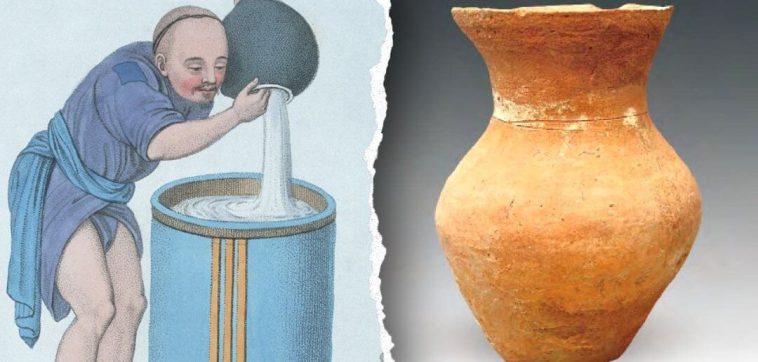
Yet archaeologists found 42 ceramic vessels in four Bronze Age tombs, all containing chemical traces of fermented beverages.
These jars were not empty offerings. They once held real beer brewed from millet, rice, wheat, and barley.

That alone was surprising. What came next was shocking.
The Brewing Ingredient That Should Not Exist There
A research team led by Stanford archaeologist Dr. Li Liu analyzed the microscopic residue inside the jars. What they discovered rewrote the story.
The beer had been fermented using red mold.
Specifically, Monascus mold, a fermentation agent still used today in traditional Chinese red rice wine.
Here is the problem.
Monascus mold requires warm and humid conditions to grow.
The Tibetan highlands are cold and dry.
According to Liu, “Rice may not have been locally produced in this highland environment, and the growing of Monascus typically requires warm and humid conditions.”
In other words, none of this should have worked.
Trade Routes Explain the Impossible
So how did Bronze Age people living in a remote cemetery on the edge of the Tibetan Plateau manage to brew beer using techniques from warm eastern China?
The answer is trade.
These people were not isolated. They were connected.
The brewing method used is known as the “qu method,” which originated in eastern China during the Neolithic period. Archaeological evidence suggests it may date back as far as 9,000 years to the Shangshan culture.
By the time the Mogou cemetery was in use between 1700 and 1100 BC, this knowledge had traveled thousands of miles west.
Liu explained, “Its presence in the western highlands suggests a remarkably long-lasting and far-reaching cultural transmission of brewing knowledge.”
This was not accidental. It was intentional and preserved across generations.
Beer Meant for the Dead and the Divine
The beer found in the tombs was nothing like modern commercial brews.
Liu described the drink as “likely similar to unfiltered beer, with a porridge-like consistency.”
There were no hops. It was consumed fresh. The alcohol content was low.
But its purpose was deeply serious.
The jars were placed in tombs because fermented beverages held ritual importance. Across ancient civilizations from China to Egypt to Europe, alcohol was believed to connect the living to the dead and to the gods.
These drinks were tools for accessing the spiritual realm.
That is why they were buried alongside the deceased.
Ancient Brewing Was Practical and Sacred
Fermented beverages also served a practical purpose. They were safer to drink than untreated water and more nutritious than raw grains.
Liu told Fox News Digital, “They were probably consumed fresh and did not include hops, which are used in brewing modern beer.”
She also noted the flavor profile was “mildly sweet-sour.”
These drinks were not just ceremonial. They were part of daily survival.
A 9,000-Year Legacy of Knowledge Sharing
The earliest confirmed alcoholic beverage in China dates back to 7000 to 6600 BC at the Jiahu site. That drink combined rice, honey, and hawthorn fruit.
That means humans have spent roughly 9,000 years refining fermentation.
The Mogou discovery shows that this knowledge was not locked in one place. It crossed mountains, climates, and generations.
Red mold fermentation had no business existing in a cold highland cemetery.
Yet there it was.
Because someone taught someone else, and that knowledge survived.
The research, published in the Journal of Archaeological Science: Reports in December, marks the first scientific analysis of ancient alcoholic residues from Bronze Age western China.
The Mogou people knew the limitations of their environment.
They ignored them.
They brewed anyway.
And they made sure their dead had access to the same carefully crafted drinks the living enjoyed.
That is not coincidence.
That is civilization.

