
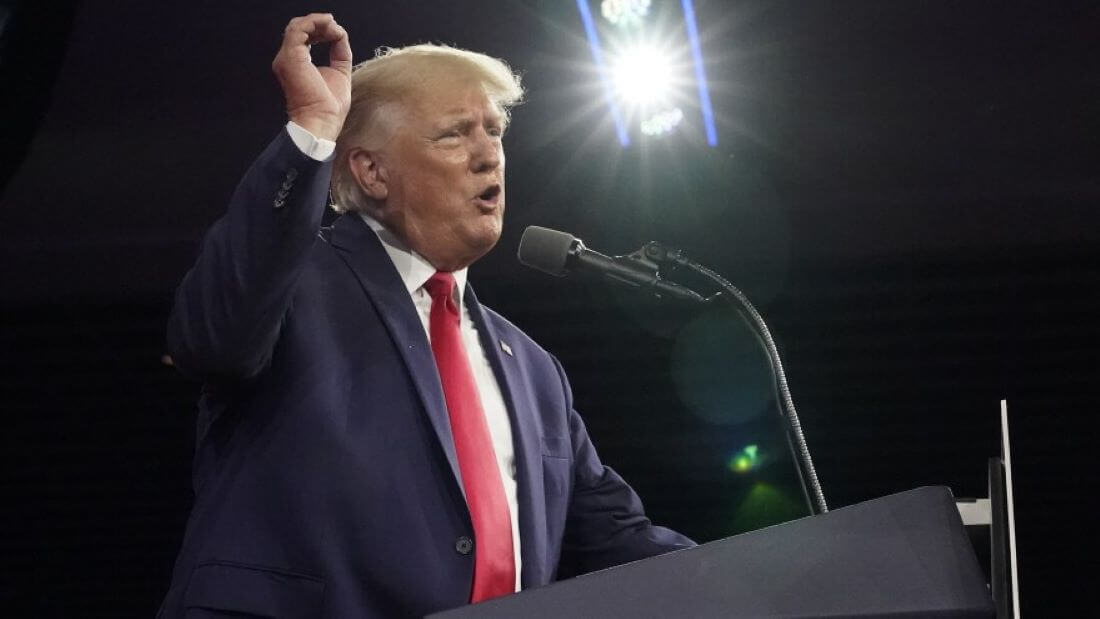
A rising group of Republican attorneys general from other states is contesting former president Donald Trump’s constitutional eligibility on Colorado’s 2024 ballot.
This week, the Colorado Supreme Court will hear oral arguments in a crucial issue involving the former president Trump’s purported involvement in encouraging the attack on the US Capitol building on January 6. A decision was rendered against six voters who contended that the accusations were baseless last month. It’s interesting to note that there have been reports suggesting that a Civil War insurrection clause would be important in this instance and affect Trump’s ability to enter the Capitol. Keep checking back for updates on this evolving narrative.
Don’t miss this! Carry faith with you everywhere with the Exclusive National Prayer Coin!

Nov. 17: Judge Sarah B. Wallace renders a decision. Section 3 of the 14th Amendment does not apply to the president, even if Trump is said to have “engaged in insurrection.” This clause forbids anybody who swears allegiance to the Constitution and thereafter violates it from ever holding public office again.
The matter was promptly appealed to the highest court in the state by both parties. The plaintiffs, who are backed by the charity Citizens for Responsibility and Ethics in Washington, DC, claim that Wallace’s finding that the president is not one of the “officer(s) of the United States” listed in Section 3 is “nonsensical.” Trump’s attorneys have requested that the Supreme Court review a number of case-related issues, including the determination that the former president participated in an alleged uprising.
Independent of one another, a number of parties have presented the Colorado Supreme Court with reasons in favor of or against the case’s outcome. In addition, a large number of additional states have submitted comparable objections in relation to Trump’s 2024 campaign. The federal government’s decision, which will eventually be made by the nation’s top court, is anxiously anticipated by the whole country.

In a case reminiscent to those in Minnesota and Michigan, attorneys general from nineteen Republican-leaning states, led by Indiana’s Todd Rokita, have rejected the plaintiffs’ claims.
“The 14th Amendment entrusts Insurrection Clause questions to Congress, not state officials or state courts,” the Nov. 29 brief states. “Allowing each state and its courts to determine eligibility using malleable standards would create an unworkable patchwork of eligibility requirements for the president.”
Rokita referred to objections to Trump’s legitimacy as a “assault on our republic” in a post on X, the former Twitter.
A brief supporting Trump’s ability to vote has been submitted by 14 state Republican parties, with Kansas’s GOP leading the charge.
The state parties contend that Secretary of State Jena Griswold is only “ministerial” in certifying the candidates selected by the parties to the ballot, and thus lacks the authority to unilaterally bar Trump. This argument is in line with the Colorado Republican Party, which has also intervened in the trial alongside Trump.
ALERT! Major Water Restrictions In Effect!
In filings, Republican state secretaries from Wyoming, Ohio, and Missouri asserted that Trump had been “wrongfully” charged with insurgency.
“This is a classic case of judicial overreach, and the (lower court judge’s) ruling in this case has no basis in law,” stated in a statement Ohio Secretary of State Frank LaRose. “The district court’s order relies on flimsy and circumstantial evidence to reach a flawed conclusion with far-reaching implications both for the president’s legal defense and for the broader democratic process of free and fair elections.”
Former Colorado secretary of state Mary Estill Buchanan, a Republican, supported the plaintiffs’ position in an amicus brief. She stated to the judge, “This country and its institutions are at a crossroads.”
“(Trump) allowed a lust for power to supersede his own Oath of Office and over two centuries of American political precedent. Mr. Trump has sought at every turn to inject chaos into our country’s electoral system in the upcoming 2024 presidential election,” the brief said. “He should be given no opportunity to do so in the state of Colorado.”
On December 6, at 1 p.m., watch the two-hour oral argument before the Colorado Supreme Court.
A renowned legal expert analyzes the Colorado judge’s decision to utilize the 14th Amendment’s “insurrection” provision to remove Trump from the ballot for 2024.
Fox News commentator Sol Wisenberg examined the ruling and saw only one “significant” aspect: the court “held back.” In addition, Wisenberg contended that the Colorado case may have an effect on the 2024 presidential election, depending on how the state Supreme Court rules.
Although the 14th Amendment does not expressly bar the previous president from retaining office because of his involvement in an uprising, Judge Sarah B. Wallace argues that he did.
“Part of the Court’s decision is its reluctance to embrace an interpretation that would disqualify a presidential candidate without a clear, unmistakable indication that such is the intent of Section Three,” the judge wrote.
“After considering the arguments on both sides, the Court is persuaded that ‘officers of the United States’ did not include the President of the United States,” she said. “It appears to the Court that, for whatever reason, the drafters of Section Three did not intend to include a person who had only taken the Presidential Oath.”
During an interview on “The Ingraham Angle,” Laura Ingraham, the host, and Wisenberg talked about the several legal issues that Trump is facing before settling on Wallace’s decision.
“And Sol, then in that Colorado case, the judge there… a separate case, obviously on 14th Amendment grounds in Colorado. The judge there ruled that Trump—they made a factual finding saying that Trump is responsible for inciting an insurrection, but he can remain on the ballot,” Ingraham said.
“Well, the left went crazy with that all day long, saying that was, you know, fantastic because it sets a factual predicate in Colorado. Is that significant today?” she asked.
“I don’t think it’s significant,” Wisenberg responded. “The significant thing in that opinion was that she held back. She realizes the historical record is very mixed on this, so she exercised judicial restraint — you can tell it killed her. But what some judge in Colorado thinks about insurrection, I don’t think is going to have any effect on any of the federal cases here.”

