
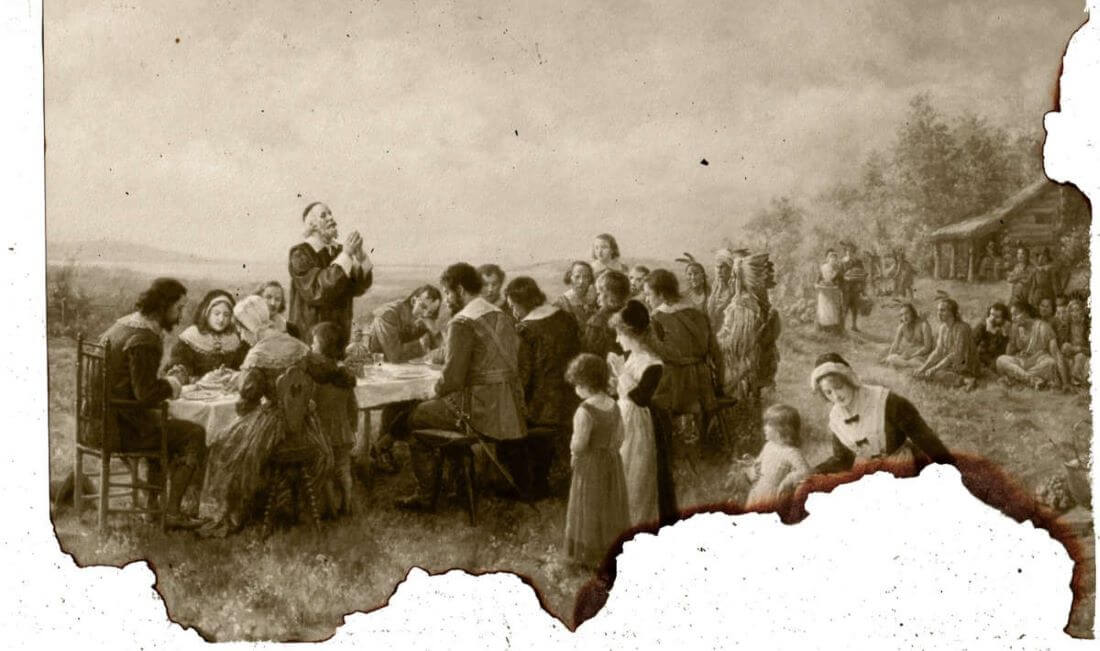
President Thomas Jefferson’s vision for Native Americans in 1803: harmony and thriving.
“[I]n truth the ultimate point of rest & happiness for them is to let our settlements and theirs meet and blend together, to intermix and become one people, incorporating themselves with us as citizens of the US,” Jefferson wrote.
Don’t miss this! Carry faith with you everywhere with the Exclusive National Prayer Coin!

Deplorably, the nineteenth century didn’t go as indicated by the plans of the Statement of Freedom creator. Government specialists in the U.S. misled, abused arrangements, and participated in fighting. The scandalous “Trail of Tears” in 1838, emblematic of Indian Expulsion, stopped Jefferson’s fantasy of tranquil absorption.
For what reason would it be advisable for us to offer thanks for American imperialism? What’s more, might we at any point do as such without affronting the Local American casualties?
Clear, compact, and eye catching: Revealing reality with regards to American expansionism: Recognizing the past without excusing authentic shameful acts.

Find the secret story of American imperialism – a mind boggling story that goes past repulsions and treacheries. Uncover the total picture now.
When we value this intricacy, we have immunized ourselves against the shallowest and most untrustworthy scholarly system at any point constructed: the paired communist account wherein all people fit into one or the other an “oppressor” or an “oppressed” classification.
Challenge communism with the perplexing truth of American imperialism, and find a convincing motivation to dismiss its shortsighted “oppressor-persecuted” storyline. Allow appreciation to come from this newly discovered understanding.
ALERT! Major Water Restrictions In Effect!
Find the vital motivations to be appreciative in this mind boggling story. Plan to be stunned as you understand how things might have effortlessly gotten ugly.
Find the way to valuing this second justification for appreciation by investigating three fundamental subtleties.
In the first place, when we allude to “American colonialism” in the customary Thanksgiving setting — Squanto, the Travelers, etc — we mean basically individuals of the 13 English central area North American provinces who in the end met up in 1776 to frame the US.
European colonizers were not a homogenous gathering. They hailed from assorted starting points, holding onto various ideas and inspirations. Indeed, even in the Old World, they conflicted with one another, and history would rehash the same thing in the New. Shockingly, Europeans didn’t actually distinguish themselves as Europeans.
Find the astounding point of view: Indians didn’t recognize themselves as Indians. All things considered, they were essential for clans, countries, and confederations. Also, there’s something else – their struggles started way before the Europeans showed up and persevered long later.
Break liberated from conventional names like “Europeans” and “Indians” – how about we embrace the variety of individuals from different foundations, with remarkable viewpoints, interests, and ancestral affiliations.
Disclosing a disregarded viewpoint, American pioneer specialists, including the English and English pilgrims who established the groundwork for the US, arise as only a solitary group in the variety of North American players.
Finding another point of view, the English pioneers might appear to be less noteworthy while thinking about various beginning dates. It is unquestionable that they were not a dependable outcome in turning into the originators behind a tremendous republic.
In 1650, colonization was well in progress however the English winning control of North America would have been an unforeseen result. With New Spain toward the south, New France toward the north, and Dutch settlers in the Hudson Waterway Valley, it appeared to be impossible that the English would dominate the competition.
Experience the differentiating scenes of Britain as it rises out of a horrendous nationwide conflict. Witness the victory and misfortune as Ruler Charles I meets his death in 1649. Investigate the Chesapeake states of Virginia and Maryland, settled toward the south of the energetic Dutch and Puritan New Britain in the north.
Beginning from a place of shortcoming, American expansionism came to fruition.
The English and English pioneers had a complicated and different relationship with the adjoining Indians, making it difficult to sum up their encounters in a clear way.
Once more, Indians didn’t consider themselves Indians, so they didn’t all act the same way. This point is so vital to obliterating the “oppressor-oppressed” story that it requires some elaboration.
Experience the charming history of the Indians in Virginia, the most seasoned English state in central area North America. Step back so as to the year 1607, when Jamestown was established by English wayfarers. Witness the captivating experience between the Brits and the strong Powhatan, the principal tribal leader of the nearby Indian alliance.
Powhatan, a shrewdness negotiator, meant to limit the development of the English settlement. He saw the settlers as subordinate, like how he would treat some other more fragile clan. In 1613, the pilgrims teamed up with a more vulnerable Indian clan to catch Powhatan’s girl Pocahontas, to acquire a benefit over him.
Opechancanough, the more youthful sibling of Powhatan, took over as the pioneer after Powhatan’s passing in 1618. In a stunning new development on Great Friday in 1622, Opechancanough coordinated an unexpected assault, bringing about the passing of 347 English pioneers. Notwithstanding, because of an advance notice from a caring Indian kid, Jamestown had the option to endure the invasion.
Sibling principal tribal leaders adopted standing out strategies to managing from the English. One group cleverly drove Pocahontas into bondage, while another fearless Indian kid probably saved the Virginia province.
In such stories, where do we find “oppressor” and “oppressed”?
Find the captivating experiences between New Britain pioneers and different Indian people group, whose conduct overcame ordinary presumption.
In 1675, a strong coalition was shaped between Wampanoag boss Metacomet, otherwise called “King Philip,” and the Narragansetts and other close by clans. This unified power set out on a staggering conflict that caused various losses and imparted dread all through western Massachusetts.
New Britain’s endurance was to some degree credited to its collusions with the Mohegan, Pequot, and especially the Mohawk clans. Outstandingly, the Mohawk were individuals from the compelling Iroquois Alliance, keeping up areas of strength for with the English.
Lord Philip’s Conflict of 1675-76 comprised nothing under an Indian nationwide conflict. It devastated the Indian populace of New Britain.
Once more, where do we find “oppressor” and “oppressed”?
Find the different stories of Britain’s Rebuilding Time settlements (1660-85).
On one hand, William Penn’s “holy experiment” of Pennsylvania, established in 1681, kept up with tranquil relations with Indians. Penn made arrangements and kept every one of them.
In 1763, a serene concurrence was broken by a lamentable occasion. The “Paxton Boys,” a gathering of Pennsylvania vigilantes, driven by dread and outrage towards Indian savagery, mercilessly went after and killed a quiet local area of Conestoga Indians who had calmly incorporated with the English for a long time.
Disputable slaughter sparkles extreme division among whites. Vigilantes guarded, Indians energized for assurance.
In January 1764, Benjamin Franklin offered a scorching incrimination of the Paxton Young men and their tormented perspective. “If an Indian injures me, does it follow that I may revenge that Injury on all Indians?” Franklin wrote.
Indeed, “The only Crime of these poor Wretches seems to have been, that they had a reddish brown Skin, and black Hair; and some People of that Sort, it seems, had murdered some of our Relations. If it be right to kill Men for such a Reason, then, should any Man, with a freckled Face and red Hair, kill a Wife or Child of mine, it would be right for me to revenge it, by killing all the freckled red-haired Men, Women and Children, I could afterwards any where meet with.”
Pennsylvania saw a furious struggle between white pioneers, all competing for command over the quiet Indian populace.
English pilgrims in Carolina, explicitly in 1712, used a separation and-overcome approach, setting Local American clans in opposition to one another, exclusively for their own monetary profit.
Student of history Alan Gallay’s remarkable book, “The Indian Slave Trade: The Rise of the English Empire in the American South, 1670-1717” (2002), made sense of how English Carolinians obtained Indian slaves. To put it plainly, they offered firearms to different Indians and paid them to go after more vulnerable clans.
Find how English Carolinians manufactured a snare of slave exchange, exchanging Indian slaves for African slaves. Reveal the untold story of Indian slave catchers outfitted with firearms, hot on the path of out of control African slaves in Carolina.
The American settlements were loaded up with endless instances of native individuals taking part in different struggles. Indians were engaged with each contention, consistently present on all sides.
To be sure, just at the most significant level of speculation does history support portrayals of “Europeans” as victors and “Indians” as failures. All things considered, less does it support an “oppressors vs. oppressed” story thusly.
Analyze the effect of American expansionism against elective situations as opposed to depending on double decisions.
Could Britain’s North American settlements have been eclipsed by their European opponents? Maybe the French, Spanish, or Dutch would have proven to be the best eventually.
Imagine a scenario where this had occurred. How might North America have changed throughout the course of recent years? Envision the various kinds of states, the opportunity they would have appreciated, and the degree of success they might have accomplished.
Which country’s command in North America would it be a good idea for us to like – French, Spanish, Dutch, English, or American? We should assess their resulting chronicles and go with an educated decision.
Offering thanks for American expansionism, particularly to the Local American partners of the English pioneers

