
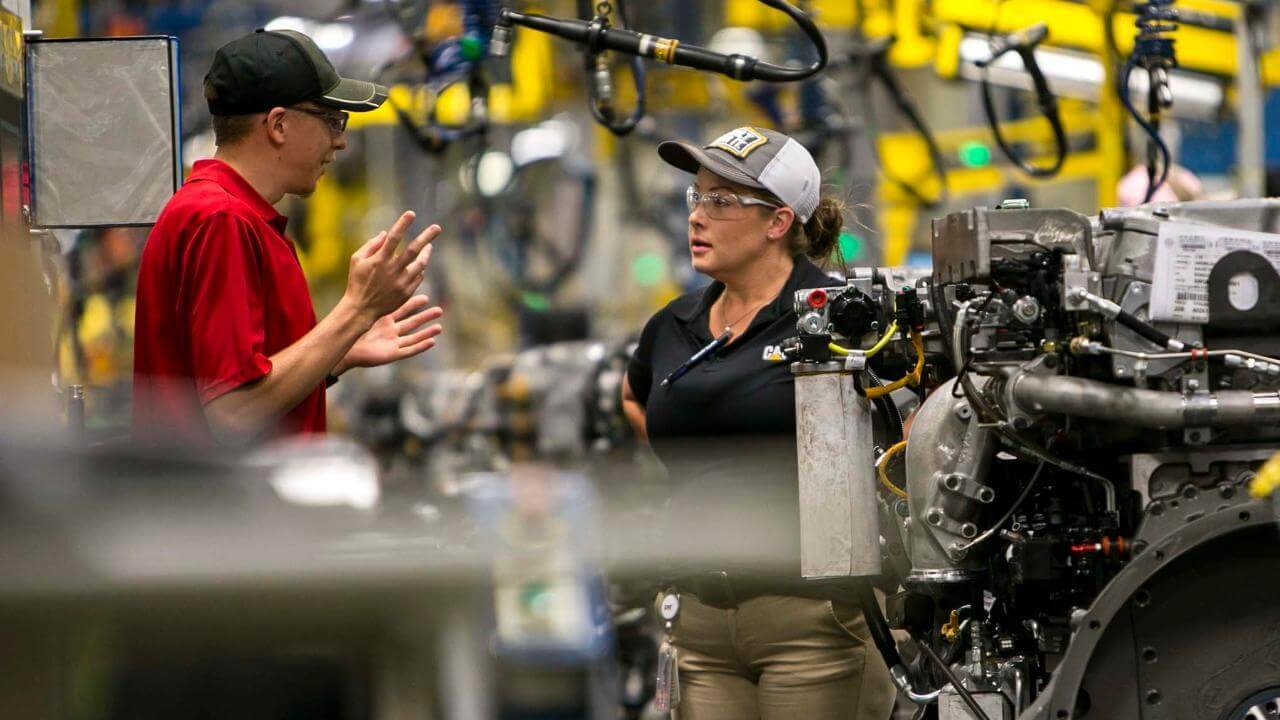
The American manufacturing industry entered its second month of a prolonged slump in May. Experts are raising the alarm and pointing out the “clear challenges” that our economy will face in the future.
The manufacturing purchasing managers index, which stood at 46.0 last month, decreased to its lowest level since May 2020, according to a study by the Institute for Supply Management (ISM). This is the ninth time in a row that the reading has been below 50, signaling a downturn in the industry.
WATCH: Church Leaders PRAYED you’d never see this…

Recessions are indicated by values that are lower than 50. All significant sub-components, including the employment index, which indicates a rise in layoffs, are affected by this.
“In fact, nothing is growing,” In a note, analysts at ING stated. “The one bit of good news is that this is also the case for prices paid, which dropped to 41.8—the lowest seen since December. This suggests producer price inflation should soon drop below 1 [percent] year-on-year.”
The ISM data, taken as a whole, “suggests the economy faces clear challenges,” the ING team stated.

The Producer Price Index (PPI), the most recent measure provided by the Bureau of Labor Statistics (BLS), decreased by 0.3% in May. This index monitors changes in wholesaler, farmer, and manufacturer prices. 1.1 percent is the annualized figure for May.
After many rate increases by the Federal Reserve, wholesale inflation has seen a drop. The economy has been significantly impacted by these increases, prompting worries of a possible recession.
“The last 3 times ISM Manufacturing was this low, the U.S. economy was in or about to be in a recession,” In a tweet, Charlie Bilello, the chief market strategist at asset management company Creative Planning, stated. “You have to go back to 1995-96 to find a lower reading with no recession.”
As of July 3, the GDP nowcast, a real-time estimate of U.S. economic production provided by the Atlanta Fed, shows a second-quarter growth rate of 1.9 percent. This is a modest decrease from the June 30 prediction of 2.2 percent.
Despite the Biden administration’s optimism over the economy and its lack of forecasts for a recession, signs of cooling are beginning to appear.
TRENDING: Little-Known Trick Clears Blurry Eyesight
The unemployment rate increased by 0.3 percentage points to 3.7 percent in May. Additionally, pay growth slowed, going from 4.4 percent to 4.3 percent for average hourly earnings.
Recent information from Challenger, Gray & Christmas indicates that the number of layoffs in the United States increased dramatically in the month of May. Employers with headquarters in the United States declared the elimination of almost 80,000 jobs, a significant rise from the 66,995 layoffs recorded in April. This shows a startling 286 percent increase in layoffs from the same time last year.
Companies have announced astonishing 417,500 job losses in just five months of 2023, a 315 percent increase from the same period last year.
“Consumer confidence is down to a six-month low and job openings are flattening. Companies appear to be putting the brakes on hiring in anticipation of a slowdown,” Senior vice president of Challenger, Gray & Christmas and labor specialist Andrew Challenger made the comment in a statement.
Only 101,833 posts are anticipated to be added by employers in the first five months of 2023 compared to the same period in 2022. This amount is alarmingly down by 83 percent and has dropped to its lowest level since 2016.
Indicators of the labor market are regularly watched by Fed officials for any possible impacts on the economy from tighter monetary policies. Fed officials warn that more tightening is likely despite the unemployment rate remaining below the long-term average of 5.72 percent and inflation surpassing goals.
“With the Federal Reserve seemingly intent on raising interest rates further, these two interest rate-sensitive sectors—construction and manufacturing—are likely to find things tougher as we head through the second half of 2023, putting even greater pressure on the services sector to generate the growth needed to sustain employment,” ING analysts wrote.
Jerome Powell, the chairman of the Federal Reserve, has declared that future monetary policies for the American economy will be more stringent. In addition, he noted that it will be a while before inflation reaches the central bank’s 2 percent objective.
“We believe there’s more restriction coming,” Powell stated at a June 28 European Central Bank event.
Powell stated that he believes policymakers should continue to focus on tightening labor market conditions and improving overall economic growth compared to earlier expectations. “May not be restrictive enough, and it has not been restrictive for long enough.”
The Federal Reserve expects to raise interest rates twice more this year, according to its Survey of Economic Projections (SEP). According to the statistics, this would raise the median policy rate to 5.61 percent.
Currently, the benchmark Fed funds rate is between 5 and 5.25 percent. Investors anticipate a quarter-point hike at the forthcoming policy meeting of the central bank in late July.
Powell made it clear throughout the discussion that the Fed should prioritize continuing to manage inflationary pressures, notably in labor costs.
“We need to see a better alignment of supply and demand in the labor market and see some more softening and labor market conditions so that inflationary pressures in that sector can also begin to subside,” he stated.
According to the head of the Federal Reserve, core inflation, which excludes the volatile costs of food and energy, won’t get to the Fed’s preferred objective of 2 percent until 2025.
“It’s going to take some time. Inflation has proven to be more persistent than we expected and not less,” Powell said. “Of course, if that day comes when that turns around, that’ll be great. But we don’t expect that.”

