
>> Continued From the Previous Page <<
Yet Rodney’s legacy became a target during the wave of monument removals that swept the country in 2020.
That year, officials in Wilmington, Delaware removed his statue from Rodney Square after activists criticized his historical connection to slavery. The monument had occupied the location for nearly a century before being taken down amid mounting political pressure.

Rather than allowing the statue to remain hidden indefinitely, the Trump administration chose a dramatically different path.
Under the leadership of Interior Secretary Doug Burgum, Rodney’s statue has now been returned to public view and placed in one of the most symbolic locations in the nation’s capital.
The installation does not stop with Rodney.

Surrounding him are twelve bronze figures representing Revolutionary War patriots who fought for American independence. Several of those honored are Black soldiers whose contributions to the nation’s founding are often overlooked in modern political debates.
Among them are Peter Salem, James Armistead Lafayette, and Salem Poor, all of whom played important roles during the Revolutionary War.
The exhibit aims to tell a broader story about America’s founding and the diverse individuals who contributed to its success.
“This exhibition featuring Caesar Rodney and the 12 Soldiers of the Revolutionary War is a powerful tribute to the patriots whose service and sacrifice helped secure the freedoms we enjoy today,” Burgum told Fox News Digital.
The timing is significant.
The installation arrives as the United States moves closer to its semiquincentennial celebration in 2026, marking 250 years since the signing of the Declaration of Independence.
For supporters of the project, the display represents more than historical recognition. It also symbolizes a shift away from the political messaging that dominated the area during recent years.
Freedom Plaza and nearby streets became focal points during the unrest of 2020. The surrounding area hosted large demonstrations, activist gatherings, and became closely associated with the massive “Black Lives Matter” street mural championed by D.C. Mayor Muriel Bowser.
At the time, city leaders promoted the mural as a permanent statement.
That permanence proved short-lived.
Earlier this year, pressure from congressional Republicans intensified after lawmakers moved to challenge continued federal support for the project. Georgia Congressman Andrew Clyde introduced legislation targeting the display, and by March 2025 the mural had been removed.
Following the decision, Bowser acknowledged the change publicly.
She wrote on X that “the mural inspired millions of people and helped our city through a very painful period, but now we can’t afford to be distracted by meaningless congressional interference.”
For many conservatives, the replacement of activist symbolism with monuments honoring America’s founding generation represents a dramatic cultural reversal.
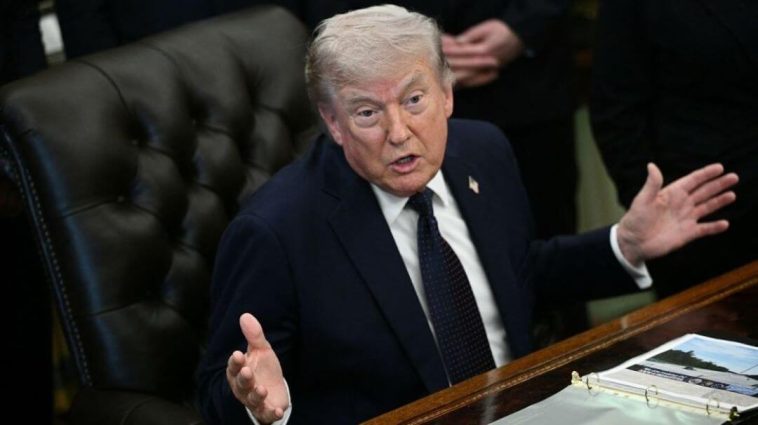
President Trump had warned about the dangers of removing historical figures during the monument controversies of 2020.
When Caesar Rodney’s statue was first removed, Trump argued that the effort was part of a broader campaign against America’s heritage.
“If Caesar Rodney cannot be defended, then there is no principle by which the other signers of the Declaration can be shielded from similar eradication.”
Six years later, Rodney is no longer sitting in storage.
Instead, he now stands in the nation’s capital, surrounded by Revolutionary War heroes and positioned along one of Washington’s most recognizable corridors.
With an official ribbon-cutting ceremony expected soon, supporters see the installation as a powerful reminder that America’s founding story remains central to the country’s identity, even as debates over history, monuments, and national memory continue to divide the political landscape.

