
>> Continued From the Previous Page <<
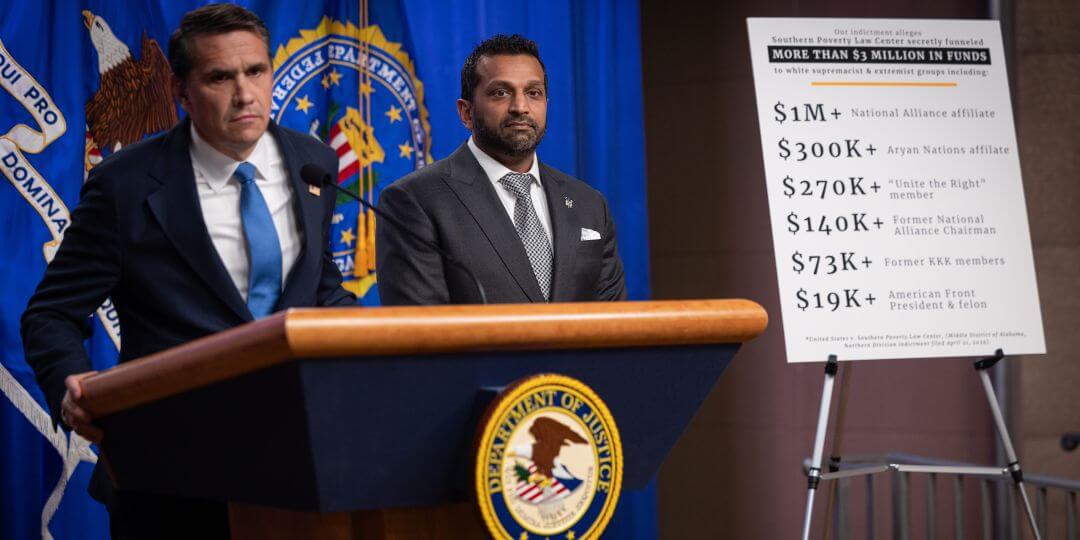
From there, according to the indictment, money allegedly moved from SPLC accounts into shell companies, then into secondary pass-through accounts, and finally onto prepaid debit cards allegedly distributed to individuals tied to extremist groups.
Blanche was direct in describing the structure of the alleged operation, stating:
“This was designed to shield the source of those funds,” Blanche said.

Prosecutors further allege that some of the individuals receiving payments were simultaneously engaged in promoting extremist ideology, even as the SPLC publicly condemned the same movements on its website and in its widely cited “hate map.”
Blanche also alleged the organization was not simply funding informants but was effectively enabling the very extremism it claimed to oppose, stating:
“manufacturing the extremism it purports to oppose by paying sources to stoke racial hatred.”
Kash Patel, now serving in a senior federal investigative capacity, has also claimed that investigators uncovered additional concerns involving financial institutions. According to Patel, the FBI found evidence suggesting misleading representations were made to banks regarding the origin and destination of funds, allegedly to conceal the flow of money through the shell network.
Another key detail emerging from the case is the timeline of the investigation itself. Blanche confirmed that the probe had been active for years before being halted during the Biden administration. It was later revived under the Trump administration, ultimately resulting in the current indictment.
At the center of the broader controversy is the SPLC’s long-running “hate map,” a tool that has been widely used by corporations, nonprofits, and educational institutions to classify extremist groups. Over the years, critics have argued that the map has also swept up mainstream conservative and religious organizations, including Moms for Liberty, the Family Research Council, and Turning Point USA.
The SPLC’s influence extended into corporate philanthropy systems as well. Reports indicate that at least 224 Fortune 1000 companies used Benevity, a workplace giving platform, which in turn restricted donations to organizations flagged by the SPLC. That meant employees at major corporations such as Amazon, Microsoft, Apple, and Coca-Cola were often unable to direct charitable contributions to groups designated as “hate organizations” by the SPLC.
The controversy surrounding the SPLC’s labeling power has been heightened by past violence linked to its lists. In 2012, Floyd Lee Corkins entered the Family Research Council headquarters in Washington, D.C. with a firearm and ammunition. A security guard was shot but managed to subdue him, preventing further casualties.
During FBI questioning, Corkins reportedly cited the SPLC’s listings as his guide. He stated:
“It was a Southern Poverty Law – lists – anti-gay groups,” he said.
The SPLC condemned the attack publicly, but the Family Research Council remained on its hate map.
Now, with federal prosecutors alleging that SPLC-linked accounts were simultaneously routing money through shell companies tied to extremist figures, critics are calling for deeper scrutiny of the organization’s operations, funding practices, and influence over public and private institutions.
As the case unfolds, officials say more details could emerge about how the alleged financial network operated—and whether a decades-old civil rights nonprofit may have crossed into something far more legally and politically explosive than ever previously acknowledged.

