
>> Continued From the Previous Page <<
Their target is not random.
China is focused on the moon’s south pole, a region believed to contain frozen water inside permanently shadowed craters. That resource is far more than scientific curiosity. It is the key to sustaining human presence and fueling missions deeper into space.

NASA leadership is now openly acknowledging the challenge.
“We find ourselves with a real geopolitical rival, challenging American leadership in the high ground of space.”
That statement reflects a growing realization inside Washington: this is no longer just exploration. It is competition.
A Race for Strategic Ground
Experts warn that the lunar south pole offers limited viable terrain for long-term operations. That means the first nation to establish infrastructure there could hold a lasting advantage.
Astrophysicist Jonathan McDowell explained the situation bluntly:
“The establishment of a lunar base by China would be a real challenge to America’s ability to establish such a base – there’s only a small amount of suitable area near the lunar south pole.”
In other words, this is not an open frontier. It is a strategic bottleneck.
And both global powers know it.
Trump’s Moon Strategy: From Visits to Permanence
Unlike earlier programs that focused on short-term missions, the current push aims for something far more ambitious.
Just days before launch, Jared Isaacman outlined a sweeping plan to return Americans to the lunar surface and keep them there. The proposal includes regular crewed landings, construction of permanent habitats, and even the deployment of nuclear power systems and navigation infrastructure.
“This time, the goal is not flags and footprints,” Isaacman said. “This time, the goal is to stay.”
The timeline is aggressive. U.S. leadership wants boots on the moon and a sustained presence established before China secures its own foothold.
“The clock is running in this great-power competition, and success or failure will be measured in months, not years.”
That urgency is driving every decision behind the Artemis program.
Artemis II: The First Step Back
The current mission is not a landing attempt, but it is a critical proving ground.
The crew, led by NASA astronauts and a Canadian partner, will travel around the moon aboard the Orion spacecraft, testing life support, navigation, and deep-space maneuvering systems.
Everything learned from this mission will determine whether the next crew can safely land.
After decades of delay, the United States is finally moving again. But it is doing so in a far more crowded and competitive environment than it faced during the Cold War.
Why the Moon Matters More Than Ever
The renewed focus on the moon is not about nostalgia. It is about control of future space infrastructure.
Water ice at the lunar south pole can be converted into hydrogen and oxygen, the essential ingredients for rocket fuel. That means spacecraft could refuel in space instead of launching everything from Earth.
Whoever controls that supply chain could dominate the next phase of human expansion beyond Earth.
China is not pursuing this goal alone. Through its partnership with Russia, it is advancing the International Lunar Research Station, a direct counterweight to America’s Artemis coalition, which includes allies across Europe and Asia.
A New Era of Competition
China’s rise in space has followed a deliberate, step-by-step trajectory. From early human spaceflight to building its own station in orbit, each decade has marked steady progress.
Now, the focus has shifted to the moon.
For the United States, the return to lunar exploration represents more than a technological milestone. It is a test of leadership in a domain that could define the next century.
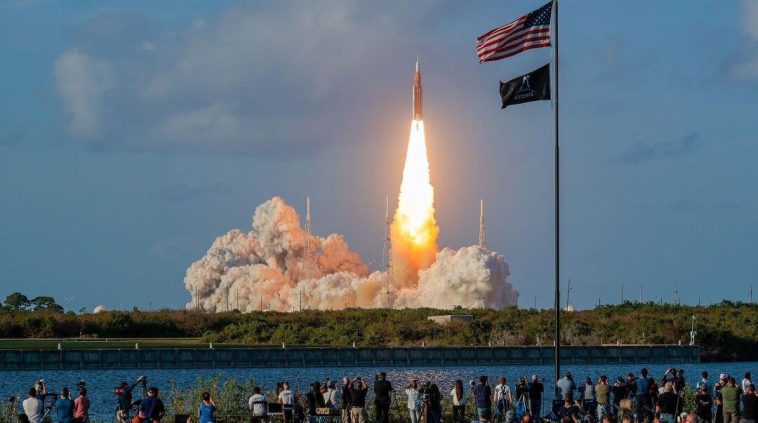
After years of hesitation, the launch of Artemis II signals that America is back in the race.
But this time, it is not running alone.

