>> Continued From the Previous Page <<
“In balance, the defendant has not provided a sufficient basis for the court to find that the interests favoring closure outweigh the interest favoring an open proceeding and the presumptive right to access,” Judge Graf said during Friday’s hearing.
Still, the judge acknowledged that while the April hearing will generally remain open to the public and the press, certain segments may be closed if privacy or safety issues arise.

The defense has been granted until March 30, 2026, to submit a redacted version of its motion seeking to restrict cameras. That filing would outline specific arguments for limiting media access during parts of the legal proceedings.
In reaching his decision, Judge Graf pointed to the landmark 1981 Supreme Court case Chandler v. Florida. That ruling established that allowing cameras in a courtroom does not automatically violate a defendant’s constitutional right to a fair trial.
By referencing the decision, Graf emphasized that courts must carefully balance two important principles: the public’s right to transparency and the defendant’s right to an unbiased trial.
Ultimately, the court rejected the defense’s claim that the presence of media coverage would inherently prejudice potential jurors.
Robinson’s legal team argued forcefully during the hearing that releasing certain preliminary evidence to the public could contaminate the jury pool long before the trial begins.
“So what we’re talking about is releasing preliminary evidence into the public sphere that has the potential to impact jurors,” defense attorney Staci Visser said. “And it is important enough that we are concerned that it will sway people’s opinions one way or the other.”
Visser further emphasized that the defense’s core concern centers on ensuring that jurors remain neutral when the case finally reaches trial.
“I want to make clear that our concern here is with selecting an impartial jury,” Visser added. “Really, it goes both ways. Whether the evidence is good for my client or bad for my client, whatever it is, it makes it harder to find impartial jurors if they are entrenched in an opinion about our client’s guilt or innocence either way.”
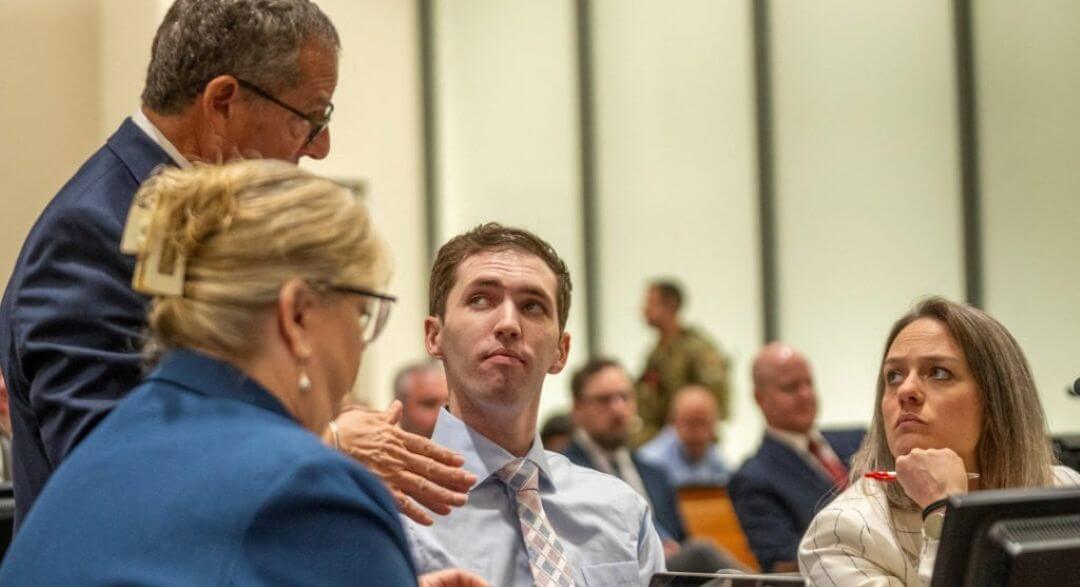
Robinson, who appeared in court Friday wearing a blue dress shirt and tie, reportedly took notes throughout the proceedings. If convicted of the alleged killing of Kirk at Utah Valley University on September 10, he could face the death penalty.
Defense filings submitted to the court also outlined Robinson’s request to present certain evidence behind closed doors, particularly when addressing controversial media coverage and statements from public officials.
“Specifically, Mr. Robinson seeks to take evidence in a closed setting regarding the unfairly prejudicial and misleading media coverage and the improper statements of government officials in order to avoid republicizing the same. Mr. Robinson also asks this court to take evidence regarding the privacy violations detailed in the ‘motion to exclude cameras’ in a closed setting, to, again, avoid reiterating the violative material,” according to defense filings.
Robinson’s attorneys have also sought to prohibit cameras and microphones entirely, arguing that widespread media attention could shape public perception and make it harder to seat an impartial jury.
“We’ll show both that we have categories of prejudice that are recognized as presumptively prejudicial, and we’ll show that beyond that, the overall picture of this case is one of extreme prejudicial pretrial publicity that justifies the kind of relief we’re asking for,” defense attorney Michael Burt said.
At the upcoming April 17 hearing, Robinson’s legal team plans to introduce examples they say demonstrate damaging press coverage surrounding the case.
“While there is simply not enough time to present all of what is referenced in the ‘motion to exclude cameras,’ the compilation anticipated will highlight the most egregious and most concerning media coverage impacting Mr. Robinson’s case,” said the defense.
Prosecutors, however, strongly opposed the attempt to restrict media access. They argued that the public has a legitimate right to observe the proceedings in such a significant and high-profile criminal case.
With the April hearing approaching, the courtroom battle over transparency versus trial fairness is likely only just beginning — and the outcome could shape how the public witnesses one of the most controversial murder trials in recent years.