
>> Continued From the Previous Page <<
Authorities ultimately arrested six people following the incident, which unfolded Saturday afternoon.
According to reports from the Federal Bureau of Investigation, agents later conducted raids on homes in Pennsylvania connected to two of the suspects. The individuals identified were Ibraham Kayumi, 19, and Emir Balat, 18.

Federal investigators descended on properties in Langhorne, Pennsylvania, searching for evidence tied to the alleged attack. Images from the raid reportedly showed agents carrying out bags of materials, including what appeared to be computer components and other items.
The alleged explosives themselves were far from harmless props. Investigators said the devices consisted of sports drink bottles packed with TATP, an unstable and highly dangerous explosive compound sometimes referred to by counterterrorism experts as the “Mother of Satan.” Construction tape wrapped around the bottles helped secure the materials inside.
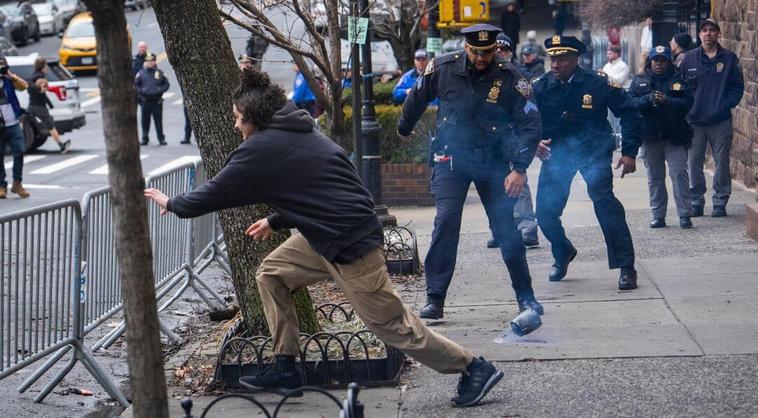
Authorities say the devices were thrown during a heated confrontation between demonstrators aligned with right-wing activist Jake Lang and a large group of counter-protesters.
Lang had organized a march protesting what he described as the “Islamification of NYC.” The protest occurred near the residence of the city’s mayor, Zohran Mamdani.
Fortunately, the explosive devices failed to detonate. Police quickly secured the scene and neutralized the potential threat before anyone was seriously injured.
Investigators also reported that the suspects shouted “Allahu Akbar” shortly before throwing the explosives—an apparent indication of their motivation, according to law enforcement accounts cited by multiple outlets.
Given the severity of the situation, major media organizations had little choice but to report on the incident. However, critics argue that the way the story was initially framed raised serious questions.
Early coverage by The New York Times carried a headline that read: “Homemade Bomb Thrown at Protest Near N.Y.C. Mayor’s House, Police Say.”
But observers quickly noticed that earlier versions of the reporting used more ambiguous descriptions, referring to the explosives in unusually indirect language.
For critics, the phrasing echoed the same media tendency that sparked outrage years ago during coverage of the death of Abu Bakr al-Baghdadi.
The article itself devoted significant attention to the protest organized by Jake Lang, describing the gathering and the political tensions surrounding it before detailing the moment when the explosive devices were thrown.
According to reports, Lang arrived with roughly 20 supporters carrying American flags and wearing patriotic clothing. As the afternoon progressed, counter-protesters gathered in larger numbers—eventually exceeding 100 people.
Tensions escalated quickly.
At one point, pepper spray was deployed, leading to several people in the crowd being affected. Physical confrontations followed, and protesters reportedly hurled eggs at one another as tempers flared.
Then the situation took a far more dangerous turn.
A counter-protester allegedly threw two smoking objects into the crowd. One of the devices landed in the street while burning, sending nearby demonstrators scrambling for cover.
City officials later condemned the violence, including Mayor Zohran Mamdani, who described the incident as deeply troubling.
For many critics of the media, however, the episode reignited a broader argument: whether some news organizations instinctively soften descriptions of politically inconvenient violence.
In an era when public trust in journalism is already under pressure, the way stories are framed—especially during volatile events—can become just as controversial as the events themselves.

