
>> Continued From the Previous Page <<
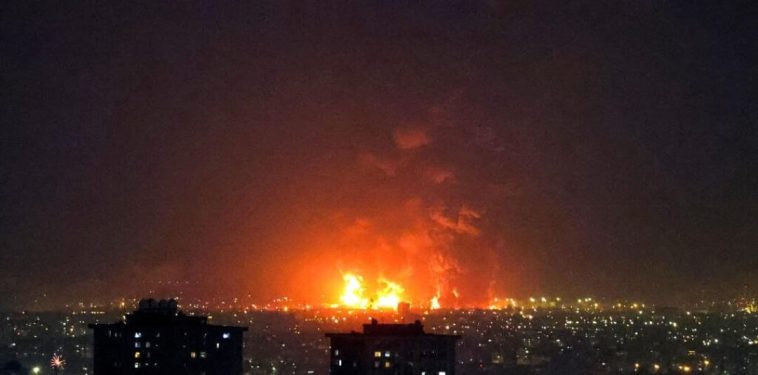
Another facility reportedly struck was the Aghdasieh oil warehouse in the northeastern section of Tehran. The Tehran refinery itself also sustained damage in the attack, according to a report from CNN.
The wave of strikes extended beyond the capital. At least one oil depot in the nearby city of Karaj, located in Alborz province, was also reportedly hit during the overnight operation.

Israeli officials said the targets were chosen specifically because they supported Iran’s military operations. According to officials, the facilities were involved in supplying fuel for armed forces activities and possibly tied to infrastructure linked to missile operations.
Iranian state media acknowledged that the strikes took place but referred to the attackers only as “enemy aircraft.” Officials confirmed that the attacks occurred overnight and caused widespread fires across several petroleum sites.
By Sunday morning, Tehran’s skyline was still choked with smoke.
Witness videos show thick black clouds blanketing the city while drivers navigated through streets filled with oily haze drifting from the burning facilities. Some of the footage shows smoke so heavy it nearly obscures the skyline.
In a troubling development, reports indicate that oil from the damaged facilities leaked into sections of the city’s sewer system. The fuel reportedly ignited underground, triggering additional fires that spread across several blocks in Tehran.
Emergency crews managed to bring some of the fires under control, but the aftermath continued to create serious environmental hazards.
Residents began reporting a phenomenon described as “black rain,” believed to be caused by oil particles mixing with precipitation and falling back onto the city.
The Iranian Red Crescent issued warnings urging people to avoid prolonged exposure to the polluted air and advised residents to wear protective masks outdoors due to the toxic smoke drifting across the capital.
Beyond the dramatic visuals, the strikes may also have immediate economic consequences for the Iranian regime.
Iran’s oil industry remains the backbone of the country’s finances despite years of international sanctions. Revenue generated from oil exports provides the government with billions of dollars annually and supports a large portion of state spending.
Under current restricted conditions, Iranian oil exports have generated roughly $30 to $35 billion in annual revenue in recent years. Analysts estimate that these funds cover a significant share of the regime’s security and military spending.
China has become the dominant buyer of Iranian crude, purchasing the vast majority of the country’s oil exports. Estimates suggest that Chinese buyers account for more than 90 percent of Iran’s overseas oil sales.
Smaller shipments are reportedly routed to countries such as Syria, while other barrels are quietly moved through intermediaries in places like the United Arab Emirates, Malaysia, and Indonesia. These routes are often used to disguise the oil’s origin and avoid international sanctions.
Saturday’s strikes did not appear to target Iran’s primary oil fields along the Persian Gulf, which are responsible for the majority of the country’s crude production. Instead, the operation focused on storage and refining facilities that play a key role in moving fuel throughout the country.
Still, the images now coming out of Tehran suggest the strikes delivered a dramatic and highly visible blow to infrastructure tied to the regime’s energy network.
And as video continues to emerge showing the capital wrapped in smoke, the message from the battlefield appears unmistakable: the conflict has now moved directly into the heart of Iran’s economic lifeline.

