
>> Continued From the Previous Page <<
In that terrifying instant, something—whether it was her ski, a gate fragment, or something else entirely—punched a seven-centimeter hole through her abdominal wall.
It missed her colon by a hair. One millimeter.

Surgeons had to operate twice, closing the wound and draining it.
Suddenly, the simplest actions became excruciating. Laughing, sneezing, even rising from a chair caused intense pain.
Rebuilding her strength wasn’t simple. Her physical therapist had to consult the training teams of professional baseball and hockey players—Los Angeles Angels and Edmonton Oilers—to figure out how to restore the muscles that power every turn down a ski slope.
Then came the mental battle.
PTSD, Fear, and the Long Road Back
Shiffrin didn’t just heal physically. She also wrestled with full-blown PTSD. Flashbacks, intrusive images, and a paralyzing fear gripped her whenever she returned to a giant slalom course.
“It was almost as though I was no longer in control of my body,” she wrote in a public letter detailing her recovery.
Her return to competition began in January 2025. She started with slalom, the event that felt safest, and by February, she claimed her historic 100th World Cup victory.
But the trauma lingered in giant slalom. She withdrew from the World Championships GS event in February, acknowledging that “coming to terms with how much fear I have doing an event that I loved so dearly only two months ago has been soul-crushing.”
Step by step, race by race, and therapy session by therapy session, she rebuilt herself.
The Olympic Stage Beckons
Arriving in Cortina, Italy, for the 2026 Olympics, Shiffrin’s first two events were a struggle. Eleventh in giant slalom. Fifteenth in the slalom leg of the team combined. She was on the verge of leaving Italy without a single medal—eight years after her last Olympic podium.
Wednesday’s slalom on the Tofane course was her last chance.
She dominated the first run, posting a 0.82-second lead. Four hours later, she returned to the start gate, focused and calm. The skier ahead of her—Germany’s Lena Duerr, sitting in second place—struggled and stopped.
Shiffrin launched herself down the mountain.
Crossing the finish line at a combined time of 1:39.10, she was 1.5 seconds ahead of silver medalist Camille Rast of Switzerland. That margin was the largest in any Olympic alpine skiing event since 1998.
She raised her fists, embraced her mother, and cried.
“Honestly, the skiing is what I cared about,” she told NBC. “Of course, a medal and gold – that’s a dream come true.”
A Legacy Etched in Gold
Shiffrin first won Olympic slalom gold at 18 in Sochi, becoming the youngest champion in history. Twelve years later, she became the oldest American woman to win alpine skiing gold.
She now joins Switzerland’s Vreni Schneider as the only skier to win Olympic slalom gold twice. Her 108 World Cup wins, including 71 in slalom, make her the most decorated alpine skier alive.
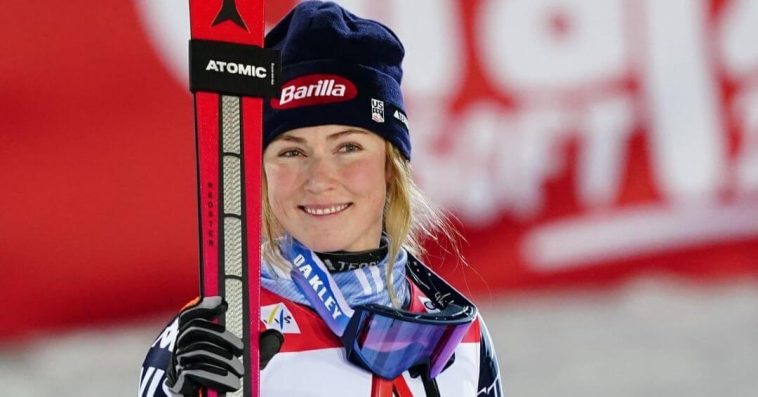
But this victory isn’t just numbers. It’s a story of survival, grit, and unmatched determination. A woman who faced near-death, battled PTSD, rebuilt herself from scratch, and emerged to crush the world’s best by a margin unseen for nearly three decades.
That’s not a statistic. That’s character. And in America, we celebrate that.

