

>> Continued From the Previous Page <<
The U.K. is also reportedly in the midst of negotiations for a new trade deal with Australia, signaling Starmer’s commitment to diversifying the nation’s trade partners in a post-Brexit world.
While Prime Minister Starmer has expressed concerns over the approach taken by U.S. President Donald Trump, particularly regarding tariffs, he has acknowledged the popularity of Trump’s economic nationalism. Starmer believes tariffs are the “wrong” solution but also recognizes the deep-rooted frustrations of voters who feel neglected by the forces of free trade and mass immigration.

As reported by The Times, Starmer’s spokesperson shared insight into his views on Trump’s policies, stating, “Trump has done something that we don’t agree with but there’s a reason why people are behind him on this. The world has changed, globalisation is over and we are now in a new era.” The spokesperson went on to highlight that Starmer’s government is focused on providing “the answers for people in every part of this country” by adopting a more active and reform-oriented approach.
During the weekend, Starmer is expected to be at Chequers, his official country residence in Buckinghamshire, where he will engage in discussions with world leaders about the impact of tariffs on global trade. On Saturday, Starmer held a productive phone call with French President Emmanuel Macron, with both leaders agreeing that a full-blown trade war would be detrimental, but that all options should remain on the table.
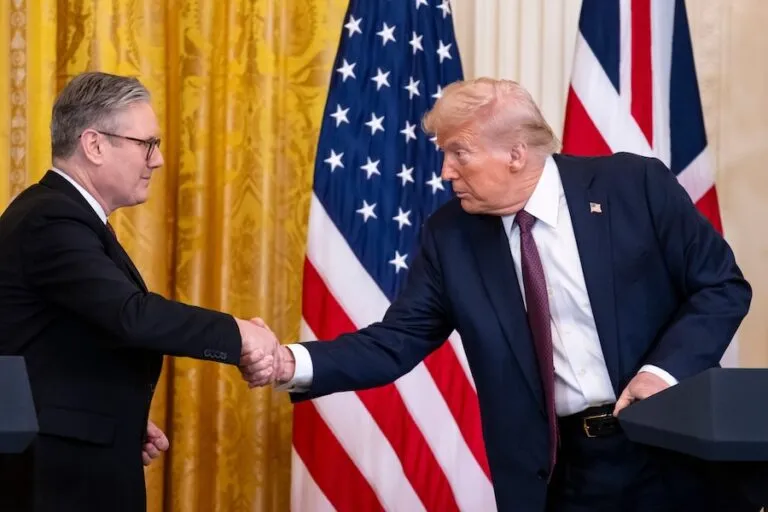
Though a meeting between Starmer and Trump is not yet on the calendar, the two countries continue to work toward securing a new trade agreement. Following Britain’s departure from the European Union in 2020, negotiations for a U.K.-U.S. trade deal have been a key priority for the government. Under the previous Conservative government, talks stalled, but Starmer’s administration has shown renewed optimism. Starmer met with Trump at the White House earlier this year and left the meeting feeling “confident” that a deal could be reached. Trump himself has since echoed this optimism, stating that a “great” deal could be struck, potentially helping Britain avoid tariffs.
In the meantime, Business Secretary Jonathan Reynolds traveled to Washington recently to continue discussions, while Starmer and Trump held another phone call last week to further explore the prospects of a trade deal. Though the U.K. is hopeful, sources have indicated that the deal may not take the form of the “free trade” agreement originally envisioned.
Just Released: Trump White House Collector’s Bobblehead!
Jonathan Portes, a professor of economics at King’s College London, told the Associated Press that the U.K.’s post-Brexit flexibility could be both a blessing and a curse. “Some type of arrangement that might let the UK escape some tariffs is possible but it would not be a full-scale trade deal,” Portes noted. “Brexit is a double-edged sword — it gives us more flexibility and we can negotiate with a view to our own interests.”
To sweeten the deal, the U.K. has reportedly offered to reduce tariffs on American beef and fish imports, a move aimed at strengthening trade relations with the U.S. Additionally, Starmer’s government has signaled that it may lower taxes on major American tech companies—a move that aligns with President Trump’s longstanding goal of reducing corporate tax burdens.
As global trade dynamics continue to evolve, Starmer’s administration is positioning itself to lead Britain through the shifting economic landscape, all while attempting to balance the needs of voters who are feeling the sting of globalization’s failure.

