
Earlier Asylum Application Raises Questions About CBS Report
An asylum application obtained by Fox News reportedly shows that Diawara previously claimed he feared persecution in Mali because of his sexuality.
That detail was not included in the 60 Minutes segment, which instead focused on his conversion to Christianity and his stated concerns about religious persecution in the predominantly Muslim West African nation.
The distinction has drawn attention from DHS officials, who have questioned the credibility of Diawara’s claims. However, the existence of different explanations for his fears does not, by itself, establish that he committed immigration fraud.

The controversy now centers on what CBS knew before the broadcast, what information it chose to present, and whether the omitted material would have provided viewers with important context.
DHS Official Challenges the Network’s Coverage
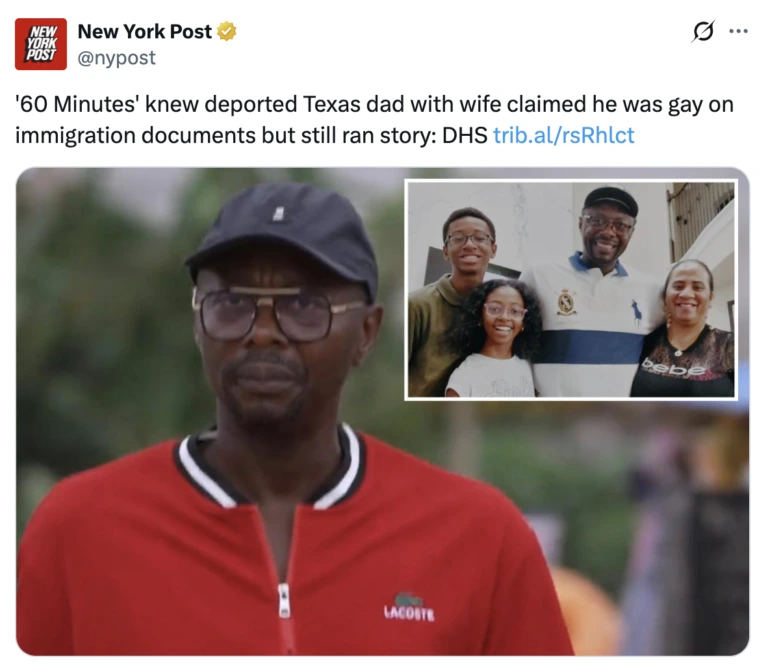
Following the broadcast, DHS General Counsel James Percival publicly challenged the reporting in a post on X.
Percival said he had examined Diawara’s immigration file and pointed to the earlier asylum application as a significant part of the case.
“his claimed reason for fearing Mali was that he is ‘gay,’ just in case you’re wondering how bad the immigration fraud problem is.”
His remarks brought renewed attention to the discrepancy between the account presented in the television segment and the explanation contained in the earlier application.
The application included statements in which Diawara described his experiences and feelings regarding his sexuality.
“Although I was born as a boy, but things appeared differently for me as I was already having female behaviors and feelings,” Diawara wrote. “I was more comfortable being intimate with boys rather than with girls.”
He also wrote:
“since I came to the USA I had the possibilities to express my feelings to men without any embarrassment [and] no reserve.”
These statements are part of the application cited in the reporting. While DHS officials have raised concerns about the credibility of Diawara’s claims, the available information does not establish that the earlier statements were false or that a formal finding of immigration fraud was made.
A Long Immigration Case With Complicated Legal History
Diawara first entered the United States in 2001 using a tourist visa. He remained in the country after the visa expired, according to the account of his immigration history.
An immigration judge ruled in 2012 that he could be deported. However, the ruling prohibited his removal specifically to Mali because of concerns that he could face persecution there.
That decision allowed Diawara to remain in the United States with a work permit, although it did not prevent immigration authorities from deporting him to another country.
The distinction is important: protection against removal to one particular country does not necessarily provide permanent protection from deportation altogether.
In its Sunday broadcast, 60 Minutes portrayed Diawara as a Texas father whose separation from his family followed his removal to Ghana in July. The program also acknowledged that DHS had questioned the credibility of his stated fears of persecution.
However, the segment did not disclose the earlier claims about his sexuality, according to the reports that prompted the controversy.
CBS Insider Defends the Segment
A source described as a 60 Minutes insider subsequently defended the program’s coverage in comments to Fox News.
The insider pointed to the segment’s discussion of Diawara’s religious concerns and the government’s questions about the credibility of his claims, arguing that those issues were addressed in the broadcast.
Meanwhile, a representative for 60 Minutes did not immediately respond to a request for comment from the New York Post on Tuesday.
The dispute raises a broader question about how news organizations handle cases involving conflicting accounts, sensitive personal information, and complex immigration proceedings.
Journalists must make editorial decisions about which details are relevant to a story. At the same time, when a report focuses on a person’s reasons for seeking asylum, other explanations previously offered to immigration authorities may be relevant to understanding the full record.
Whether CBS adequately handled that responsibility remains at the center of the criticism.
Diawara Says He Was Sent Back to Mali
The case took another turn after Diawara’s arrival in Ghana.
According to the 60 Minutes account, Diawara alleged that Ghanaian authorities placed him on a flight to Mali within days of his arrival, despite the earlier U.S. immigration ruling that barred his removal to that country.
He reportedly fled Mali afterward and is now living in an undisclosed African country.
His allegations concerning the events in Ghana and Mali have not been independently established in the information cited here.
The case therefore involves several distinct questions: the accuracy of Diawara’s asylum claims, the circumstances surrounding his deportation, the treatment he says he received after arriving in Ghana, and CBS’s decision not to include his earlier statements about his sexuality.
For DHS officials, the earlier application is relevant to their concerns about the credibility of his immigration history. For CBS, the controversy has put the network’s editorial judgment under scrutiny.
Ultimately, the available reporting establishes that the earlier asylum statements were cited by DHS officials and that the 60 Minutes segment did not disclose them. It does not, on its own, establish that Diawara committed fraud or resolve the competing accounts of his treatment after deportation.
As questions continue over the broadcast, the key issue is whether viewers received enough information to understand the full complexity of the case—and whether CBS adequately explained the competing claims surrounding Diawara’s immigration history.

