
>> Continued From the Previous Page <<
“We do not aspire to be the 51st state … If it was a joke, it was never funny, and it ends now.”
May further referenced Trump’s social media post, saying:
“No matter how many Trump photos of him in business suits striding Swiss mountains he posts with a Canadian flag, we’re not intimidated.”
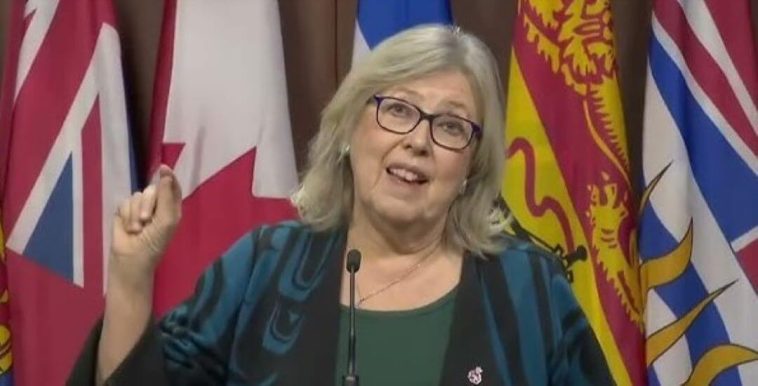
However, May’s rejection of Trump’s idea quickly morphed into an outlandish counterproposal. Instead of addressing Canada’s internal challenges or the strained U.S.-Canada relations, she extended an invitation for California, Oregon, and Washington to join Canada as provinces.

Selling Canadian Policies
In her remarks, May touted Canada’s social programs and gun control measures, offering them as incentives for the West Coast states to consider annexation.
“Hey, Donald, have we got a deal for you. You think we want to be the 51st state? Nah, but maybe California would like to be the 11th province. How about it? California, Oregon, Washington—you’ve got geography in common with us. And not only that, we’ve already got a carbon trading system between California and Quebec. We’ve got some strong alliances on our West Coast from British Columbia. There’s been a lot of academic papers on the idea of Cascadia.”
May painted a rosy picture of life under Canadian governance, highlighting universal healthcare and strict gun control as key benefits.
“This is what you get: free health care. Universal free health care. No more one-year-olds who suddenly fall off the Medicaid list, and their parents are in the news because they’re trying to do a GoFundMe so they can get their daughter to a doctor. Universal free health care.
“And guess what? Those laws your Congress is too afraid to pass because of the National Gun Lobby—we’ve already got our strict gun laws.”
WATCH:
Political Theatre or Serious Debate?
While some observers saw May’s remarks as lighthearted banter, others criticized her for wasting political capital on what they deemed a far-fetched idea. Critics argue that the Green Party leader should focus on addressing Canada’s own pressing issues, including housing shortages, inflation, and health care challenges, rather than making bold suggestions about annexing U.S. states.
The comments also brought the longstanding cultural and political differences between the two countries into sharper focus. Some commentators noted that May’s vision of Canada’s superiority may not resonate with many Americans, even in the progressive states she mentioned.
Cascadia Dream or Political Nightmare?
The idea of Cascadia—a hypothetical region encompassing parts of the U.S. and Canada—has been floated in academic circles for years but has never gained serious political traction. May’s remarks, while imaginative, are unlikely to lead to any tangible political shifts. Instead, they appear to be an attempt to shift the spotlight back to Canada in the wake of Trump’s provocative suggestion.
In the end, May’s comments may serve more as political theatre than serious policy discussion. For Canadians and Americans alike, the exchange highlights the growing tension and theatrics that dominate today’s political landscape. Whether this sparks further debate or fades into obscurity, one thing is certain: Elizabeth May’s proposal will not be forgotten anytime soon.

