
>> Continued From the Previous Page <<
That earlier operation, like Saturday’s, was not a symbolic gesture. It involved coordination between the Coast Guard, the FBI, and U.S. military assets, all operating under a federal seizure warrant. Venezuelan officials immediately lashed out, branding the actions “piracy.” U.S. authorities, however, dismissed that rhetoric, labeling the seized vessels as components of a sanctions-dodging shadow fleet designed to secretly move oil and bankroll criminal enterprises.
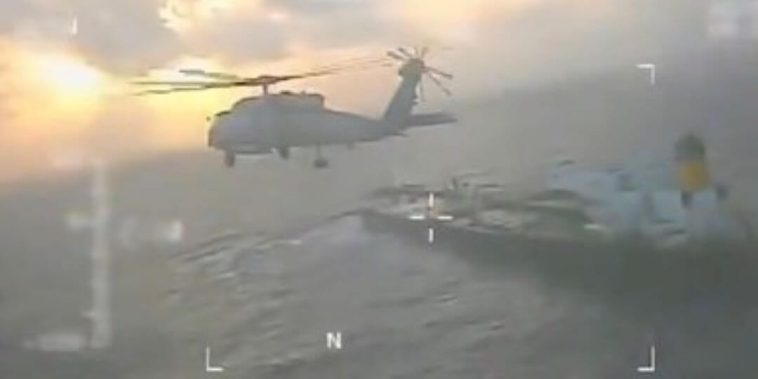
Noem left no room for ambiguity about Washington’s intent. Posting alongside video footage of Coast Guard units rappelling from helicopters onto the tanker, she delivered a blunt warning:

“The United States will continue to pursue the illicit movement of sanctioned oil that is used to fund narco terrorism in the region. We will find you, and we will stop you,”
The seizure also directly aligns with a sweeping directive issued by Donald Trump on December 16. The president ordered what he described as a “total and complete blockade” of all sanctioned oil tankers entering or leaving Venezuela, signaling a return to hardline enforcement that defined his previous administration.
Trump’s own words on Truth Social were characteristically forceful:
“Venezuela is completely surrounded by the largest Armada ever assembled in the History of South America. It will only get bigger, and the shock to them will be like nothing they have ever seen before — Until such time as they return to the United States of America all of the Oil, Land, and other Assets that they previously stole from us,”
The objective is clear: choke off Venezuela’s primary revenue stream. Oil sales remain the regime’s financial lifeline, and since Trump’s directive, exports have reportedly fallen sharply, with multiple tankers now stranded in Venezuelan waters, unwilling or unable to risk interception.
Backing up the enforcement is a formidable U.S. military footprint across the Caribbean. U.S. Southern Command has acknowledged the deployment of approximately 15,000 personnel, supported by advanced naval and air assets. Among them is the USS Gerald R. Ford carrier strike group, along with several warships positioned to enforce maritime security and counter illicit trafficking.
Those forces have already been active. U.S. operations in the region have reportedly included more than 25 kinetic strikes against drug-smuggling vessels, resulting in over 100 deaths—a stark reminder that this is not a paper blockade, but a live enforcement zone.
Trump has also issued direct demands to Venezuelan strongman Nicolás Maduro, calling for his immediate departure. The president has even floated the possibility of safe passage for Maduro and his family—if he agrees to step down now. At the same time, Trump has openly warned that the window for a peaceful resolution is closing.
As he put it bluntly:
“If we have to, we’ll attack on land. We’re taking those sons of a bitches out. The bottom line is we’re going to do what we have to do to stop the drugs from coming into our country,”
With a second tanker now in U.S. custody, the message is unmistakable. The era of sanctions being quietly ignored in the Caribbean appears to be over—and the Trump administration is making it clear that Venezuela’s oil-fueled defiance will no longer be tolerated.

