
The president’s intervention comes as Sullivan faces an unexpectedly tight contest against Peltola, a former Democratic congresswoman who has emerged as a serious threat to the incumbent’s political future.
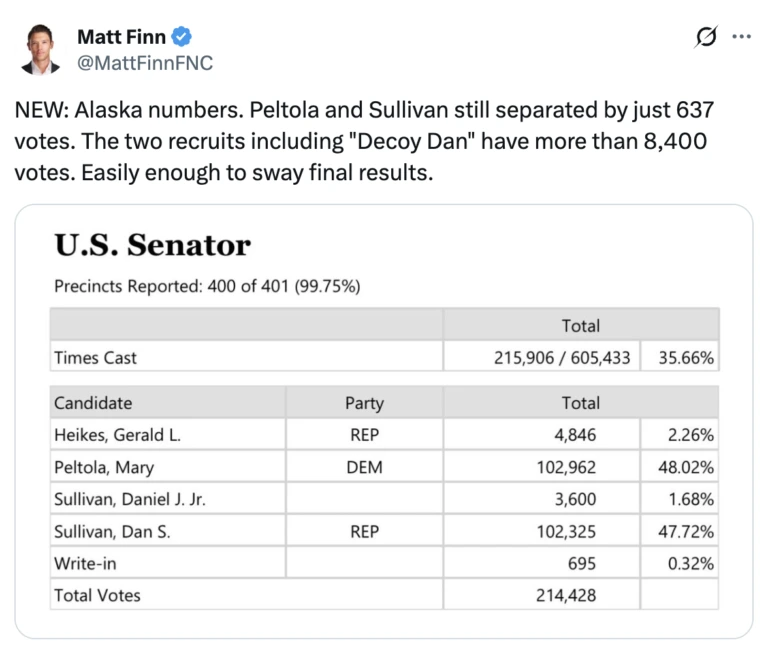
According to the preliminary figures available Thursday morning, approximately 75% of the estimated vote had been counted. Peltola was leading with 102,962 votes, representing 48.2% of the total, while Sullivan had accumulated 102,325 votes, or 47.9%.
That amounted to a difference of just 637 votes.

However, the numbers involving two additional candidates have become a major point of contention for Republicans.
Independent candidate Daniel J. Sullivan Jr. received 3,600 votes, equivalent to 1.7% of the reported total. Meanwhile, Republican candidate Gerald Heikes collected another 4,846 votes, or 2.3%.

Combined, those two candidates received 8,446 votes — more than 13 times the difference separating Peltola and Sullivan.
The similarities between the candidates’ names have prompted questions from Republicans about whether the additional candidacies could have confused voters and diverted support away from the sitting Republican senator.
Republicans have particularly focused on Daniel J. Sullivan Jr., arguing that his presence on the ballot could have created confusion among voters intending to support the incumbent.
Peltola, for her part, has denied allegations that her campaign recruited the independent candidate as part of an effort to weaken Sullivan’s reelection prospects.
But the controversy has placed Alaska’s unusual election rules under an even brighter spotlight.
Unlike most states, Alaska uses ranked-choice voting for its general elections. Under this arrangement, voters have the opportunity to rank candidates according to their preferences rather than selecting only one individual.
The system becomes particularly important when no candidate receives more than 50% of the first-choice votes.
If that happens, the candidate finishing last is eliminated. Ballots cast for that individual are then examined to determine whether voters selected another candidate as their second preference. Those votes can subsequently transfer to the remaining candidates.
The elimination process continues until one contender secures a majority of the active ballots.
Consequently, Sullivan’s current position in the preliminary count does not necessarily determine his ultimate fate. Depending on how supporters of eliminated candidates ranked their choices, the Republican incumbent could receive additional votes during the subsequent rounds of tabulation.
That makes the thousands of ballots currently associated with the other candidates particularly significant.
The official ranked-choice tabulation is scheduled for November 18, meaning the final outcome will not be immediately known.
Alaska’s election rules also allow certain absentee ballots to arrive after Election Day. Qualifying ballots mailed from within the United States can be accepted for up to 10 days afterward, while overseas ballots have a 15-day window. However, both categories must carry an Election Day postmark to qualify.
Until the remaining ballots are processed and the ranked-choice calculations are completed, declaring either candidate the winner would be premature.
A Senate Battle With National Implications
Although the Alaska contest involves only one Senate seat, its outcome carries implications for the broader political balance in Washington.
Democrats have already secured 54 Senate seats and could potentially increase that figure to 56 if Peltola defeats Sullivan and Democrat Scott Colom manages to defeat Republican Senator Cindy Hyde-Smith in Mississippi.
Both contests remain officially uncalled in the figures provided.
A 56-seat Democratic majority would represent a significant advantage for the party, giving its leadership additional room to maneuver when advancing nominations and legislation.
Nevertheless, even that result would leave Democrats below the 60-vote threshold generally required to overcome a filibuster on most major pieces of legislation.
That means Democratic leaders would still need cooperation from at least some Republicans to move many controversial measures through the Senate.
For Republicans, however, losing Alaska would represent another setback in an already consequential political battle over control of Washington.
Trump’s intervention underscores how seriously the president views the Alaska contest and the potential consequences of its outcome.
With the preliminary margin sitting at just 637 votes, thousands of ballots still in play, and ranked-choice tabulation yet to take place, the race is far from settled.
The November 18 count will provide the next major indication of whether Sullivan can overcome Peltola’s narrow lead or whether Democrats will add another Republican-held Senate seat to their column.
For now, both campaigns remain in a waiting game, while Trump’s demand has added another layer of controversy to an election already drawing national attention.

