
>> Continued From the Previous Page <<
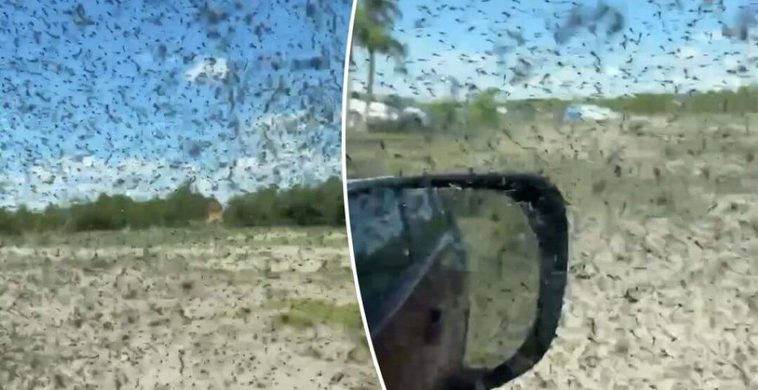
Just a few years later, Buenos Aires again faced overwhelming mosquito outbreaks. Entire neighborhoods reported surfaces covered in insects, with walls, windows, and streets overtaken by the species Aedes albifasciatus, commonly referred to as the “flood mosquito.” The insect thrives after heavy rainfall, when standing water becomes widespread breeding ground. Females can lay hundreds of eggs in small pools, allowing populations to explode within days under the right conditions.
Now, similar warnings are being raised in the United States as experts track what is shaping up to be an unusually aggressive insect season.

According to the National Pest Management Association’s Spring and Summer 2026 Bug Barometer, a combination of erratic winter weather patterns, heavy precipitation, and extended cold snaps created conditions that allowed insect populations to survive in higher-than-normal numbers. Instead of dying off, many pests effectively overwintered, emerging earlier and in larger quantities than expected.
Entomologists say this creates a compounding effect: more insects surviving the winter means a stronger initial wave in spring, which then multiplies as summer storms create additional breeding sites.
The Southeast is expected to experience some of the most significant mosquito surges, including states like Florida, Georgia, Alabama, and the Carolinas. Tropical storm activity later in the season could further accelerate outbreaks by leaving behind widespread standing water.
In response to growing concerns, major cities have already begun intervention efforts. New York City recently deployed helicopter-based larvicide operations across multiple boroughs, including the Bronx, Queens, Brooklyn, and Staten Island. The aerial treatments targeted marshes and wetlands identified as high-risk breeding zones, with operations carried out over a multi-day period in early June.
New York City Health Commissioner Dr. Alister Martin emphasized early prevention, stating: “Preventing mosquito-borne disease starts long before mosquitoes become a nuisance.”
Public health officials warn that this urgency is not exaggerated.
Mosquitoes remain the deadliest animals on Earth due to the diseases they transmit, according to the CDC. This year, West Nile virus has already been detected earlier than usual in several U.S. regions. In San Antonio, officials confirmed infected mosquito traps in early May, while the Dallas area reported positive samples by early June. New Orleans has also initiated aerial spraying after surveillance teams identified viral activity in local mosquito populations.
At the same time, other mosquito-borne and insect-related threats are expanding geographically. Dengue fever, once largely confined to tropical climates, is appearing in areas that historically never recorded local transmission. Zika virus, which caused global concern in past outbreaks, continues to circulate at low levels.
Even more alarming to some health officials is the reappearance of New World screwworm in the United States, a parasitic fly larva that had previously been eradicated domestically. A confirmed animal case was reported in Texas earlier this month, raising concerns about potential agricultural and veterinary impacts.
Taken together, these developments suggest a broader pattern rather than isolated incidents. The mosquito swarm captured on video is not being viewed by experts as an anomaly, but as an early snapshot of what could become a more widespread seasonal challenge.
As weather patterns continue to shift and insect populations respond in kind, what was once considered a simple summer annoyance is increasingly being treated as a serious public health concern.
And for drivers caught in that viral swarm, the message is already clear: this is no longer just mosquito season as usual.

