
“Before you know it, you get people that get carried away in their job and whatever it may be, and all of a sudden, then you’re dragging people away that have lived on your street corner for 15 years, and I don’t know that we need to be doing that stuff,” Justice told Politico.
The senator’s remarks raise questions about how he would approach immigration policy if he returned to the governor’s office. They also highlight a debate within Republican circles over how aggressively federal authorities should pursue deportations.
Justice Raises Concerns About Immigration Enforcement
President Trump has made border security and immigration enforcement central priorities of his administration. His deportation efforts have also drawn scrutiny from some business interests that rely on immigrant labor.

Justice’s comments place him on a different footing from the administration’s enforcement approach, particularly when it comes to people who have spent years living and working in the United States.
The senator did not suggest in the quoted remarks that immigration laws should be abandoned. Instead, he focused on the conduct of enforcement personnel and the removal of individuals with long-standing connections to their communities.
His reference to people who have lived in the same neighborhood for 15 years underscores the distinction he appears to be drawing between enforcing immigration law and pursuing individuals whose presence in a community has become familiar to their neighbors.
That distinction could become a point of discussion as Republicans debate the scope and implementation of the president’s immigration policies.
For Justice, the issue also carries potential political consequences. His position may invite questions from voters who support Trump’s deportation agenda, while his concerns could resonate with those who favor a more measured approach to enforcement.
Agricultural Industry Adds Pressure on Republicans
Justice’s comments also come amid pressure from agricultural employers who want Republicans to reconsider aspects of the deportation crackdown.
Some agricultural businesses argue that removing workers who are in the country illegally is making it more difficult to fill jobs and is increasing labor expenses.
Those concerns have created a difficult balancing act for Republican officials. While the party has emphasized immigration enforcement, employers in labor-intensive industries have warned that a shrinking workforce can create operational challenges.
The debate involves competing considerations: enforcing immigration laws, addressing the needs of employers, and determining how authorities should handle individuals who have lived in the country for extended periods.
Justice’s remarks touch on that broader discussion, although his quoted comments specifically focus on enforcement agents and people with longstanding community ties.
The senator’s position could therefore become relevant beyond West Virginia, where agricultural labor concerns and immigration policy remain subjects of debate among Republicans.
Senator Responds to Critics on Social Media
Justice did not leave his comments unanswered after they attracted criticism.
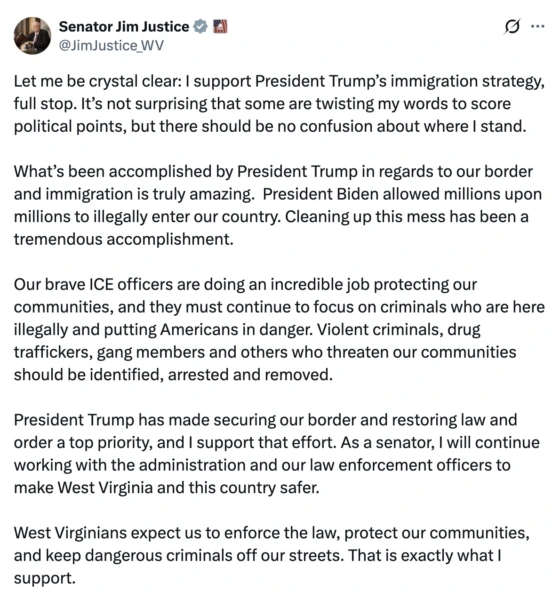
Later Wednesday, the West Virginia Republican published a lengthy message on X responding to those who had challenged his position.
The social media post offered Justice an opportunity to address the reaction directly as questions continued about his views on the administration’s deportation efforts.
His response could also help clarify how he intends to explain his position to Republican voters, particularly if he ultimately enters a gubernatorial primary against Morrisey.
The remarks and subsequent response place immigration policy among the issues likely to draw attention as Justice considers his political future.
A Potential Return to the Governor’s Mansion
A challenge against Morrisey would bring Justice back to a familiar political arena, but his path to the governor’s office would look different from the one he took in 2016.
Justice first won the governorship as a Democrat. While serving in office, he switched his party affiliation to Republican and later won reelection under the GOP banner.
He subsequently pursued a seat in the U.S. Senate, winning election in 2024.
Now, the possibility of another gubernatorial campaign could put his record, policy positions and relationship with the Republican Party’s national leadership under renewed scrutiny.
Morrisey, meanwhile, would be defending his position against a potential challenger who has already held the state’s highest office.
Justice has not yet committed to a 2028 primary campaign, leaving open the question of whether he will formally seek to return to the governor’s mansion.
His comments on deportations nevertheless provide an early indication of an issue that could feature in the political discussion surrounding a potential bid.
For now, the senator is balancing his responsibilities in Washington with speculation about his next political move. His criticism of certain immigration enforcement practices has added another dimension to that discussion, placing him at odds with aspects of Trump’s approach while he weighs a possible return to state leadership.

