
The findings were highlighted Wednesday by Lone Star Liberty PAC, a political group backing Paxton’s Senate campaign. The group also drew attention to an earlier investigation examining another emotional story Talarico has repeatedly shared about his teaching experience.
State Records Raise Questions About Talarico’s 45-Student Claim
Talarico has presented the overcrowded classroom anecdote as an example of what he considers a broader failure of the American education system.
During a CNN town hall earlier this month, he described the situation in stark terms.

“At one point, I had 45 students in one classroom,” Talarico said during a CNN town hall earlier this month. “There weren’t enough desks for all those kids, so I had students sitting on the air-conditioning unit in the wealthiest country in human history — in the 21st century, children sitting on the air-conditioning unit.”
The account paints a picture of severe classroom overcrowding, with students allegedly left without basic seating. But the records cited by The New York Times tell a different story about the class sizes officially assigned to the candidate.
According to the newspaper, Talarico’s classes generally contained between 22 and 27 students, while the largest recorded class had 30.
The Times also spoke with former students and colleagues. Although some remembered crowded classrooms, the newspaper reported that they did not recall students being required to sit on air-conditioning units.
The discrepancy raises questions about how the anecdote developed and whether Talarico’s repeated description accurately reflects the classroom conditions documented in state records.
Campaign Responds Without Challenging the Records
Despite the findings, Talarico has continued to feature the 45-student story on his campaign website. The account remains part of his explanation for why he entered politics and became critical of Republican education policies.
His campaign did not dispute the accuracy of the state records cited in the Times report. Instead, spokesman JT Ennis offered an explanation that focused on what allegedly happened before the class sizes were reduced.
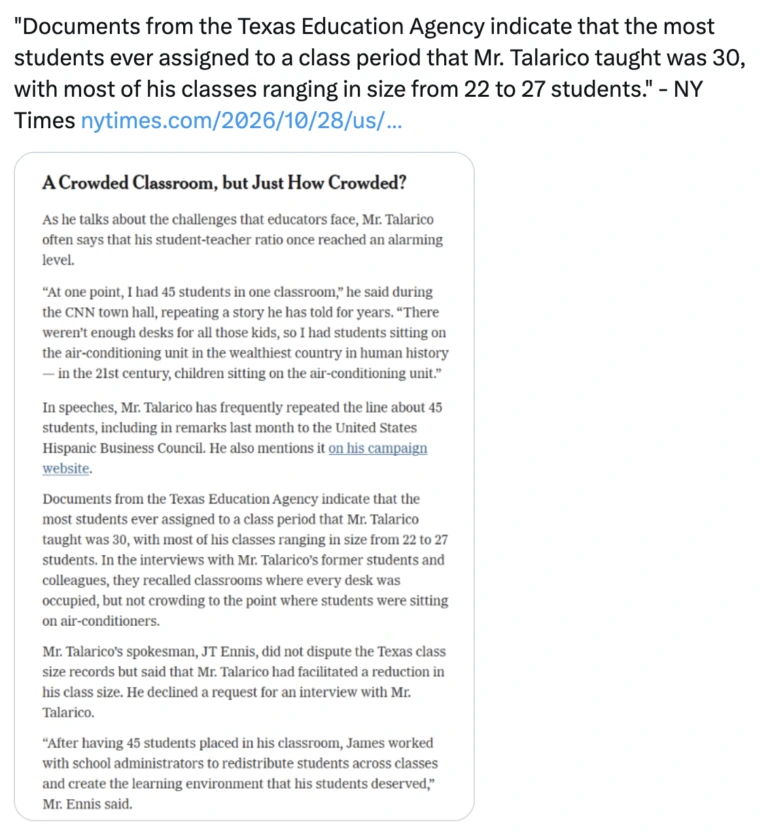
“After having 45 students placed in his classroom, James worked with school administrators to redistribute students across classes and create the learning environment that his students deserved,” Ennis said.
That response introduces an important distinction: the campaign maintains that Talarico initially had 45 students before administrators redistributed them, while the education records cited by the newspaper reportedly show no class period exceeding 30.
The available account does not establish precisely when the alleged initial placement occurred or provide independent documentation confirming the campaign’s explanation.
Ennis also declined the newspaper’s request for an interview with Talarico.
The controversy is likely to draw additional attention because the classroom anecdote has served as more than a passing campaign remark. It has become part of the candidate’s broader political message about public education, government spending and the condition of Texas schools.

A Second Teaching Story Also Faces Scrutiny
The classroom-size dispute is not the only episode from Talarico’s brief teaching career to attract questions.
Lone Star Liberty PAC also highlighted a January investigation by The Texas Tribune that examined his account of a troubled student identified as Justin.
Talarico has repeatedly invoked the story to explain his decision to enter public service. According to his version of events, Justin was an 11-year-old boy who had previously threatened a teacher with a knife.
The candidate has described developing a relationship with the student before disciplinary problems and personal difficulties eventually led to the boy’s removal from the school.
Talarico has connected the episode to what he sees as the consequences of education funding reductions and the loss of support services for vulnerable students.
During a campaign appearance in Houston, he used the experience to deliver an emotional message about the responsibilities of public officials.
“We failed Justin,” Talarico said during a campaign appearance in Houston. “In that moment, I promised myself that if I ever got a little bit of power, I would do everything I possibly could to stop something like that from happening ever again.”
The story has helped frame Talarico’s political identity around the idea that his experiences as a teacher convinced him to seek elected office.
But The Texas Tribune found that school officials who worked at the campus during his tenure could not independently confirm several specific details of the account.
Those officials remembered Justin as a troubled student who had formed a relationship with Talarico. They also confirmed that layoffs occurred during the relevant period.
However, they could not independently verify the complete sequence of events described by the candidate.
Their recollections therefore provide partial support for elements of the story without establishing every detail Talarico has presented publicly.
Teaching Career Now Under the Political Spotlight
Talarico taught for just two years at Rhodes Middle School in San Antonio before turning his attention to politics.
His experiences in education have since become a cornerstone of his public profile, helping him explain his criticism of Republican lawmakers and his arguments for changes to the state’s education system.
Now, two accounts from that period are attracting renewed attention as the Senate campaign intensifies.
The distinction between a candidate’s personal recollections and independently documented facts is particularly important when those stories become central to a political message. Campaign anecdotes can illustrate genuine problems, but specific claims about classroom conditions and individual students also invite scrutiny when records or witnesses offer a different account.
For Talarico, the immediate challenge is explaining the apparent gap between his description of the 45-student classroom and the enrollment figures reported by The New York Times, while addressing questions raised by the earlier investigation into the story about Justin.
Neither report, based on the information presented, establishes that every aspect of Talarico’s accounts was false. The classroom-size findings concern the official records cited by the Times, while the Justin investigation found that some details could not be independently corroborated.
Nevertheless, the controversies give Paxton’s supporters an opportunity to challenge a defining part of the Democrat’s political biography.
With the November 3 Senate election approaching, Talarico’s record as a teacher—and the stories he tells about that experience—could become an increasingly prominent issue in the contest.
For voters, the central question is whether the candidate can reconcile his public accounts with the available documentation and explain the discrepancies clearly.
As the campaign continues, the competing accounts of Talarico’s classroom experiences may prove to be more than personal anecdotes. They could become a test of credibility for a candidate whose political ambitions are closely tied to the story of how he says his teaching career changed his life.

