
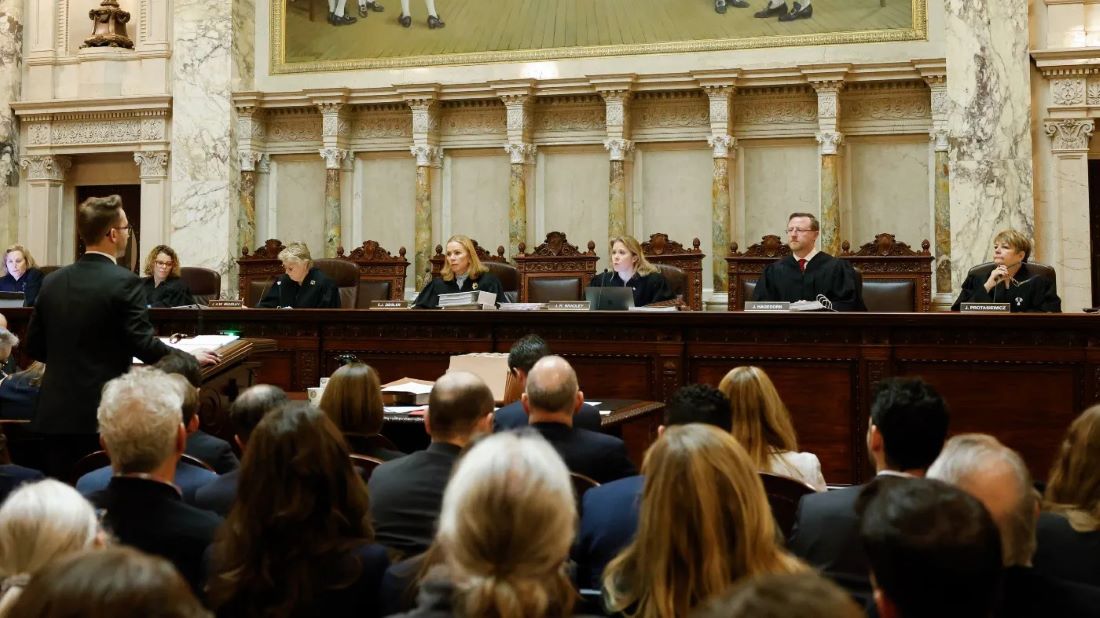
In a landmark decision, the U.S. Supreme Court has sided with Republicans in a contentious redistricting case from South Carolina, sparking widespread debate over the motives behind legislative map drawing. The case, which Democrats and civil rights groups claimed was racially motivated, saw the state legislature’s redistricting map challenged as unconstitutional due to alleged racial discrimination.
The challenge, backed by the NAACP, argued that the redistricting diluted minority voting strength, a claim initially upheld by a lower court. However, the Supreme Court, in a decisive 6-3 vote, overturned this ruling, asserting that the map was not crafted with discriminatory intent.
Don’t miss this! Carry faith with you everywhere with the Exclusive National Prayer Coin!

Justice Samuel Alito, writing for the majority, emphasized that accusations of racial motivations must be clearly distinguished from partisan strategy. Alito criticized the lower court’s approach, stating, “The three-judge District Court paid only lip service to the requirement that race and politics be disentangled to prove that the legislature was motivated by race as opposed to partisanship.”
Alito further noted that the lower court’s findings were flawed under the appropriate legal standards. “No direct evidence supports the District Court’s finding that race predominated in the design of District 1,” he wrote. The evidence, he argued, did not convincingly demonstrate that racial considerations overrode partisan goals in the redistricting process.
This Supreme Court ruling centers on South Carolina’s District 1, represented by GOP Rep. Nancy Mace. The district had been trending Republican since 2018, and state Republicans sought to solidify this shift in their favor through the new map, asserting that their motives were purely political and unrelated to racial demographics.

