
When Republican primary voters were presented with a list of potential presidential candidates, Rubio captured an impressive 44 percent support. Vance, meanwhile, attracted just 24 percent.
That represents a staggering 20-point advantage for Rubio over the sitting vice president.
Florida Gov. Ron DeSantis placed a distant third with 9 percent, followed by Donald Trump Jr. at 6 percent. The numbers suggest that Rubio is generating considerable interest among Republican voters, potentially positioning himself as a serious contender for the party’s future leadership.

And the secretary of state’s advantage did not disappear when pollsters changed the question.
In an open-ended question allowing Republican respondents to identify their preferred presidential candidate without being shown a predetermined list, Rubio again finished comfortably ahead.
He received 36 percent support, compared with 20 percent for Vance. DeSantis, President Trump and Republican Rep. Thomas Massie each registered 7 percent.
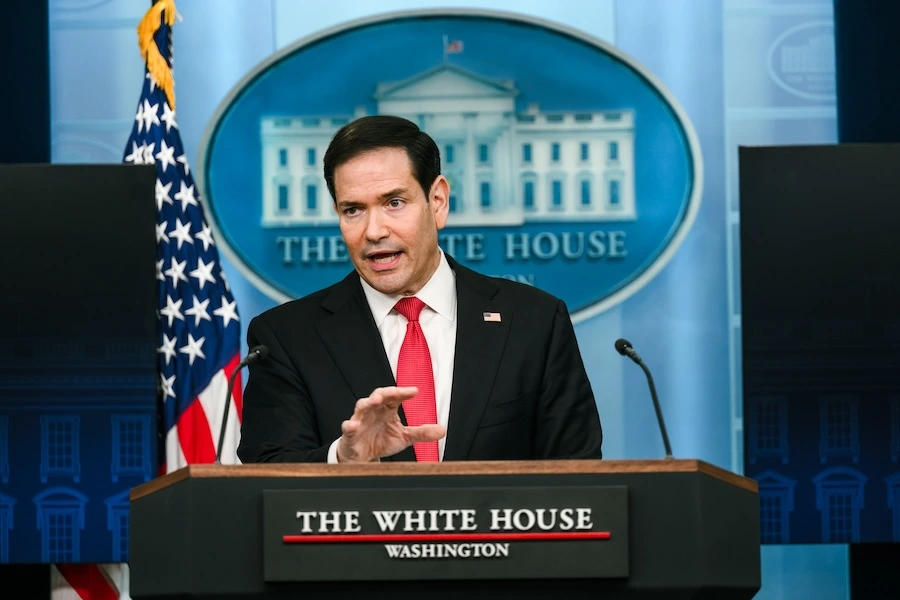
The results provide an interesting glimpse into the evolving Republican political landscape. While Vance has long been considered a potential heir to Trump’s movement, Rubio appears to be gaining momentum among voters who may be looking for another figure to lead the party into the next political era.
Neither Republican has officially announced a presidential campaign for 2028, and there is still considerable time before the nomination contest begins. Nevertheless, the early numbers are difficult to ignore.
Rubio’s growing profile is hardly surprising. Since taking over as secretary of state, he has occupied one of the most influential positions in the administration, placing him directly in the middle of major diplomatic developments and international negotiations.
That responsibility has given him an opportunity to build his national reputation beyond the political battles that defined his earlier career.
Rubio is also no stranger to presidential politics. He previously challenged Trump for the Republican nomination during the contentious 2016 primary campaign. The political landscape has changed considerably since then, and Rubio’s current position within the administration places him in a very different relationship with the president and the Republican base.
Vance, however, should not be counted out.
The vice president remains one of the most recognizable figures in the Republican Party and has developed a substantial national following. His close association with Trump and his willingness to defend the administration’s priorities give him a political foundation that could prove valuable as the 2028 contest approaches.
The latest survey is only an early measurement of voter preferences, not a final verdict on either man’s political future.
Beyond the presidential horse race, however, the Emerson poll contained some concerning findings for Republicans.
The survey found that only 35 percent of respondents viewed the Republican Party favorably, while 56 percent expressed an unfavorable opinion. Those figures highlight the political challenges facing the GOP as it prepares for the next congressional cycle.
Trump’s own approval numbers were similarly difficult. His approval rating stood at 37 percent, compared with 54 percent who disapproved of his performance.
Meanwhile, Democrats are beginning to develop their own potential field of presidential contenders.
Georgia Sen. Jon Ossoff emerged as the early leader in the Democratic presidential nomination question, receiving 17 percent support. Former Vice President Kamala Harris followed closely at 16 percent, with progressive Rep. Alexandria Ocasio-Cortez right behind at 15 percent.
Former Transportation Secretary Pete Buttigieg registered 14 percent, while California Gov. Gavin Newsom received 11 percent.
The relatively close numbers suggest Democrats have not yet settled on an obvious successor or dominant candidate of their own.
The survey also revealed that economic pressures remain a central concern for American voters. Fifty-seven percent identified lowering the cost of living as a major priority for the lawmakers who will take office in 2027.
That finding could become particularly important as both parties attempt to convince voters that they have a credible plan to address the financial challenges facing ordinary Americans.
Emerson College conducted the national survey between November 14 and November 16, interviewing 1,000 registered voters. The overall poll carried a credibility interval of approximately three percentage points. The smaller samples of Republican and Democratic primary respondents, however, carry greater uncertainty.
For now, the Republican presidential race remains wide open.
But one thing is becoming increasingly clear: the assumption that JD Vance will automatically become the next standard-bearer of the MAGA movement may be premature.
Marco Rubio has emerged as a formidable name in the early polling, and his substantial advantage in this survey is likely to generate fresh discussion about who Republicans want leading their party after Trump.
Whether that momentum survives the next two years remains to be seen. With no official campaigns underway and the political landscape still capable of changing dramatically, there is plenty of time for the contenders to make their case.
Still, the latest numbers have delivered an unexpected message to Washington: JD Vance may have some serious competition for the Republican Party’s future, and Marco Rubio is making his presence felt.

