
Still, the report did not establish that Rubio had made any decision to leave.
In fact, accounts from inside the administration painted a considerably different picture.
One administration insider reportedly told the newspaper that Rubio had given no indication he was preparing to walk away from his responsibilities. Another source suggested that keeping Rubio in the administration could provide valuable continuity and stability during a politically challenging period.

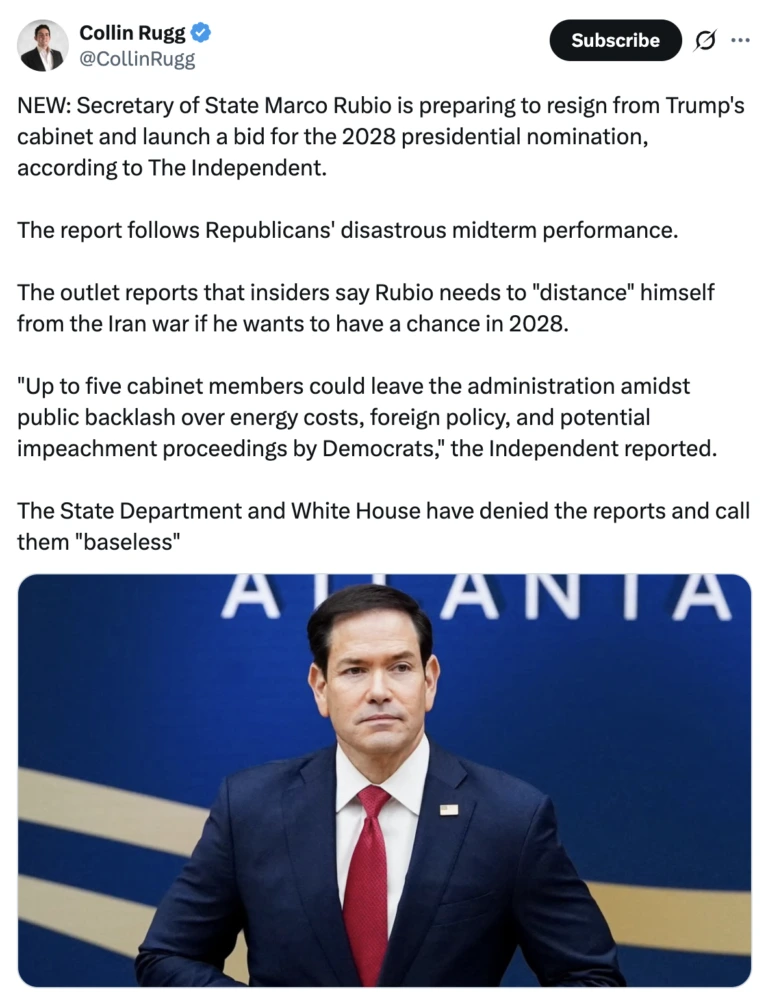
The White House also moved quickly to challenge the story, dismissing the reporting as baseless.
The State Department similarly questioned the newspaper’s reliance on anonymous sources, adding another layer of uncertainty to the claims surrounding Rubio’s political ambitions.
Nevertheless, the speculation raises an interesting question about the Republican Party’s increasingly complicated 2028 succession picture.
Rubio occupies one of the most prominent positions in the Trump administration. As America’s top diplomat, he has become a central figure in the president’s foreign policy operation, placing him in a position to build relationships with world leaders while maintaining a significant public profile at home.
But the responsibilities of the job could also create political complications if Rubio eventually decides to pursue the presidency.
One ally of the secretary of state reportedly argued that stepping away from the administration could give Rubio an opportunity to establish a political identity independent of the Trump White House.
That separation could prove particularly important given the political controversy surrounding the Iran war.
A presidential hopeful looking to appeal to Republican voters in 2028 may want to demonstrate that his political future is not entirely tied to every major decision made by the current administration. Leaving the Cabinet could provide Rubio with greater freedom to articulate his own positions and develop a distinct political message.
The same ally reportedly suggested that Rubio was positioned ahead of Vice President JD Vance in the emerging Republican political landscape.
However, that assessment remains an individual’s opinion rather than an established polling conclusion. The report did not provide polling evidence demonstrating that Rubio currently leads Vance in a potential Republican presidential contest.
Vance, meanwhile, remains a significant figure in discussions about the party’s future leadership. As Trump’s vice president, he holds a prominent position within the administration and is widely viewed as one of the potential contenders for the Republican nomination when the president’s second term concludes.
Rubio has previously attempted to downplay speculation about his own presidential ambitions.
He has indicated that he would defer to Vance should the vice president decide to pursue the Republican nomination, a position that appeared to reduce the possibility of an immediate political rivalry between the two men.
Whether that stance remains unchanged as the 2028 election approaches is another question entirely.
For now, there is no confirmed indication that Rubio intends to resign, launch a presidential campaign, or abandon his current responsibilities.
The conflicting accounts highlight how quickly speculation about the post-Trump Republican Party can generate headlines, particularly when prominent administration figures are involved.
One thing is certain: Rubio’s political future will attract considerable attention as Republicans begin considering what comes after Trump.
If he eventually decides to leave the State Department, it could significantly alter the early dynamics of the 2028 Republican presidential race. But until Rubio or the administration announces an actual departure, reports of an impending exit remain speculation — not a confirmed political development.

