
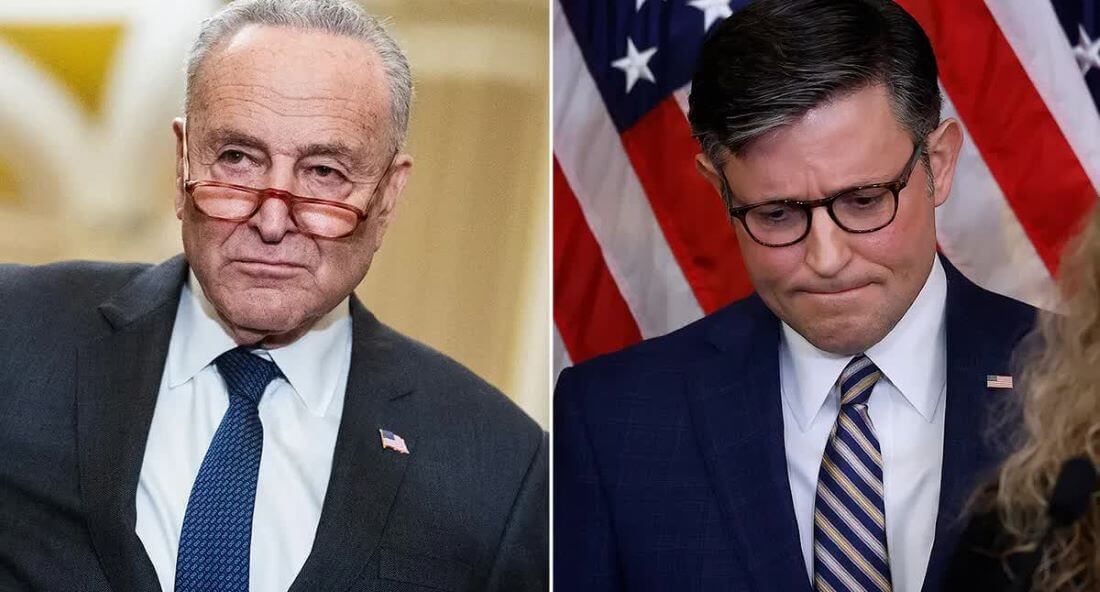
Members of the House Freedom Caucus, who are unhappy with the most recent bipartisan budget agreement, are thinking of removing Speaker Mike Johnson (R-LA). Concerns over the agreement’s impact on the national debt as well as the lack of essential border security measures have been raised.
Last September, the House of Representatives successfully passed a crucial bill to extend the government’s budget for an additional 45 days, despite a tight deadline. By taking immediate action, the government shutdown that was about to occur at 12:01 a.m. was successfully avoided. The main force behind the measure was none other than California lawmaker and former House Speaker Kevin McCarthy.
Don’t miss this! Carry faith with you everywhere with the Exclusive National Prayer Coin!

A 45-day interim funding plan that excludes $6 billion for Ukraine and border security was approved by the House by a vote of 335 to 91.
The bill’s disaster relief funding provisions probably persuaded several Democrats to vote in favor of it. There were one Democratic vote and ninety Republican votes cast against the proposal.
early order to prevent a government shutdown after November 17, when funding was scheduled to expire, Speaker Johnson devised a “two-part” plan early November.
Two distinct deadlines are established by this resolution for appropriations measures. legislation pertaining to Housing and Urban Development, Transportation, Agriculture, Military Construction and Veterans Affairs, Energy, and Water will all be extended until January 19; the other legislation will be prolonged until February 2. Interestingly, neither an extension of FISA 702 authority nor assistance to Israel or the Ukraine is included in the measure. It does, however, prolong until September 2024 the Farm Bill’s lapsed provisions.
Johnson strikes a long-term spending agreement to begin the new year. He unveils a $1.590 trillion fiscal 2024 budget, emphasizing large reductions to Democratic spending objectives.
Read the letter Johnson wrote to his coworkers:
After many weeks of dialogue and debate, we have secured hard-fought concessions to unlock the FY 24 topline numbers and allow the Appropriations Committee to finally begin negotiating and completing the twelve annual appropriations bills.
ALERT! Major Water Restrictions In Effect!
The topline constitutes $1.590 trillion for FY24 — the statutory levels of the Fiscal Responsibility Act. That includes $886 billion for defense and $704 billion for nondefense.
As has been widely reported, a list of extra-statutory adjustments was agreed upon by negotiators last summer. The agreement today achieves key modifications to the June framework that will secure more than $16 billion in additional spending cuts to offset the discretionary spending levels.
As you know, the Senate marked up their appropriations bills $14 billion above the FRA levels and the adjustments. The agreement reached today thus allows for none of that funding, and combined with the additional savings described above, results in an overall $30 billion total reduction from the Senate’s spending plans.
While the levels of emergency spending from FY23 will be maintained, no additional emergency funding, or additional no-outlay changes in mandatory programs (CHIMPS), will be included, thus eliminating two of the worst accounting gimmicks included in the FRA framework. Unlike other adjustments, which are by nature limited in time or amount, the adjustments described above threatened to become permanent fixtures of the funding baseline as in previous budget agreements. Removing them now could save taxpayers more than $200 billion over the next 10 years.
In summary, the concessions we achieved will include an additional $10 billion in cuts to the IRS mandatory funding (for a total of $20 billion), which was a key part of the Democrats’ “Inflation Reduction Act.” In addition, we will cut $6.1 billion from the Biden’s Administration’s continued COVID-era slush funds, which we achieved despite fierce opposition from the White House. The result is real savings to American taxpayers and real reductions in the federal bureaucracy.
On this agreement, Senate Majority Leader Charles Schumer (D-N.Y.) has commended Johnson, stating, “He’s a very decent, respectful guy, unlike some, who want to be macho and bullying and threatening and all that. He’s not like that.”
Reportedly, the Senate minibus consists of:
- $65.5 billion dollars to Ukraine
- $14.4 billion to Israel
- $5.318 billion emergency funding to CBP to process illegals faster
- $2.352 billion emergency funding for ICE
- $755 million for U.S citizenship & immigration
Despite the startling $34 trillion in national debt—which FOX News believed to be much higher—and the additional $725 billion in interest payments,

Representatives Chip Roy (TX), Eric Burlison (MO), Andrew Clyde (GA), Bob Good (VA), Andy Ogles (TN), and Andy Biggs (AZ) are among the members of the House Freedom Caucus that are vehemently opposed to the spending agreement. They see it as a continuance of lavish spending and a disdain for conservative principles.
READ:
Via X, the House Freedom Caucus also issued the following statement: “It’s even worse than we thought. Don’t believe the spin. Once you break through typical Washington math, the true total programmatic spending level is $1.658 trillion — not $1.59 trillion. This is total failure.”
There is growing momentum to remove Johnson from his Speaker role; on The Steve Deace Show, Representative Chip Roy alluded to a possible motion to remove Johnson from the office. Other members, such as Representatives Tim Burchett (TN) and Victoria Spartz (IN), emphasized the need for strong leadership and accountability while acknowledging the conversations around Johnson’s removal.
According to Newsweek:
Representative Chip Roy, a Republican from Texas and the leader of the Freedom Caucus policy committee, has been vocally opposing the planned budget compromise. In an interview with BlazeTV’s The Steve Deace Show, Roy said he was prepared to act and would even consider filing a request to remove Johnson because of the arrangement.
“I’m leaving it on the table,” Roy said. “I’m not going to say I’m going to go file it tomorrow night. I’m not saying I’m not going to file it tomorrow. I think the speaker needs to know that we’re angry about it.”
In response to a question on Tuesday on the potential removal of Johnson from office, Tennessee Republican Representative Tim Burchett said reporters that “a lot of people were talking about it.”
Republicans from Indiana, such as Representative Victoria Spartz, revealed to Newsweek on Tuesday night that “people here and there” have been discussing taking the speaker out of office.
“Ultimately, it’s up to us members to be able to pull the gun,” Spartz said. “It’s not even just the Speaker. We’ll have to figure it out and be strong. Ultimately, Mike [Johnson] needs to show that he can win. He definitely inherited a difficult situation, so we’ll judge the result.”
Rep. Chip Roy did not rule out the prospect of Speaker Mike Johnson being removed from his position as House Speaker during an interview on Monday.
“That’s not the road I prefer,” stated Representative Chip Roy, but he doesn’t discount it. “It isn’t good.”
Congressman Matt Rosendale (MT-02), who is calling for stricter border control, is scheduled to attend a press conference on Wednesday, January 10, in the midst of this chaos. Colleagues from the House and Senate will join him, suggesting a wider conservative backlash against the policies of the present government.
As the deadline for the spending deal draws near, the Freedom Caucus is pressing for border security and fiscal conservatism, putting Speaker Mike Johnson’s job at risk.


It should have been Jim Jordon. As House Speaker!!!!!!!!