
Former Campaign Manager Challenges Peltola’s Denials
The most significant allegations come from Elisa Rios, Peltola’s former campaign manager and longtime adviser, who offered the newspaper an account that raises questions about the campaign’s previous denials.
“Alaskan voters need to know,” Rios said. “There was a lot of speculation, and voters should get the full picture when making their decisions.”
Rios, who was dismissed during an August shake-up within the campaign, reportedly said Peltola did not personally participate in the alleged recruitment initiative. However, she maintained that the Democratic candidate was “definitely aware.”

Those claims create a potential political headache for Peltola as voters prepare to make their decision. Although the campaign and the Democratic Senatorial Campaign Committee have denied involvement in recruiting candidates to undermine Sullivan, neither responded to a detailed set of questions from The New York Times.
The newspaper said its investigation drew on interviews, text messages, and documents assembled in anticipation of a possible lawsuit involving the campaign.
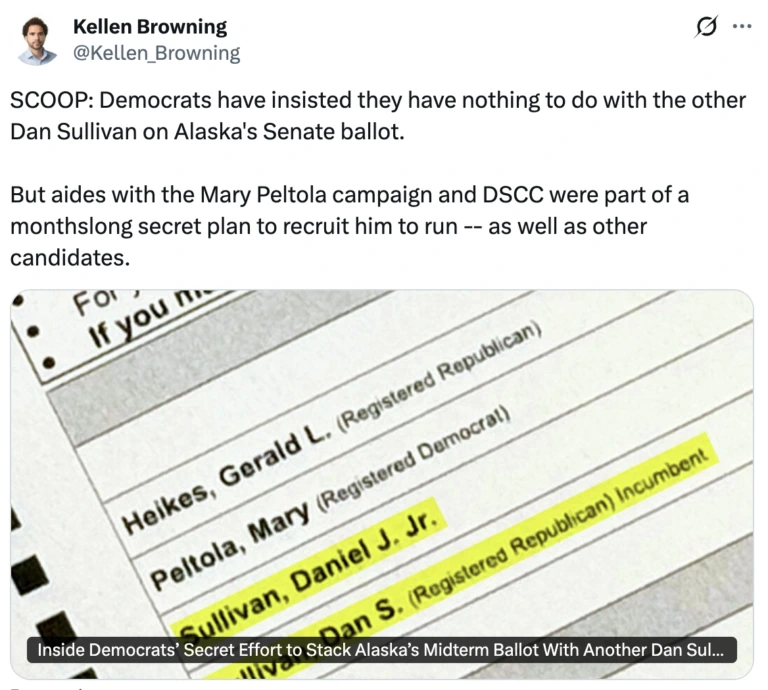
While the allegations do not establish that Peltola personally directed the effort, they raise questions about what senior campaign officials knew and how extensively the strategy was pursued.
Inside the Alleged Ballot Strategy
According to the investigation, the operation went beyond simply identifying another person named Dan Sullivan.
Campaign attorneys and senior officials associated with the Democratic Senatorial Campaign Committee reportedly took part in repeated conversations about recruiting additional candidates. Advisers also considered establishing a political party that might appeal to conservative voters.
The initiative was reportedly known internally as the “ballot composition project.”
Its alleged activities included outreach in remote Alaska communities, where prospective candidates were quietly approached about entering the race. The newspaper also described the involvement of a political operative from the Midwest who traveled using a false name and pitched potential candidates during informal meetings at brewpubs.
If accurate, the account suggests that the effort involved a coordinated attempt to influence the composition of the ballot rather than an isolated conversation about possible challengers.
The strategy’s reported objective was straightforward: Increase the number of candidates competing for votes that might otherwise go to Sullivan, potentially giving Peltola a clearer path to victory.
Such tactics can be politically controversial, particularly when voters are confronted with candidates whose names are similar enough to create confusion.
Search for a Second Dan Sullivan Began in 2025
The Times traced the search for a candidate sharing the incumbent senator’s name to the summer of 2025, when Peltola was considering a run for the Senate.
According to the investigation, senior campaign aides directed a staff member to identify as many Alaskans named Dan Sullivan as possible. The staffer reportedly searched voter records and compiled a list of potential matches.
By the following spring, Dan J. Sullivan, a retired teacher living in a small fishing community in Alaska’s Panhandle, had entered the contest. The remote village is accessible only by air or sea.
The report alleges that Peltola’s team worked with individuals involved in efforts to recruit the retired educator, despite the campaign’s repeated denials that it had participated in bringing him into the race.
The circumstances surrounding his candidacy are particularly significant because the incumbent’s full name is Dan S. Sullivan. On a ballot featuring four candidates, the appearance of another Dan Sullivan could create uncertainty for voters who recognize the name but are unfamiliar with the candidates’ middle initials or backgrounds.
Even a relatively small number of misdirected votes could prove consequential in a closely contested election.
The available allegations, however, do not establish how many voters might actually confuse the two men or whether the recruitment effort would ultimately change the result.
Justice Department Enters the Controversy
The dispute has also drawn attention from the Justice Department, which has challenged the potential consequences of votes cast for the second Dan Sullivan.
At President Donald Trump’s direction, the department filed a federal lawsuit last week seeking to prevent certification of the election results if votes for the namesake candidate deny the Republican incumbent a victory.
The legal challenge adds another layer of uncertainty to an already unusual Senate contest. Its ultimate implications will depend on the court proceedings and the applicable election laws.
The case also highlights a broader debate over the limits of campaign tactics designed to influence the distribution of votes among competing candidates.
Both Republicans and Democrats have employed ballot strategies in Alaska, and efforts to recruit additional candidates are generally considered legal. However, the latest allegations could intensify scrutiny of the methods campaigns use to gain an advantage, particularly when those methods involve candidates with similar names.
The distinction between a controversial political tactic and unlawful conduct remains important. The reported investigation, by itself, does not establish that the alleged participants violated election law.
A High-Stakes Test for Alaska Democrats and Republicans
Peltola enters the race with polling suggesting she has a strong chance of defeating Sullivan. That makes the allegations especially sensitive for Democrats seeking to secure a Senate victory in a state where every vote could matter to the national balance of power.
For Republicans, the report raises concerns about whether the incumbent faced an organized effort to dilute his support. For Democrats, the controversy threatens to shift attention away from the candidates’ policy positions and toward questions about campaign conduct and transparency.
The allegations also place renewed emphasis on the importance of voters examining the full names and identities of the candidates appearing on their ballots.
Ultimately, Alaskans will decide between Peltola, Heikes, Dan S. Sullivan, and Dan J. Sullivan. Whether the alleged recruitment strategy meaningfully affects the outcome remains to be seen.
For now, the report has placed Peltola’s campaign under renewed scrutiny, while the Justice Department’s legal challenge adds a potentially consequential dispute over how the election results may be certified.
With control of the Senate potentially at stake, the controversy could become one of the defining stories of Alaska’s election season.

